
1821-1846·Feast September 20
St. Andrew Kim Taegon
Priest and Martyr (first Korean priest)
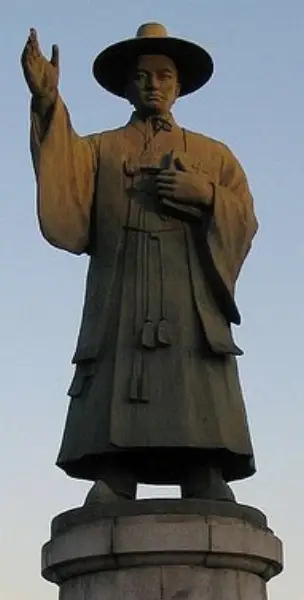
Overview
Catholicism reached Korea at the turn of the nineteenth century not through missionaries but through scholars who encountered Western books in China; by the time the first priests of the Paris Foreign Missions Society arrived in 1836, they found a native church already praying without them. Andrew Kim Taegon was born into that church in 1821, a member of the aristocratic Gimhae Kim clan. His parents were converts; his father, uncles and grandfathers would all die for a faith that Confucian law forbade. Baptized at fifteen, he was sent to the seminary in the Portuguese colony of Macau and for a time studied in the Philippines before being ordained at Shanghai in 1844 by the French bishop Jean-Joseph Ferréol — the first priest Korea itself had given. He returned home to a persecuted community that could only worship in hiding. Arrested and put to torture, he was beheaded by the Han River near Seoul on 16 September 1846, aged twenty-five, he used his last hour to testify that any dealing he had had with foreigners was for his religion and his God, and to urge his hearers to become Christian. Pope John Paul II canonized him in Seoul on 6 May 1984 with 102 companions; he is honored as patron of the Korean clergy.
The Complete Life
Early Life
Andrew Kim Taegon was born on 21 August 1821 into the aristocratic Gimhae Kim clan, a yangban family of Joseon Korea. Catholicism had reached Korea a generation earlier without missionaries: scholars who traveled to China brought back Western books in Chinese translation, and a native church grew from their reading, so that when the first priests of the Paris Foreign Missions Society arrived in 1836 they found Korean Catholics already practicing their faith without ever having seen a priest. Kim was born into that church. His parents were converts, and his family paid the full price of the faith under Confucian law: his father, his uncles and his grandfathers were all martyred for practicing Christianity, which the state treated as a subversive foreign teaching. The faith of his household was thus not inherited lightly but sealed in blood.
§ Biography
Vocation
Baptized at the age of fifteen, Kim was chosen for the priesthood at a time when Korea had never ordained a priest of its own. He was sent abroad to study: to the seminary at Macau, the Portuguese colony off the China coast, and for a time to Lolomboy, Bocaue, in the Philippines, where a mission station sheltered the young Korean seminarians. After nine years of formation in exile, he was ordained a priest at Shanghai in 1844 by the French bishop Jean-Joseph Ferréol of the Paris Foreign Missions — the first priest Korea itself had given to the Church. He returned home immediately, crossing clandestinely into a country where his ordination itself was a capital offense, to serve a church that could only worship in hiding.
§ Biography
Mission and Ministry
Kim's priestly ministry in Korea lasted barely a year and was conducted entirely underground. He said Mass in private houses, heard confessions, and moved among the scattered Catholic communities that the persecution of 1839 had reduced to remnants. His most dangerous work was also his most practical: helping foreign missionaries, including Bishop Ferréol and Father Maubant, to enter Korea secretly by way of the northern border, guiding them through the frontier defenses. It was precisely this activity — contact with foreigners — that furnished the charge on which he was condemned. He was arrested in 1846 with many of his companions, and the government, treating liaison with Westerners as treason, put him to torture to extract the names of others.
§ External links
Trial and Final Years
Tried as a traitor for his dealings with foreigners, Kim used the platform of his own execution to preach. His closing words, spoken in that final hour, were written down: he told the onlookers to give him their attention, declared that whatever dealings he had had with foreigners had been on account of his faith and his God, and confessed that it was for that God he was dying. He then called on those watching to embrace Christianity themselves and pardoned his executioners. He was beheaded by the Han River near Seoul on 16 September 1846, aged twenty-five. Bishop Ferréol, who had ordained him in Shanghai, outlived him by seven years; dying in 1853, he asked to be buried beside the young priest he had sent home to his death.
§ Biography
Canonization
Kim was among the martyrs whose cause was advanced as a single body. Pope John Paul II canonized him in Seoul on 6 May 1984 together with 102 Korean Martyrs, in the largest canonization to that date and the first held on Korean soil. The 1984 ceremony was deliberately Korean in character, honoring a church that had been founded by laypeople and fed by the blood of lay catechists as much as by clergy. Andrew Kim Taegon, as the first Korean priest, was given a principal place among them.
§ Legacy
Legacy
Andrew Kim Taegon is honored as patron saint of Korean clergy, the model of the native priesthood in a church whose first generations knew almost no priests at all. His feast is kept with the other Korean martyrs on 20 September. In Korea his memory is not confined to Catholics: he is studied as a national figure of the turbulent mid-nineteenth century, and the sites of his imprisonment and execution in Seoul are places of pilgrimage. In the Philippines, at Lolomboy in Bocaue, Bulacan, where he studied as a seminarian, he is also venerated — a small but striking instance of a Korean saint honored abroad. His last-hour testimony remains among the most quoted martyr texts of the Asian Church.
§ Biography
Timeline
- 21 Aug 1821
Born at Solmou, Dangjin, in Joseon Korea, into the aristocratic Gimhae Kim clan
§ Introduction
- 1836
Baptized at the age of fifteen, then sent to study at the seminary in Macau
§ Biography
- 1844
Made a priest at Shanghai following nine years of study, ordained by Bishop Jean-Joseph-Jean-Baptiste Ferréol
§ Biography
- 16 Sep 1846
Tortured and beheaded near Seoul on the Han River, aged twenty-five
§ Biography
- 3 Feb 1853
Bishop Ferréol dies from exhaustion, having asked to be buried beside Kim
§ Legacy
- 11 Sep 1925
Beatified
§ Introduction
- 6 May 1984
Canonized by Pope John Paul II in Seoul with 102 other Korean Martyrs
§ Legacy
In Their Own Words
This is my last hour of life, listen to me attentively: if I have held communication with foreigners, it has been for my religion and my God. It is for Him that I die. My immortal life is on the point of beginning. Become Christians if you wish to be happy after death, because God has eternal chastisements in store for those who have refused to know Him.
The Record
- Patron of
- Korean clergy·Korea
- Symbols
- Martyr's palm
- Canonization
- Canonized by Pope John Paul II in Seoul on 6 May 1984 with 102 Korean Martyrs
Prayer
Bibliography
Show 4 sources
- ↑ Michael Walsh, ed. "Butler's Lives of the Saints" (HarperCollins Publishers: New York, 1991), p. 297.
- ↑ The Liturgy of the Hours Supplement (New York: Catholic Book Publishing Co., 1992, pp. 17–18.
- 1 2 The Fathers of the London Oratory, tr., The New Glories of the Catholic Church , p.118, Richardson and Son, London, 1859
- ↑ "The story of Korea's first Catholic priest-martyr premieres at the Vatican - Rome Reports" . 2022-11-26 . Retrieved 2024-03-16 .
Profile text adapted from the Wikipedia article, licensed CC BY-SA 4.0.
Pray with this saint every day
Save St. Andrew Kim Taegon to your favorites, read the full profile, and get feast-day reminders in the Saints app.
Get the Saints AppFree on the App Store for iPhone and iPad