
c. 650-712/726/740·Feast July 4 (Orthodox, Julian; July 17 Gregorian)
St. Andrew of Crete
Archbishop of Gortyna, Hymnographer of the Great Canon
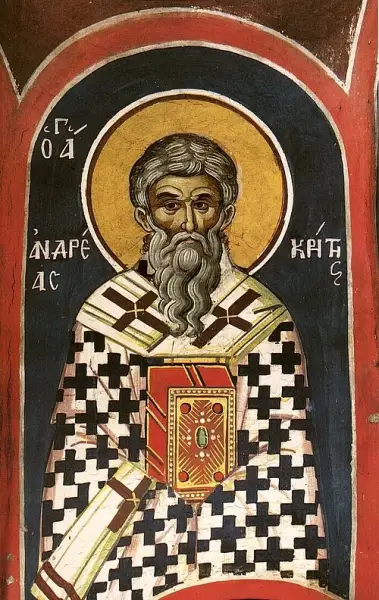
Overview
Andrew of Crete, also known as Andrew of Jerusalem, was an eighth-century bishop, theologian, homilist, and above all hymnographer, whose feast is kept on July 4. Born at Damascus around 650 to Christian parents, he could not speak for his first seven years, when — as his hagiographers recount — his tongue was loosed in answer to his reception of Holy Communion. At fourteen he entered the Lavra of St. Sabbas near Jerusalem, where he quickly attracted notice, and he was made archdeacon by Theodore, the locum tenens of the Jerusalem patriarchate, who sent him as representative to the Sixth Ecumenical Council at Constantinople in 680-681, called by Constantine IV against Monothelitism. After the council he was recalled to Constantinople and made archdeacon at Hagia Sophia, and eventually appointed to the metropolitan see of Gortyna in Crete. Though he had stood against Monothelitism, he took part in the 712 conciliabulum, which set aside the rulings of the Ecumenical Council; repentance followed the next year, and he came back to orthodoxy, thereafter devoting himself to preaching and to the composition of hymns. His sermons place him among the leading ecclesiastical speakers of the Byzantine age. To him goes the credit — as inventor, or at minimum as the one who brought it into the rite — for the canon, the great hymnic form of Byzantine worship, and his masterpiece, the Great Canon of 250 strophes, is sung in Lent. He died on Lesbos, on his way back from Constantinople, on a date the historians variously give as 712, 726, or 740; his relics were later translated to Constantinople.
The Complete Life
Early Life
Andrew was born at Damascus around the year 650, into a Christian family of a city that had recently fallen to the Arabs and that retained, under the new order, an ancient and learned church. The striking detail of his childhood is his muteness: he was, his hagiographers say, unable to speak until his seventh year, when he was healed upon receiving Holy Communion, a story that frames his whole career as one of speech given by God, fitting for the man who would give the church its greatest penitential hymn. At fourteen he entered the Lavra of St. Sabbas the Sanctified, the great monastery in the wilderness of Judaea, whose traditions of chant and prayer formed generations of Palestinian monasticism. There he gained the notice of his superiors, and his abilities carried him from the desert to the church's wider stage. The trajectory, mute child, monk of Mar Saba, deacon of Jerusalem, council father at the capital, is one of the classic monastic careers of the Byzantine world.
Vocation
Andrew's vocation unfolded through the offices the church gave him. Theodore, locum tenens of the Jerusalem patriarchate from 745 to 770 in the later reckoning though acting earlier in Andrew's career, made him archdeacon and chose him as the patriarchate's official representative to the Sixth Ecumenical Council, which met at Constantinople in 680-681 under Constantine IV to condemn the Monothelite teaching that Christ has one will. Andrew thus entered the councils of the church as a defender of the dyothelite orthodoxy that Jerusalem held. After the council he was summoned back from Jerusalem and appointed archdeacon of Hagia Sophia, the Great Church itself, where he served in the immense liturgical establishment of the capital and absorbed its musical traditions. Finally he was raised to the metropolitan see of Gortyna in Crete, the island then recently recovered for the empire, where his vocation as pastor and teacher found its full scope, and where he remained until his final journey.
Mission
Andrew's mission was threefold: doctrine, preaching, and hymnody. In doctrine he had stood for the council of 680 at the beginning of his career; at its end, however, he attended the conciliabulum of 712, the gathering under the emperor Philippikos at which the decrees of the Sixth Council were abolished under renewed Monothelite pressure. A year later he repented of the compromise and came back to the orthodox faith; the church, mindful of that return, did not hold the lapse against him, an episode that makes him an unexpected patron of those who fail and return. As a preacher his discourses are noted for their dignified and harmonious phraseology, and he ranks with the leading ecclesiastical speakers of the Byzantine age. Yet music was where his chief work lay. To him is ascribed the creation — or at any rate the bringing in — of the canon, the hymnic form that replaced the bare chanting of the nine biblical canticles at Matins with fully developed poetic odes. In his hands the liturgy's praise became a structured work of art, and every later Byzantine hymnographer worked in the space he opened.
Spirituality
The spirituality of Andrew is contained above all in the Great Canon, the Canon of Repentance, the longest canon ever composed at some 250 strophes. It is written in the first person, and it proceeds through the whole of the Old and New Testaments, drawing out examples, positive and negative, and applying each to the sinful soul's need for repentance and humble return to God. It is chanted in four portions at Great Compline during the opening nights of Great Lent, and sung complete at Matins on the Thursday of the fifth week, it is the emotional centre of the Byzantine Lent, a service at which whole congregations stand for hours while one voice, essentially, reads the soul its own biography. The canon's method, self-examination through scripture, is Andrew's lasting contribution to Orthodox spirituality: repentance not as an act but as an art, practised in the presence of the whole biblical witness. His other hymns for the great feasts carry the same quality of doctrinal depth joined to lyric force, the mark of the Palestinian school trained in the tradition of Sophronius and John of Damascus's generation.
Final Years
The date of Andrew's death is uncertain, the church historians giving 712, 726, or 740, though the commonest reckoning places it on July 4 of one of those years. What is certain is that his death came on Lesbos, at what is now Skala Eresou beside ancient Eresos, on the road home to Crete from church business at Constantinople. A large early Christian basilical church was built there in his honour, whose remains still stand. His relics were later translated to Constantinople, where the Monastery of Saint Andrew of Crete kept them; the Russian pilgrim Stephen of Novgorod saw them there in 1349, and described the shrine in the account of his pilgrimage. His death away from his see, on the road between the capital and his island, has given iconography and hymnography the image of the bishop-pilgrim, and his tomb at Lesbos, like his shrine at Constantinople, maintained his cult for centuries after the Arab, and later the Turkish, conquests had changed the world he knew.
Legacy
Andrew of Crete is remembered today primarily as a hymnographer, and his legacy is sung every Lent in every Orthodox church in the world: the Great Canon has never left the liturgy. The canon as a form, which he introduced or invented, became the principal hymnic structure of Byzantine Matins, and through it his influence extends over the whole of Orthodox worship. His repented lapse at the conciliabulum of 712 has itself become a kind of legacy, a standing evidence that even the great could fall under pressure and be restored. His homilies and encomia survive as documents of Byzantine preaching at its most polished, studied for their rhetoric as well as their theology. He is honoured in both the Orthodox and the Catholic churches, with his feast on July 4, which falls on July 17 in the Gregorian reckoning for churches on the Julian calendar. The basilica at Skala Eresou on Lesbos keeps his memory on the island of his death, and Crete, his metropolitan see, honours him as one of its fathers.
Timeline
- 650
Born at Damascus to Christian parents; mute until, per tradition, healed at age seven after receiving Holy Communion.
§ Life
- 664
Entered monastic life at fourteen, joining the Lavra of Saint Sabbas the Sanctified outside Jerusalem.
§ Life
- 680
Sent to Constantinople as the Patriarchate of Jerusalem's representative at the Sixth Ecumenical Council against Monothelitism.
§ Life
- 712
Attended the conciliabulum of 712, which abolished the decrees of the Ecumenical Council.
§ Life
- 713
Repented of the compromise and returned to orthodoxy, devoting himself to preaching and hymn-writing.
§ Life
- 4 Jul 740
Died on 4 July at Mytilene on Lesbos while returning to Crete; the year is given variously as 712, 726, or 740.
§ Life
- 1349
The Russian pilgrim Stephen of Novgorod venerated his relics at the Monastery of Saint Andrew of Crete in Constantinople.
§ Life
The Record
- Major works
- The Great Canon (Canon of Repentance), sung in Lent·Numerous canons, homilies, and encomia·Hymns for major feasts of the Lord and the Theotokos
- Patron of
- Crete (see of Gortyna)·Hymnographers (by tradition)
- Symbols
- Vested as a bishop holding a Gospel Book or scroll, right hand raised in blessing; grey hair and tapering grey beard
- Canonization
- Pre-congregation; venerated in Eastern Orthodox and Catholic Churches
Prayer
Profile text adapted from the Wikipedia article, licensed CC BY-SA 4.0.
Pray with this saint every day
Save St. Andrew of Crete to your favorites, read the full profile, and get feast-day reminders in the Saints app.
Get the Saints AppFree on the App Store for iPhone and iPad