
died 766 or 767·Feast October 17
St. Andrew of Crete
Martyr of the Iconoclast Persecution
Overview
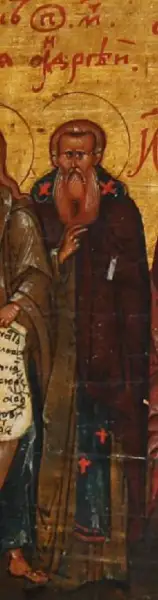
Andrew of Crete was a fervent iconophile, a defender of the holy images, executed in the Forum Bovis of Constantinople at the orders of the emperor Constantine V in 766 or 767, during the Byzantine Iconoclasm, and is regarded as a martyr by the Catholic and Eastern Orthodox churches, which keep his feast on 17 October. The monastery of Saint Andrew in Krisei in Constantinople, the church known today as the Koca Mustafa Pasha Mosque, was dedicated to him, and his memory was kept among the confessor-bishops and monks of the second iconoclasm's resistance. It must be recorded that modern scholarship, notably Brubaker and Haldon's study of the iconoclast era, treats the figure of Andrew, like those of many iconophile saints said to have suffered under the iconoclast emperors, as unverified, the tradition being the record of the party that eventually won.
The Complete Life
The Iconoclast Crisis
The age in which Andrew died was one of the strangest and most savage in Byzantine history. From the 720s the imperial government, first under Leo III and then, with far greater violence, under Constantine V, undertook to destroy the Christian use of images: icons of Christ, the Theotokos, and the saints were removed, mutilated, and burned, and those who defended them were prosecuted as enemies of the empire. The defense of images fell above all to the monks, who produced in those decades the church's confessors and martyrs. Constantine V, after the council of Hieria in 754 gave his policy conciliar cover, turned on the monastic party with systematic cruelty: floggings, mutilations, exiles, and executions, of which the executions in the squares of Constantinople were the public face. It is in this setting, in 766 or 767, that the tradition places the death of Andrew of Crete at the Forum Bovis, the ox-market of the capital, a fervent iconophile put to death for the images' sake.
§ Introduction
Memory and Verification
Andrew's commemoration, on 17 October, stands in the calendars of both the Catholic and the Eastern Orthodox churches, and a monastery of Saint Andrew in Krisei, in the western quarter of Constantinople, bore his dedication; the building survives, converted after the conquest, as the Koca Mustafa Pasha Mosque, its Byzantine fabric still legible, so that a walker in Istanbul today can stand under the roof of the house that kept his name. Honesty requires the modern caveat: scholarship on the iconoclast era, above all Brubaker and Haldon's Byzantium in the Iconoclast Era, finds the figure of Andrew, like those of many iconophile saints of the persecution, unverified, resting on hagiography composed after the victory of the images rather than on contemporary documents. The martyrologists of the ninth century, writing after Nicaea II, supplied the church with a full roll of the persecution's victims, and some of the names may be constructions. Andrew's entry is kept in the record as the tradition transmits it, with the reservation noted; the prayer of the church toward him is that of all the confessors of the images.
§ Introduction
Timeline
- 766
Executed at the orders of Emperor Constantine V in the Forum Bovis of Constantinople
§ Introduction
- 767
Alternative year given for his martyrdom as an iconophile during the Byzantine Iconoclasm
§ Introduction
The Record
- Patron of
- Defenders of sacred art·Those punished for conscience
- Symbols
- Icon of Christ·Palm of martyrdom
- Canonization
- Pre-congregation (ancient cult; historical figure unverified, per modern scholarship)
Prayer
Bibliography
Show 3 sources
- ↑ Janin (1964), p. 70.
- ↑ Müller-Wiener (1977), p. 173.
- ↑ Brubaker (2011)
Profile text adapted from the Wikipedia article, licensed CC BY-SA 4.0.
Pray with this saint every day
Save St. Andrew of Crete to your favorites, read the full profile, and get feast-day reminders in the Saints app.
Get the Saints AppFree on the App Store for iPhone and iPad