
died 235 (list date)·Feast January 13
St. Andrew of Trier
Twelfth Bishop of Trier
Overview
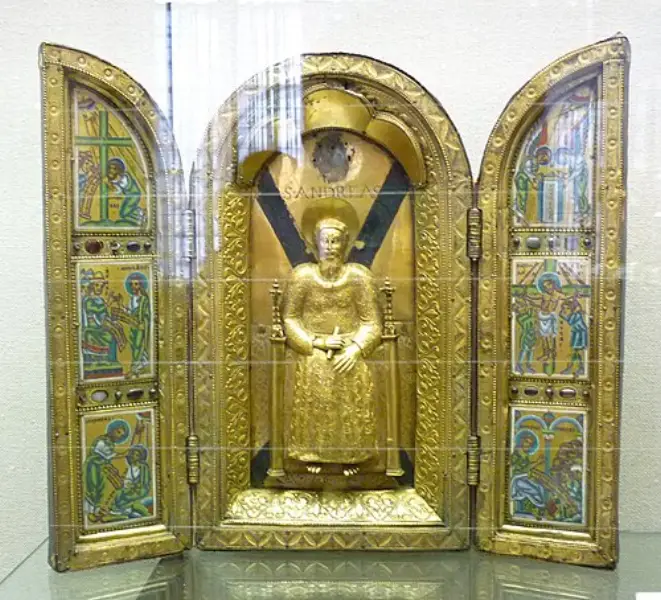
Andrew of Trier is recorded as the twelfth bishop of Trier, the great metropolitan see of Gaul, dying — according to the episcopal lists — in 235. He is a pre-congregational saint, sometimes listed as a martyr, and venerated at Trier with a feast on 13 January. Very little is known of his life beyond his place in the succession: he is one of a number of early bishops of Trier whose names the medieval lists preserve while the circumstances of their episcopates have fallen away. The twelfth place in the sequence puts his governance in the first half of the third century, in the decades before the Decian persecution first tested the Church of Gaul with systematic imperial violence. Whether he was in fact a martyr is uncertain: the lists hedge, some calling him confessor, some martyr, and the later martyrologies that carried his name were content with the bare fact of a bishop's feast. Trier itself, the oldest see north of the Alps with a continuous history, has kept his memory in its calendar since the early Middle Ages; a triptych of St Andrew in the cathedral, dated around 1150, is the most substantial monument to his cult.
The Complete Life
What the Lists Preserve
Andrew enters history through the episcopal lists of Trier — the catalogues of the see's bishops compiled and copied through the Middle Ages, which give him the twelfth place and a death in 235. Such lists are the skeleton of early Gallic church history: they preserve names and, usually, order, while the flesh of careers, building, controversy and pastoral work has almost everywhere decayed. Andrew's England, so to speak, is a single line in a chronicle. He is not to be confused with the apostle Andrew, whose feast the Church keeps in November; this Andrew is a Gallic bishop of the third century, remembered only at Trier. Nothing is recorded of his birth, his formation, or the length of his reign. The date 235 falls in the reign of Maximinus Thrax, whose persecution reached the clergy of Rome and, tradition says, the leaders of the churches elsewhere.
§ Introduction
Twelfth Bishop of an Ancient See
Trier claims to be the oldest see north of the Alps, its foundation in the second century, and by Andrew's day the city was one of the greatest in the western empire — an imperial residence in the following century, and the metropolis of northern Gaul. To be its twelfth bishop was to govern a church already old, established amid a pagan majority, with the martyr-bishop Eucharius and Valerius and Maternus in its remembered past and the coming trials of Decius and Valerian in its future. Andrew's own episcopate, the lists imply, fell in the uneasy peace between the persecutions — the decades in which the Church of Gaul grew quietly enough to be ready, badly or well, for the test of 250. Of what he did in that office the record says nothing: he belongs to the company of Trier's bishops of that age whose entire trace is an entry in a list and a feast day in the calendar.
§ Introduction
Cult and Cathedral
Andrew's cult belongs entirely to Trier and its calendar: a pre-congregational feast on 13 January, kept at the see that counted him among its fathers. Some lists style him a martyr, others leave the question open; the later martyrologies, which gathered northern saints into their vast alphabetical net, were not disposed to interrogate the tradition, and the question cannot now be resolved. The most substantial monument to his memory is artistic: a triptych of St Andrew in Trier Cathedral, dated around 1150 — a gilt work of the Rhine-Maas school, made nine centuries after the bishop's death by a church that still counted him among its own. He is commemorated in the Catholic Church and also honoured in the Anglican, Lutheran and Orthodox calendars, a wide commemoration for so silent a man — evidence that the name, once in the list, travelled with the list.
§ Introduction
Timeline
- 235
Died, according to the episcopal lists, which record him as twelfth Bishop of Trier
§ Introduction
- 1150
Triptych of Saint Andrew made for Trier Cathedral, the chief surviving witness to his medieval cult
§ Introduction
The Record
- Patron of
- Archdiocese of Trier (early bishops' calendar)
- Canonization
- Pre-congregation; sometimes listed as a martyr
Prayer
Bibliography
Show 4 sources
Profile text adapted from the Wikipedia article, licensed CC BY-SA 4.0.
Pray with this saint every day
Save St. Andrew of Trier to your favorites, read the full profile, and get feast-day reminders in the Saints app.
Get the Saints AppFree on the App Store for iPhone and iPad