
3rd century·Feast August 19
St. Andrew Stratelates
Martyr and Military Commander
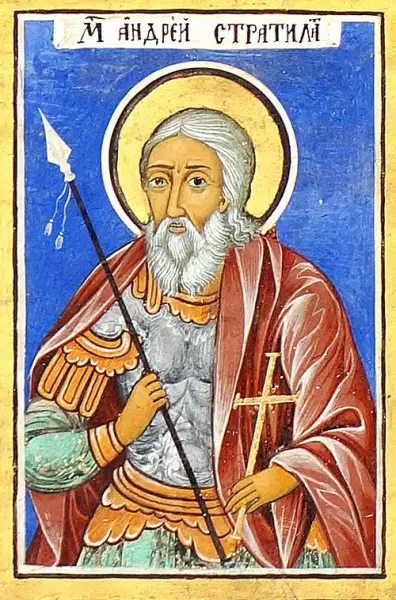
Overview
Andrew, called Stratelates — the Commander — and also Andrew the Tribune, was a Syrian officer of the Roman army in the reign of Maximian. Almost nothing is recorded of his early life beyond his birth in Syria. When a large Persian force invaded the Syrian territories, the governor Antiochus placed Andrew in command against it; leading a small detachment of pagan soldiers, he called upon Christ to give the victory and routed the far more numerous enemy. The triumph was his undoing: informers told Antiochus that Andrew was a Christian who had been winning the soldiers under him to his faith. Put on trial and tortured, he saw some of his men crucified and others locked in prison while the emperor decided their fate. Maximian, knowing how dearly the army loved its commander and fearing a revolt, set them free while secretly ordering their deaths on other pretexts. Andrew led his faithful soldiers to Tarsus, where the bishop Peter and Bishop Nonos of Beroea baptized them, and then fled with them toward Mount Taurus to escape fresh persecution in Cilicia. In a deep gorge among the mountains the Roman army ambushed the company and slaughtered Andrew and the 2,593 soldiers with him. Churches of East and West commemorate the martyr on 19 August.
The Complete Life
Early Life
Andrew, called the Stratelates, the Commander, was a Roman officer of the third century, a Syrian by birth, who served during the reign of the emperor Maximian, the partner of Diocletian in the tetrarchy that conducted the last and greatest persecution of the Roman church. Almost nothing is recorded of his origins, family, or early career; his memory rests entirely on the passion narrative that circulated under his name, a text of the hagiographical genre that shaped the memory of the military martyrs. What the tradition holds is that he was a Christian and a commander, and that his Christianity was for a time tolerated because it was useful, since he was a soldier the empire could not spare. His cult, strong in both the Greek East and the Latin West, commemorates him with the two thousand five hundred and ninety-three soldiers who are said to have died with him.
§ Introduction
Mission and Ministry
The passion narrates that when Persian forces in strength overran the Syrian provinces, the governor Antiochus, unable to spare a full force, entrusted the command to Andrew with a small detachment. Andrew, invoking Christ before a battle against vastly superior numbers, routed the Persians and returned victorious. The victory proved his undoing: informers told the governor that Andrew was a Christian and that he had converted the soldiers under his command, an accusation that was political as well as religious, since a commander's hold over his men was the empire's most guarded asset. The episode's logic, a general whose soldiers follow his god rather than the emperor's, states with unusual clarity why the military martyrs were dangerous to the Roman state and why so many of them died.
§ Life
Trial and Final Years
Summoned to trial, Andrew was tortured, and the disposition of his men followed: some of the soldiers were crucified, others imprisoned. Antiochus referred the case to the emperor for the death sentence, but Maximian, knowing how the army loved Andrew and fearing a mutiny, freed them while secretly ordering their execution on other pretexts. Released, Andrew led his faithful soldiers to Tarsus, where the bishops Peter and Nonos baptized them, and then, as persecution broke out in Cilicia, fled toward mount Taurus. In a gorge of the mountains the Roman army ambushed them, and Andrew and all the two thousand five hundred and ninety-three soldiers with him were slaughtered, the tradition dating their death to the persecutions of the tetrarchy.
§ Trial and death
Canonization
Andrew Stratelates belongs to the great company of the pre-congregation martyrs, those numbered among the saints by the immemorial cult of the church before the modern processes of canonization existed. His feast was received in both the Byzantine and the Roman traditions, where he is commemorated on 19 August with his two thousand five hundred and ninety-three companions, and his passion was translated into the Latin legendary tradition along with the Greek synaxaries. No formal acts confirm the narrative, and the church's veneration rests on the tradition of the martyrdom itself.
§ Introduction
Legacy
Andrew Stratelates is venerated as a patron of soldiers and of Syria, and his iconography shows him as a warrior bearing the pilum, the Roman spear. His cult belongs to the cycle of the military martyrs, Sergius and Bacchus, George, Theodore, and the rest, who gave the late Roman and Byzantine church its ideal of the soldier saint and the medieval church its pattern of Christian chivalry. The number attached to his companions, twenty-five hundred and ninety-three, has itself become a byword for the anonymous multitudes of the army's Christian dead. He is remembered in the Orthodox churches chiefly, and his feast keeps his name in the calendars of the East and in the Roman martyrology.
§ References
Timeline
- 284
Commands Roman troops in Syria during the reign of emperor Maximian, which began in 284
§ Life
- 300
Ambushed with his 2,593 soldiers in a gorge of the Taurus Mountains and slain with them
§ Trial and death
The Record
- Patron of
- Syria·Soldiers·The army
- Symbols
- A soldier holding a pilum
- Canonization
- Pre-congregation (ancient cult of the martyr and his 2,593 soldiers, honored by both the Catholic and Eastern Orthodox churches)
Prayer
Bibliography
Show 3 sources
- ↑ The Passion of Saint Andrew the Commander
- 1 2 3 Bishop Nikolai Velimirovich, "The Prologue of Ohrid", (New 2nd Edition 2008). The Holy Martyr Andrew Stratelates Archived 2005-11-03 at the Wayback Machine . Retrieved April 14, 2012.
- ↑ Lives of all saints commemorated on August 19, Feasts & Saints. Orthodox Church in America . Retrieved April 14, 2012
Profile text adapted from the Wikipedia article, licensed CC BY-SA 4.0.
Pray with this saint every day
Save St. Andrew Stratelates to your favorites, read the full profile, and get feast-day reminders in the Saints app.
Get the Saints AppFree on the App Store for iPhone and iPad