
c. 5 AD-60/70 AD·Feast November 30
St. Andrew the Apostle
Apostle and Martyr, the First-Called
Overview
Andrew, born at Bethsaida in Galilee around the beginning of the era, was the brother of Simon Peter, a fisherman of Capernaum, and a disciple of John the Baptist before he followed Jesus — the Gospel of John shows him as the first of the disciples to attach himself to Christ, whence the Church's title the First-Called. In the synoptic Gospels he is called with Peter from their nets by the Sea of Galilee; in John he brings Peter to Jesus, brings the boy with the loaves and fishes at the feeding of the five thousand, and brings Greeks who wished to see Christ in the last week at Jerusalem. Early tradition sends him preaching from the Black Sea to Greece, and fixes his martyrdom at Patras in Achaea on a cross to which he was bound — later art made it the X-shaped saltire — where, the old acta say, he preached from his cross for days before dying. His relics traveled to Constantinople, and by medieval legend to Scotland, whose patron he became.
The Complete Life
Early Life
Andrew was born at Bethsaida, the fishing town on the northern shore of the Sea of Galilee, 'the house of fishing,' around the beginning of the Christian era, and like his brother Simon he settled at Capernaum and worked the lake. His name is Greek — Andreas, 'manly' — a mark of the mixed culture of Galilee, and he appears in the Gospels as the disciple who moved between worlds: a Jew with a Greek name, at home in the synagogue and useful when Greeks come asking. Before he followed Jesus he was a disciple of John the Baptist, and it is in John's Gospel that his story properly begins: standing beside the Baptist when Jesus passes, hearing his teacher call him the Lamb of God, and going after him with another disciple who remains forever unnamed. They spent the day with him; Andrew found his brother and said the words the Church has never stopped repeating: we have found the Messiah.
§ External links
The First-Called
The Eastern Church's title for Andrew, Protokletos, the First-Called, rests on that scene, and it defines his vocation: he is the apostle who brings. In the synoptic Gospels he is called with Peter from their nets — follow me, and I will make you fishers of men — and in Mark's list and Luke's he is named among the first four. In John he does the connecting work the others do not: he brings Peter to Jesus at the beginning; at the feeding of the five thousand it is Andrew who says, there is a lad here with five barley loaves and two fish, but what are they among so many; and in the last week, when Greeks ask Philip to see Jesus, Philip tells Andrew, and Andrew and Philip tell Jesus. Each of these scenes is small, and each is decisive: the first-called is the one who introduces. That habit of introduction is the reason an apostle with no recorded speech carries one of the widest patronages in the Church.
§ With Jesus
Mission
The Gospels give Andrew no further scenes after the resurrection, and his mission belongs to tradition — old, consistent, and hard to verify. The strongest strand sends him north and east rather than west: through Asia Minor along the Black Sea coast, to Scythia, and to Byzantium, where later Byzantine tradition named him the founder of its church and the ordainer of its first bishop, Stachys — the claim on which Constantinople built its apostolic rank against Rome and the patriarchates. Eusebius records the general scope of his preaching; the apocryphal Acts of Andrew, rejected by the Church but old, filled it with legend, sending him through Greece to Patras in Achaea. Where the traditions converge, they show a mission running along the Greek and Black Sea world — the very coasts that would later call him patron. The apocryphal Acts of Andrew gave the preaching its legends, but the coasts that honored him treated the tradition as plenty.
§ After Jesus' Ascension
Martyrdom at Patras
The tradition of Andrew's martyrdom is among the earliest of the apostolic deaths after Peter's and Paul's. At Patras in Achaea, under the proconsul Aegeas or Aegeates, he was condemned to crucifixion and, the acta say, at his own request bound rather than nailed to a cross, out of unworthiness to die as his Lord died. The old accounts describe him teaching from the cross for two or three days to the crowd that had gathered, until the people demanded his release and he prayed for release of another kind and died. The form of the cross — described in the earliest texts simply as a cross — became in later art the X-shaped saltire now inseparable from his name; the claim that he died on such a cross first appears centuries afterward, but the emblem has belonged to him since. Patras keeps the cross and the skull in one shrine, with a ceremony every 30 November.
§ Introduction
Relics and Cult
Andrew needs no canonization: he is an apostle of Jesus Christ, honored in every church that venerates saints. His cult, however, has a history of its own. In 357 his relics were translated at imperial command to Constantinople, into the church of the Holy Apostles, where they joined those of Luke and Timothy and became one of the glories of the capital. In 1208, after the Fourth Crusade, Cardinal Peter of Capua brought what were believed to be the relics to Amalfi, and Amalfi's cathedral still holds them; the skull went to Rome in 1462 and was returned to Patras by Paul VI in 1964 as a gesture to the Greek church. Scotland's patronage rests on medieval legend — the relics brought by St Rule to Caledonia, the saltire in the sky before Athelstaneford — but its endurance is fact: the saltire is Scotland's flag. His feast on 30 November opens Advent in the West when the calendar allows, and Scotland keeps the day as a bank holiday.
§ Relics
Legacy
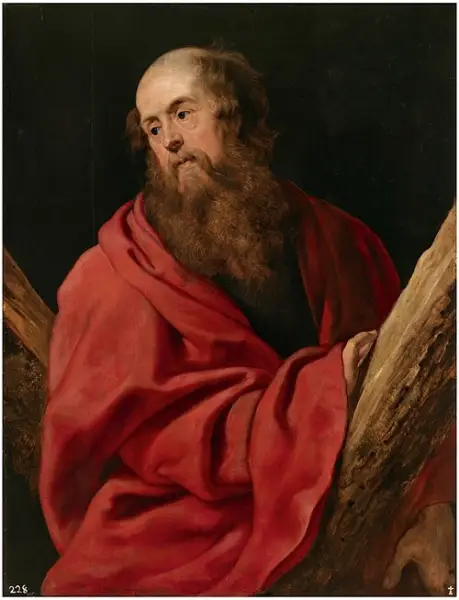
No apostle's flag flies over more countries. Andrew is the patron of Scotland, Greece, Russia, Ukraine, Barbados, Georgia, Romania, and Constantinople itself; of fishermen, fishmongers, rope-makers, singers, and miners; invoked against sore throats and convulsions. The Ecumenical Patriarchate claims him as its founder, and every serious ecumenical gesture between Rome and Constantinople in the last century has invoked his name. In art he is the lean old man leaning on the saltire, and in the Gospel he remains what he was first — the man who found the Messiah and immediately went and told his brother. The whole missionary impulse of the Church, and its instinct that faith begins by being shared with the person nearest you, stands in that gesture. From Scotland's saltire to the Russian Navy's ensign, the X-shaped cross flies as the apostle's emblem — and the patronage list runs on through Barbados, Russia, Ukraine, and Patras itself.
§ Introduction
Timeline
- 5
Born to a Jewish family at Bethsaida in Galilee, possibly between 5 and 10 AD
§ Early life
- 38
By tradition founded the see of Byzantium in this year, installing Stachys as bishop
§ After Jesus' Ascension
- 60
Tradition holds that he met death by crucifixion in the city of Patras, Achaea, about this year
§ Martyrdom
- 357
At Emperor Constantius II's command the relics left Patras for Constantinople, to rest in the Church of the Holy Apostles
§ Relics
- 597
Relics were probably brought to Britain as part of the Augustine Mission
§ Relics
- 732
Bishop Acca of Hexham brought relics to Fife in Scotland
§ Relics
- 1208
Following the sack of Constantinople, remaining relics of Andrew and Peter were taken to Amalfi by Cardinal Peter of Capua the Elder
§ Relics
- 1461
Fleeing the Ottomans, Thomas Palaiologos brought the purported skull of Andrew from Patras to Italy and gave it to Pope Pius II
§ Relics
- 24 Sep 1964
Pope Paul VI returned the relic held in Vatican City; Cardinal Augustin Bea presented the skull to Bishop Constantine of Patras
§ Relics
- 19 Jan 1980
The cross of Saint Andrew, kept in Marseille since the Crusades, was returned to Patras
§ Relics
- 2006
Cardinal Etchegaray once more conveyed a relic of the apostle from the Catholic Church to the Greek Orthodox
§ Relics
The Record
- Major works
- The Gospel of Andrew (apocryphal, rejected)·Acts of Andrew (apocryphal)
- Patron of
- Scotland, Greece, Russia, Ukraine, Barbados, Georgia, Romania and Constantinople·Patras and Amalfi·Fishermen, fishmongers, rope-makers, singers and miners·Pregnant women·Against sore throats and convulsions
- Symbols
- Long white hair and beard·Gospel book or scroll·Leaning on the saltire cross·Fishing net
- Canonization
- Pre-congregation; apostle of Jesus Christ
Prayer
Bibliography
Show 4 sources
- ↑ Bible: Mark 13:3 ; Bible: John 6:8 , Bible: 12:22 ; but in Acts of the Apostles there is only one mention of him. Bible: Acts 1:13
- ↑ The legends surrounding Andrew are discussed in Dvornik 1958
- ↑ According to Réau 1958 , p. 79, St. Andrew's Cross appeared for the first time in the tenth century, but did not become an iconographic standard before the seventeenth. Calvert 1984 was unable to find a sculptural representation of Andrew
- ↑ Several Scythian Monks, such as Dionysius Exiguus, had been of romanized Geto-Dacian origin.
Profile text adapted from the Wikipedia article, licensed CC BY-SA 4.0.
Pray with this saint every day
Save St. Andrew the Apostle to your favorites, read the full profile, and get feast-day reminders in the Saints app.
Get the Saints AppFree on the App Store for iPhone and iPad