
died 936 (traditional)·Feast October 15 (October 2, Julian)
St. Andrew the Fool for Christ
Fool-for-Christ and Visionary of the Theotokos
Overview
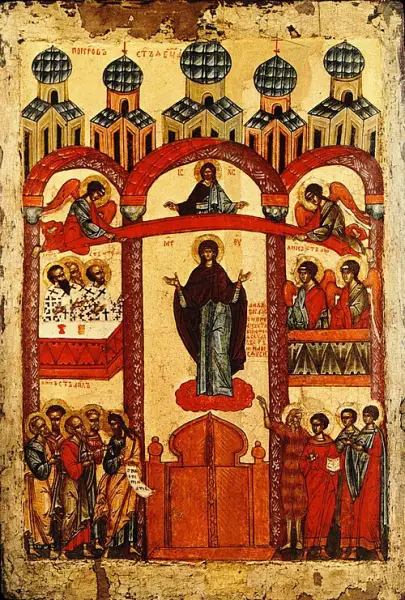
Andrew of Constantinople, called the Fool for Christ, is a saint of the Eastern Orthodox Church revered as one of the greatest of the holy fools. The Life of Andrew the Fool, which survives in more than one hundred Greek manuscripts and was translated into Georgian, Church Slavonic and Russian, says that he lived in the fifth century under the emperor Leo I; but the anachronisms of the text and its similarities to the lives of Simeon the Holy Fool and Basil the Younger have persuaded many historians that he lived in the ninth or tenth century, under Leo VI. A Scythian by birth, he was the slave of a court bodyguard named Theognostus in Constantinople, and after a visionary call he embraced the folly for Christ's sake, playing the madman in the streets of the capital while living in humility, patience and prayer. He is remembered above all for the vision he and his disciple Epiphanius received in the church of the Blachernae while the city was beset: the Mother of God, surrounded by angels and saints, praying and spreading her omophorion over the faithful. The city's deliverance in the wake of that vision gave the Orthodox church its feast of the Protection of the Theotokos.
The Complete Life
Early Life and the Problem of Dates
The Life of Andrew the Fool makes him a contemporary of the emperor Leo I, in the fifth century, and of Daniel the Stylite; but almost nothing in the text's detail fits that century, and much fits the age of Leo VI at the turn of the tenth: the sieges, the court, the ecclesiastical atmosphere all belong to the later period, and the Life shares large amounts of material with the lives of Simeon the Holy Fool of the sixth century and Basil the Younger of the tenth. Scholars therefore generally locate Andrew in the ninth or tenth century, while the church's liturgy keeps him without needing the question resolved. The Life itself says he was a Scythian, a term that in Byzantine usage covered the peoples of the steppes, and that he was bought as a slave by Theognostus, a bodyguard of the imperial guard, a man of some means who kept the boy in his household in Constantinople and allowed him a religious upbringing. The city of his slavery became the city of his sainthood.
§ Introduction
The Folly for Christ's Sake
Andrew's vocation was the paradoxical one of the fool for Christ, the salos. After a vision in which he was called to the ascetic life in its most extreme form, he began to play the madman: he wandered the streets of Constantinople in rags, endured mockery, blows and cold, said and did the outrageous things that the role demanded, and underneath the performance lived a life of extraordinary prayer, fasting and charity, seeing what the sane could not see and saying what the sane would not. The tradition of the holy fools, of which Simeon of Emesa was the founder, teaches through them the abasement of Christ, the emptiness of worldly wisdom, and the freedom of the gospel from every social calculation; the fool is the living rebuke to the world's prudence. Andrew carried the role for decades in the richest city of the world, at its theaters, its markets and its churches, known to the poor as a friend and to the respectable as a scandal, exactly as the role required. His disciple Epiphanius, a well-born youth whom he had drawn to God, became the witness of the visions that made the two of them immortal in the church's memory.
§ Biography
The Vision at Blachernae
The vision for which Andrew is remembered occurred, by the traditional dating, in the church of the Theotokos at Blachernae while hostile troops, in some sources the Muslim Arabs, besieged Constantinople. During the vigil Andrew, looking up, saw the air open and the Most Holy Mother of God entering the church escorted by a company of angels, apostles and prophets; she knelt and prayed with the people, and then removed the omophorion, the great veil of her office, and spread it over the praying faithful as a protection. Andrew asked his disciple whether he too saw it, and Epiphanius answered that he did. The siege was lifted, the city attributed its deliverance to the Theotokos of Blachernae, and from that vision the Orthodox church derived one of its most beloved feasts, the Protection, or Pokrov, of the Theotokos, kept on 1 October, which the Slavic churches celebrate with a splendor that has carried Andrew's name to the ends of the north. The scene, of the fool and the boy seeing what the whole congregation could not, is the Byzantine tradition's way of saying that purity of heart, not rank, is the organ of vision.
§ Biography
Final Years
Andrew lived out his folly to the end of a long life, dying at Constantinople in 936 by the traditional date. The Life surrounds his last years with the visions that were his specialty: the heavenly liturgy, the journey of the soul, the light of the age to come, all seen through the cracked realism of the fool's mask. The poor, who had known his kindness beneath the rags, mourned him, and the church of the city that had laughed at him began to venerate him. His body was buried honorably, and the cult spread slowly and then widely: the Life was translated early into Georgian and Church Slavonic, and its Old Russian translation, made in the late eleventh or early twelfth century, survives in more than two hundred copies, a measure of the hold the fool of Constantinople had on the Russian imagination, which made the yurodivy, the holy fool, one of the central figures of its spirituality.
§ Introduction
Canonization
Andrew's sanctity was recognized in the ordinary Byzantine manner, by the liturgical cult of the city and the diffusion of his Life, and it needs no decree to this day: the Orthodox church commemorates him on 15 October, and his place in the menaia is secure. The feast of the Protection, which his vision created, gave him a second and larger commemoration, since every celebration of the Pokrov recalls the seer as well as the seen; the Russian feast, instituted by Prince Andrey Bogolyubsky in the 1160s, carried his name through all the Slavic lands. The western church, which never received the cult of the holy fools with the same warmth, has known him chiefly through the history of art and through the Protection's icons, in which Andrew and Epiphanius appear in the corner, the two witnesses, the fool and the boy, watching the veil spread over the world.
§ Introduction
Legacy
Andrew's legacy divides into a feast and a type. The feast is the Protection of the Theotokos, one of the best loved of the Orthodox year, celebrated with particular splendor in Russia, where the Pokrov cathedral on the Red Square and countless village churches keep the memory of the veil and, with it, of the man who saw it spread. The type is the holy fool, which through Andrew's Life entered the deep tradition of the Slavic church and shaped its literature from the medieval saints' lives to Dostoevsky's Prince Myshkin. Historians of Byzantium value the Life as a document of the capital's street life, its charities and its anxieties, seen from below, from the level of the ragged. And the church that honors him keeps the lesson of his whole vocation: that God hides his wisdom from the prudent and reveals it, and his protection, to those the world dismisses.
§ Biography
Timeline
- 457
The Life places him in Constantinople under emperor Leo I, alongside Daniel the Stylite
§ Biography
- 936
Dies at Constantinople
§ Introduction
- 950
Oldest surviving fragmentary manuscript of his Greek Life, from the later tenth century
§ Biography
- 1100
First Old Russian translation of the Life completed, around the turn of the twelfth century
§ Veneration
- 1160
Andrey Bogolyubsky founds a Russian feast of the Protection from Andrew's vision account
§ Veneration
The Record
- Major works
- Life of Andrew the Fool (hagiography about him)
- Patron of
- Holy fools·The poor and the homeless
- Symbols
- Rags of the holy fool·Omophorion of the Theotokos
- Canonization
- Eastern Orthodox tradition; ancient cult at Constantinople
Prayer
Bibliography
Show 4 sources
- 1 2 3 Nikiforova & Pivovarova 2001 , p. 391.
- 1 2 3 Orthodox Church in USA
- ↑ Kazhdan, Alexander , ed. (1991). "Andrew the Fool". The Oxford Dictionary of Byzantium . Oxford and New York: Oxford University Press. p. 93. ISBN 0-19-504652-8 .
- ↑ Nikiforova & Pivovarova 2001 , pp. 392–393.
Profile text adapted from the Wikipedia article, licensed CC BY-SA 4.0.
Pray with this saint every day
Save St. Andrew the Fool for Christ to your favorites, read the full profile, and get feast-day reminders in the Saints app.
Get the Saints AppFree on the App Store for iPhone and iPad