
800s-c. 877·Feast August 22
St. Andrew the Scot
Archdeacon of Fiesole
Overview
Andrew the Scot — also called Andrew of Tuscany and Andrew of Fiesole — was an Irish-born monk and deacon of the ninth century who served as archdeacon of Fiesole under Bishop Donatus of Fiesole. An Irishman born close to the start of the ninth century into a noble family, he took his nickname from the custom of the day, when 'Scot' meant an Irishman, since the Ireland of Roman writers had been called Scotia. Bridget of Fiesole was his sister, and the two of them studied under Donatus. In 816 Andrew went along on Donatus's pilgrimage to Italy, and when they reached Fiesole they found the townspeople gathered to choose a new bishop: Donatus was elected, and upon his consecration he named Andrew his archdeacon. Many miracles are reported of Andrew's ministry in Fiesole — most famously the healing of a nobleman's paralyzed daughter, for whom the doctors could do nothing; kneeling at her bedside he told her to rise, because Jesus had cured her — along with the casting out of demons and the healing of the blind and the sick. During the forty-seven years of Donatus's episcopate Andrew served him faithfully; at the bishop's encouragement he restored the church of San Martino di Mensola and established a monastery there. Remembered for his austere way of life and his boundless charity toward the poor, he outlived Donatus by only a few years, dying around 877 — his sister arriving, it seemed miraculously, from Ireland in time to attend him at his deathbed. His body rests at St. Martin's, the church he restored, and was found still preserved when later exhumed.
The Complete Life
Ireland
Andrew was born in Ireland close to the start of the ninth century, into a noble family belonging to the Gaelic church. He was 'the Scot' because Ireland was Scotia to the learned of the day: the name marks him as one of the Irish peregrini, the wandering monks and scholars who in the early Middle Ages carried their learning and their sanctity to every court and cloister of Europe. His sister Bridget — remembered as Bridget of Fiesole — shared his path. Both studied under Donatus, the Irish master whose pilgrimage in 816 would take them both to Italy.
§ Life
Archdeacon of Fiesole
When Donatus and Andrew reached Fiesole the townspeople were assembled to elect a new bishop, and in the manner of such stories the pilgrim was chosen: consecrated bishop, Donatus made Andrew his archdeacon, the second officer of the diocese. Andrew held that office through the forty-seven years of Donatus's episcopate, the faithful administrator of one of the most distinguished Irish missions in Italy. His ministry was marked by works of power: the healing of the nobleman's paralyzed daughter — kneeling at her bedside, he told her to rise, because Jesus had cured her — and many other miracles of casting out demons, giving sight to the blind, and healing the sick. At Donatus's encouragement he restored the church of San Martino di Mensola in the hills above Florence and founded a monastery there.
§ Life
Death and Relics
Andrew survived Donatus by only a few years, dying around 877 at Fiesole. His sister Bridget arrived from Ireland — seemingly miraculously, the tradition insists — in time to assist at his deathbed. He was buried at St. Martin's, the church he had restored, and when his remains were later exhumed, his body proved still incorrupt; his relics are still venerated in that church, one of the oldest sites of Irish pilgrimage memory in Tuscany.
§ Introduction
Veneration
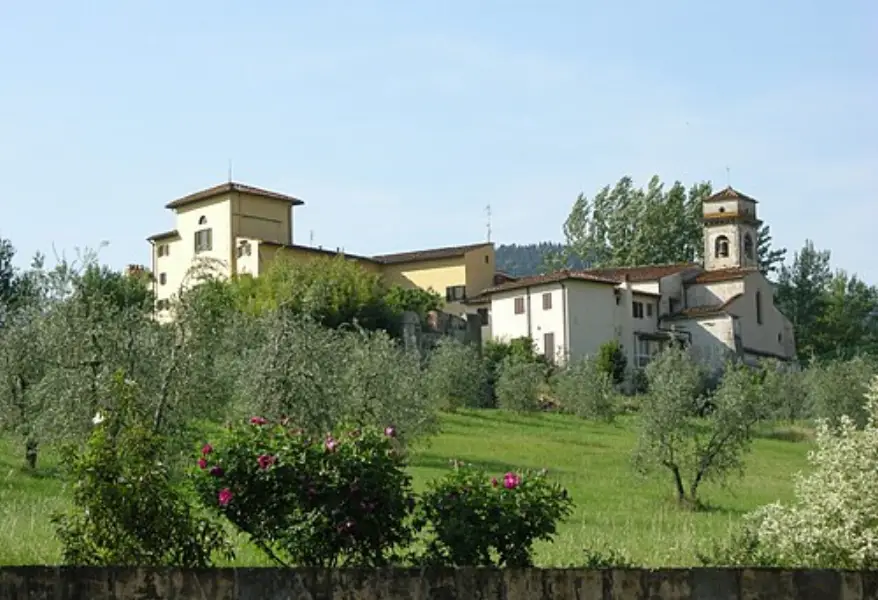
Andrew is a pre-congregation saint, venerated in the Roman Catholic and Eastern Orthodox Churches, with his feast on 22 August. His major shrine is the church of San Martino a Mensola near Fiesole, where his body lies. His cult, like that of Donatus, belongs to the memory of the Irish contribution to the Carolingian church of Italy — the pilgrim scholars who became bishops and abbots far from home.
§ Introduction
Legacy
Andrew's legacy is the long friendship of Ireland and Italy in the church of the early Middle Ages. With Donatus, his sister Bridget, and the Irish community they formed in Tuscany, he represents the peregrinatio pro Christo, the exile for Christ that sent Irish monks across Europe with their manuscripts and their chant. The church of San Martino, restored by his hands and holding his body, keeps his memory in the hills where he worked, and his iconography — the deacon healing, the Irish wolfhound at his side — keeps the island in the picture.
§ Introduction
Timeline
- 800
Born in Ireland to a noble family as the ninth century was beginning
§ Life
- 816
Leaves home with his teacher Donatus, joining the Irish master's pilgrimage to Italy
§ Life
- 816
On their arrival at Fiesole Donatus is chosen bishop and, once consecrated, appoints Andrew archdeacon of the see
§ Life
- 880
Dies at Fiesole a few years after Donatus, his sister Bridget having reached his deathbed from Ireland
§ Life
- 880
Laid to rest at St Martin's, the Mensola church he had restored, where exhumation later finds the body uncorrupted
§ Veneration
The Record
- Symbols
- Deacon curing a paralytic girl·Irish Wolfhound
- Canonization
- Pre-congregation; venerated in the Roman Catholic and Eastern Orthodox Churches
Prayer
Bibliography
Show 6 sources
- ↑ Butler, Alban. "Saint Andrew of Ireland, Deacon and Confessor". Lives of the Fathers, Martyrs, and Principal Saints 1866. CatholicSaints.Info. 27 July 2014 This article incorporates text from this source, which is in the public domain .
- ↑ Thurston, Herbert. "St. Andrew the Scot." The Catholic Encyclopedia Vol. 1. New York: Robert Appleton Company, 1907. 25 December 2012 This article incorporates text from this source, which is in the public domain .
- 1 2 Lives Of The Irish Saints (O'Hanlon)
- ↑ "Saint Andrew the Scot". New Catholic Dictionary CatholicSaints.Info. 29 July 2012
- ↑ Monks of Ramsgate. "Andrew of Tuscany". Book of Saints 1921. CatholicSaints.Info. 20 July 2012 This article incorporates text from this source, which is in the public domain .
- ↑ Stokes, Margaret . Six Months in the Apennines: Or a Pilgrimage in Search of Vestiges of the Irish Saints in Italy , (London, 1892), p. 252 This article incorporates text from this source, which is in the public domain .
Profile text adapted from the Wikipedia article, licensed CC BY-SA 4.0.
Pray with this saint every day
Save St. Andrew the Scot to your favorites, read the full profile, and get feast-day reminders in the Saints app.
Get the Saints AppFree on the App Store for iPhone and iPad