
c. 980-c. 1030·Feast July 17 (Slovakia); June 13 (Poland)
St. Andrew Zorard
Hermit of Zobor, Monk and Missionary
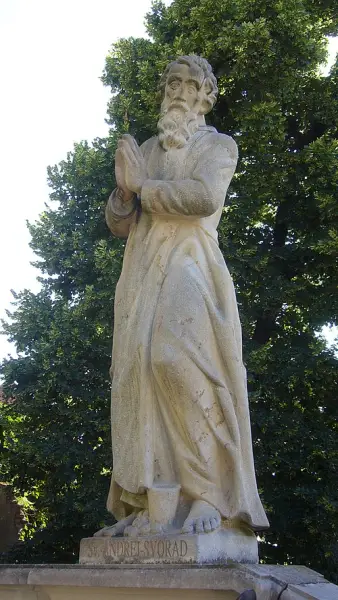
Overview
Andrew Zorard — Polish Andrzej Świerad, Slovak Svätý Svorad, Hungarian Zoerárd — was a Benedictine monk, born in Poland around 980, whose activity lay in the Kingdom of Hungary and who is venerated as a saint by the Catholic Church and the Orthodox Churches alike. His birthplace was Opatowiec, though one tradition, from the village of Tropie, says that in his younger monastic days he lived nearby. Around the year 1000, at about twenty, he began living as a hermit and missionary, evangelizing at Oława in Silesia. He then travelled to northern Hungary, settling around 1003 in the Benedictine monastery of St Hippolytus on Mount Zobor near Nitra, where he lived as a hermit under obedience, wearing an iron chain and eating little but nuts and herbs; a spring bears his name on the mountain. He became the spiritual father of Benedict, the hermit of Skalka, who found him dead in his cell, his body uncorrupted, lit by a heavenly light per the Life. He died around 1030-1034.
The Complete Life
Early Life
Zorard was born around 980 at Opatowiec, a small village in what is now the Kazimierza district of Poland, just then entering the light of history as the young Piast state received baptism. His names multiply across the languages of his cult — Andrzej Świerad and Żurawek in Polish, Svorad in Slovak, Zoerárd in Hungarian, Zoerardus in Latin — a sign of how widely he was claimed. The village of Tropie, on the Dunajec, preserves a tradition that as a young man he lived in the area as a monk, in a time before any written life of him existed. Around the year 1000, aged about twenty and moved by the missionary energy of the newly Christian lands, he began to live as a hermit and missionary, evangelizing at Oława in Silesia. The pattern is the classic one of the age: the monk who is also a frontier preacher, carrying the gospel into villages the parishes had not yet reached.
Zobor
At some point Zorard travelled south to northern Hungary — today Slovakia — and around 1003 settled in the Benedictine monastery of St Hippolytus on Mount Zobor above Nitra, one of the earliest monasteries of the kingdom, founded under the patronage of the Arpád dynasty's church. There he lived the strangest of hybrid vocations: a monk of the house who was also its hermit, dwelling alone on the mountain in a cell, under obedience to the abbot, wearing an iron chain around his body next to the skin, and subsisting on almost nothing — the traditions say nuts and wild herbs, whence the walnuts of his iconography. A spring on Zobor still bears his name. The Life composed for his canonization, the legend of SS Zorard and Benedict, describes his austerities in the idiom of the Desert Fathers translated to the Carpathians: the hermit as a second Anthony, the Slovak mountain as a Thebaid.
Spiritual Father of Benedict
Zorard's most consequential act was to gather a disciple. Benedict, a hermit of Skalka near Trenčín — later St Benedict Sčráka or Strocimir — sought out the older man on Zobor and lived under his direction, receiving the solitary life from him hand to hand. The two hermits, on mountains a day's journey apart, formed a school of two, the way eastern hesychast networks would later run. When Benedict came to visit his master, so the Life relates, he found Zorard dead in his cell, his body incorrupt and a heavenly light shining upon it — the classic signs by which the medieval Church read sanctity in a corpse. Benedict carried the news and the manner of death to Nitra, and the cult of the holy hermit of Zobor began at the monastery that had sheltered him; Benedict's own martyr's death at the hands of robbers followed, binding the two forever in one cult.
Canonization
In 1083, at the initiative of King Ladislaus I of Hungary and with the approval of Pope Gregory VII, the church of Hungary raised its first saints in a single act: King Stephen, his son Emeric, the bishop Gerard, and the hermits Zorard and Benedict of Skalka. The canonization, among the earliest formal processes in central Europe, gave the young kingdom a native pantheon drawn from throne, cathedral and mountain. Zorard's cult centres on St Emmeram's Cathedral at Nitra at the foot of Zobor, where his memory is part of the city's identity; Poland claims him equally from Opatowiec and Tropie, and his feast is kept on 17 July in Slovakia and 13 June in Poland. Catholic and Orthodox calendars both carry him, a western monk of the first evangelization honoured across the later divide.
Legacy
Zorard is the earliest and dearest saint of Slovak Christianity, the apostle of the hermit life in the northern kingdom, and his mountain, his spring and his chain are fixed points of Nitra's sacred geography. For Poland he is one of the first Polish-born saints, proof that the new church north of the Carpathians could produce holiness as well as receive it. His cult, shared between two modern nations and two churches, preserves the unity of the tenth-century mission field that politics has since divided. The attributes the painters give him — walnuts, eagle, chain, axe, rocks — are a complete biography in five objects: the hermit's food, the mountain's bird, the ascetic's iron, the woodsman's tool, the landscape itself. He remains what the Life made him: the man who died alone on Zobor in the light.
Timeline
- 980
Born around this year at Opatowiec, a small village in Poland
§ Life
- 1000
Around this year, aged about twenty, began living as a hermit and missionary, evangelizing in Olawa, Silesia
§ Life
- 1003
Settled around this year at St. Hippolytus Monastery on Mt. Zobor near Nitra, becoming a Benedictine monk under the name Andrew
§ Life
- 1009
Died of natural causes around this year after severe austerities as a hermit near Skalka
§ Life
- 1064
King Géza I of Hungary took the first steps towards his canonization
§ Feast Day and veneration
- Jul 1083
His relics were transferred to St. Emmeram's Cathedral in Nitra and his cult officially confirmed by Pope Gregory VII
§ Feast Day and veneration
The Record
- Patron of
- Hungary·Nitra and the Diocese of Nitra·Diocese of Tarnów·St. Andrew Abbey, Cleveland
- Symbols
- Walnuts·Eagle·Chain·Axe·Rocks
- Canonization
- Canonized 1083 by Pope Gregory VII among the first saints of Hungary
Prayer
Profile text adapted from the Wikipedia article, licensed CC BY-SA 4.0.
Pray with this saint every day
Save St. Andrew Zorard to your favorites, read the full profile, and get feast-day reminders in the Saints app.
Get the Saints AppFree on the App Store for iPhone and iPad