
1st century·Feast May 17 (East); 22 Pashons (Coptic)
St. Andronicus of Pannonia
Apostle of the Seventy, Bishop of Pannonia
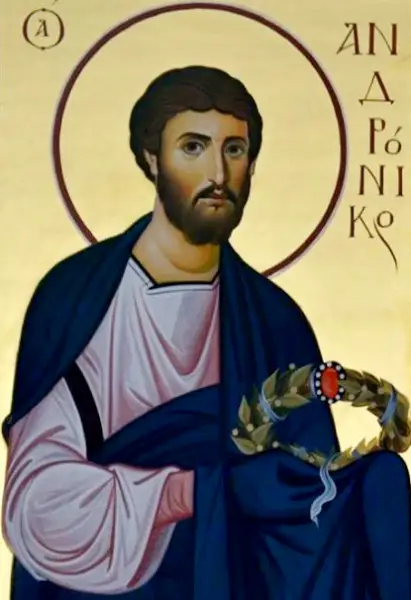
Overview
Andronicus is one of the few figures of the apostolic church known by name from the New Testament itself. Paul, writing to the church at Rome, greets Andronicus and Junia together — his kin, his fellow prisoners, people of standing among the apostles, and believers before he was — a single verse that makes him a relative of Paul, a fellow prisoner, a person of standing among the apostles, and a Christian of longer standing than Paul himself. Junia, greeted with him, is usually taken to be his wife. Later tradition enlarged the verse: the Eastern churches count Andronicus among the Seventy Apostles sent out by Jesus, make him bishop of Pannonia — the Roman province covering western Hungary — and hold that he and Junia preached throughout that land, pulled down temples of idols, and died as martyrs. The Oriental tradition instead reports that he died in peace, a day before Junia. Modern biblical scholarship debates whether 'of note among the apostles' means the pair were themselves apostles or merely esteemed by them; the Catholic archbishopric of Moravia, founded in the ninth century, was regarded as the revival of the see Andronicus had held.
The Complete Life
Known by One Verse
Everything certain about Andronicus is contained in one sentence of Paul's letter to the Romans, written from Corinth around 57 AD. In the long roll of greetings that closes the letter, Paul writes: 'Salute Andronicus and Junia' — his kinsmen, his fellow prisoners, notable among the apostles, in Christ before him. Each phrase carries weight. 'Kinsmen' (syngeneis) makes him a blood relative of Paul, or at least of his people — several such persons appear in Romans 16. 'Fellow prisoners' recalls some shared confinement, whether literal or metaphorical, otherwise unknown. 'In Christ before me' is extraordinary: this man and Junia were believers while Paul was still persecuting the church. The one verse is a better biography than most first-century Christians received.
Apostle — In What Sense
The phrase 'of note among the apostles' (episemoi en tois apostolois) has generated a long argument. One reading takes it to mean that Andronicus and Junia were well known and highly regarded by the apostles — distinguished in the eyes of the Twelve. Another, argued forcibly by Evelyn and Frank Stagg among others, takes Paul to be commending the pair as apostles themselves: Paul, they note, is vouching on the basis of his own long acquaintance — their imprisonment together, their seniority in the faith — and would not appeal to others' opinion as their credential. On this reading the couple belong with Silas, Timothy, and others who bore the title in the wider apostolic circle. Junia, on any reading, is the most prominent woman in the pauline greetings, and the tradition has generally taken the two as husband and wife, though the sources allow brother and sister or no relation.
Bishop of Pannonia
The tradition of the churches gave the verse a mission-field. The Eastern and Oriental Orthodox churches count Andronicus among the Seventy, the larger company of disciples Luke records Jesus sending out; they make him bishop of Pannonia, the Danubian province of the empire, and Junia his co-worker. The acts of the Seventy in this tradition are of a piece: preaching through the province, the overthrow of idol temples, conversions in number, and the gifts of healing and exorcism that the acts of the apostles promise. The claims cannot be checked against any first-century document — Pannonia's documented Christian history begins centuries later — but they are old, and they gave the Danube lands an apostolic pedigree that the medieval church took entirely seriously: when Pope Nicholas I erected the archbishopric of Moravia in the ninth century, it was understood as the revival of the see Andronicus had founded.
Two Traditions of a Death
The churches remember the death of Andronicus differently, and the difference is itself instructive. The Eastern Orthodox tradition, following the menologia and the Prologue of Ochrid, holds that he and Junia ended as martyrs — the natural completion of a life that had already known prison for the faith. The Coptic tradition records instead that he departed in peace, one day before Junia, the two deaths close together as their lives had been. The calendars agree in honoring them jointly, Andronicus on 17 May in the Byzantine books and on 22 Pashons in the Coptic.
Veneration
Andronicus belongs to the apostolic company whose sanctity no process ever questioned. He is liturgically honored in the Eastern Orthodox Church on 17 May, in the Coptic Orthodox Church on 22 Pashons, and is claimed by the Anglican and Catholic traditions as one of the New Testament saints. The catholicity of the cult — East, Oriental, Rome, Canterbury all greeting the same man — corresponds exactly to the one thing the New Testament actually says about him: that he was notable among the apostles, and in Christ before almost anyone.
Legacy
Andronicus's legacy rests on a single verse and the edifice of devotion built upon it. For biblical scholarship he is a principal exhibit in the debate over women's ministry, since Junia's greeting beside his — 'notable among the apostles' — is the strongest New Testament evidence that women bore apostolic standing in the pauline circle. For the Danubian churches he is the apostolic root: the claim that Pannonia heard the Gospel from one of the Seventy, kin to Paul himself. And for every reader of Romans 16 he remains what Paul made him: a kinsman, a prisoner, and a senior — someone who was in Christ while the great apostle was still on the other side.
The Record
- Patron of
- Pannonia·Married couples in ministry
- Symbols
- Apostolic wreath·Bishop's vestments
- Canonization
- Pre-congregation; apostle of the Seventy in Orthodox and Oriental tradition
Prayer
Profile text adapted from the Wikipedia article, licensed CC BY-SA 4.0.
Pray with this saint every day
Save St. Andronicus of Pannonia to your favorites, read the full profile, and get feast-day reminders in the Saints app.
Get the Saints AppFree on the App Store for iPhone and iPad