
1870 – 1918·Feast July 7 (Julian calendar; July 20 Gregorian)
St. Andronik (Nikolsky) of Perm
Archbishop of Perm, Hieromartyr
Overview
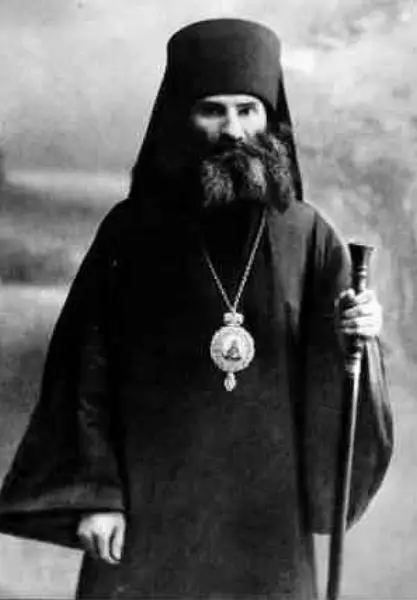
Vladimir Alexandrovich Nikolsky, in monastic life Archbishop Andronik, born on 1 August 1870 at Povodnevo in the Yaroslavl diocese, the son of a deacon, was a bishop of the Russian Orthodox Church who served as a missionary in Japan and died one of the first hieromartyrs of the Soviet yoke. Tonsured in 1893 during his studies at the Moscow Theological Academy and ordained priest in 1895, he taught in Georgia, then joined the Russian mission to Japan in 1897 under Saint Nicholas of Japan, writing a book about the journey, and was consecrated in 1906 as the first Bishop of Kyoto; illness forced his return to Russia in 1907. After sees at Tikhvin and, from July 1914, Perm and Solikamsk, where he labored for a region of a million and a half people and 570 churches through the World War, he was elevated to archbishop by Patriarch Tikhon on Palm Sunday 1918. Arrested at midnight on 4 July 1918, he was killed a few days later, on the most consistent account forced to dig his own grave, laid in it, covered with earth, and shot. The clergy of Perm responded with a nine-day strike of the divine services. He was glorified among the New Martyrs in 2000.
The Complete Life
Formation
Vladimir Nikolsky was born on 1 August 1870 at Povodnevo, a village of the Myshkinsky Uyezd in the Yaroslavl diocese, the son of a village deacon, and thus a child of the clerical estate that supplied the Russian church's educated clergy. He followed its standard ladder: the Yaroslavl Seminary, finished in 1891, then the Moscow Theological Academy, where he took monastic vows on 1 August 1893, his twenty-third birthday, receiving the name Andronik; he became deacon on the 6th of that month and, on 22 July 1895, priest. His first assignments were pedagogical and southern: from 1895 he taught at the theological seminary of Kutaisi in Georgia and then at the seminary at Ardon, in the Caucasus, as inspector and instructor, the church's schools in its Muslim and mountain borderlands. The pattern of his life was already visible: the scholar sent to the frontiers, formed in the academy's strict learning and spent on the empire's difficult edges.
§ Early life
Japan, Kyoto, and Return
In 1897 came the assignment that determined how history would remember him: a place on the Russian Orthodox mission to Japan, serving under Bishop Nicholas — the apostle of that land, later glorified as Saint Nicholas of Japan, whose work there had begun in 1861. Hieromonk Andronik was, he admitted, surprised by the appointment and felt inadequate to it, but accepted it as God's will. He left St. Petersburg on 21 September 1897 and sailed from Odessa on 26 October with Archimandrite Sergius, the future patriarch, traveling through Europe and the United States and arriving in Japan on 26 December; the book he wrote about the journey, A Missionary Journey to Japan, was published at Kazan in 1899. On 5 November 1906 he was consecrated the first Bishop of Kyoto, the seat of the new West Japan diocese, and took up residence in Osaka, where most of the Orthodox faithful lived; but after three months illness so disabled him that he asked leave to resign, and on 27 May 1907 he left Japan. Back in Russia he served as deputy bishop at Kholm, then from 1908 as bishop of Tikhvin in the Novgorod diocese.
§ Bishop of Kyoto
Perm, the War, and the Revolution
Eleven days after the outbreak of the World War, on 30 July 1914, Andronik became bishop of Perm and Solikamsk, a see numbering a million and a half souls and well over five hundred churches, and he worked for it through the war with an energy the diocese long remembered: hospitals, refugees, the spiritual care of a province carrying the eastern front's rear. In the summer of 1916 he traveled to army headquarters to warn the Tsar about Rasputin, a mission that failed, though Nicholas was pleased with the gift Andronik bore from the people of Perm, a pair of the soldier's boots the province made for the army. In 1917 he became bishop of Perm and Kungur and served among the seven hierarchs of the pre-conciliar synod, working through the Local Council in Moscow from August 1917 to April 1918. As the Bolsheviks took Perm he appealed in writing for the defense of the church's heritage; Patriarch Tikhon raised him to archbishop on Palm Sunday; and after a search of his residence on Holy Thursday he kept the Holy Week services in calm. He was arrested at midnight on 4 July (Gregorian 17 July) 1918.
§ Bolshevik Revolution
Martyrdom and Glorification
The manner of Andronik's death, on the account apparently most consistent, belongs to the cruelest chapter of the terror: on about 7 July 1918 he was taken to the forest, forced to dig his own grave, laid down in it, covered with earth, and shot through the dirt. Other accounts circulated, as they did for every such death, but the digging of the grave is the detail the tradition kept, and the iconography of the saint has kept it too. The clergy of Perm answered the arrest with a strike: from the night of the taking until 13 July (Gregorian 26) all divine services in the region were halted, baptism and the last rites alone excepted, an extraordinary collective act that shows what the diocese thought it had lost. At the Jubilee Council of 2000 the Church of Russia glorified him as Hieromartyr Andronik, Archbishop of Perm, among the New Martyrs and Confessors, his feast falling on 7 July of the Julian calendar, the 20th of the Gregorian.
§ Bolshevik Revolution
Legacy
Andronik's life joins three histories: the Russian mission in Japan, which numbers him among the successors of Saint Nicholas and the founding bishops of the Japanese church; the church of the World War, of which his Perm episcopate was a model of wartime service; and the martyrology of the revolution, in which his grave-digging death made him one of the emblematic figures. His writings are few, the journey-book above all, but his figure has been taken up by the historiography of the New Martyrs as the type of the bishop who would not flee: offered every occasion to leave Perm, as the sources note of the council's end, he returned to his city in the spring of 1918 and was taken from it within weeks. The Perm church that struck for him for nine days has kept his memory ever since, and the glorification of 2000 gave it to the whole Orthodox world.
§ Bolshevik Revolution
Timeline
- 1 Aug 1870
Born Vladimir Nikolsky at Povodnevo in the Yaroslavl diocese, son of a deacon
§ Early life
- 1891
Finished studies at the Yaroslavl Seminary and entered the Moscow Theological Academy
§ Early life
- 1 Aug 1893
Tonsured a monk in Moscow and given the religious name Andronik
§ Early life
- 6 Aug 1893
Ordained to the diaconate
§ Early life
- 22 Jul 1895
Ordained as a priest, then assigned to seminaries in Kutaisi and Ardon
§ Early life
- 26 Dec 1897
Arrived in Japan by way of Europe and the United States with Archimandrite Sergius Stragorodsky
§ Bishop of Kyoto
- 1897
Assigned to the Russian Orthodox mission to Japan under Bishop Nikolai Kasatkin
§ Bishop of Kyoto
- 1899
Published his account of the voyage, A Missionary Journey to Japan, at Kazan
§ Bishop of Kyoto
- 5 Nov 1906
Consecrated the first Bishop of Kyoto, seated in the West Japan Diocese
§ Bishop of Kyoto
- 27 May 1907
Left Japan for Russia after illness made his duties in Osaka difficult
§ Bishop of Kyoto
- 1908
Assigned bishop of Tikhvin in the Novgorod diocese
§ Bishop of Kyoto
- 30 Jul 1914
Named to lead the diocese of Perm and Solikamsk shortly after the war began
§ Bishop of Perm and Solokamsk
- 1916
Traveled to imperial army headquarters to warn Tsar Nicholas II about Rasputin
§ Bishop of Perm and Solokamsk
- 25 Jan 1918
Issued a written appeal urging the faithful to defend church property from Bolshevik looters
§ Bolshevik Revolution
- 25 Apr 1918
Elevated to archbishop by Patriarch Tikhon on Palm Sunday
§ Bolshevik Revolution
- 4 Jul 1918
Arrested at midnight by the Bolshevik authorities (Gregorian date July 17)
§ Bolshevik Revolution
- 7 Jul 1918
Taken to a forest and killed, forced to dig his own grave before being shot
§ Bolshevik Revolution
- 2000
Glorified by the Russian Orthodox Church as Hieromartyr Andronik, Archbishop of Perm, among the New Martyrs
§ Introduction
The Record
- Major works
- A Missionary Journey to Japan (Kazan, 1899)
- Patron of
- Missionaries·Bishops under persecution·The Perm region
- Symbols
- Archbishop's vestments·Cross and shovel (his forced grave)
- Canonization
- Glorified in 2000 by the Russian Orthodox Church as Hieromartyr Andronik, Archbishop of Perm, one of the Russian New Martyrs and Confessors
Prayer
Bibliography
Show 2 sources
Profile text adapted from the Wikipedia article, licensed CC BY-SA 4.0.
Pray with this saint every day
Save St. Andronik (Nikolsky) of Perm to your favorites, read the full profile, and get feast-day reminders in the Saints app.
Get the Saints AppFree on the App Store for iPhone and iPad