
d. c. 695·Feast October 14
St. Angadrisma
Abbess of Oroër (Angadrême)
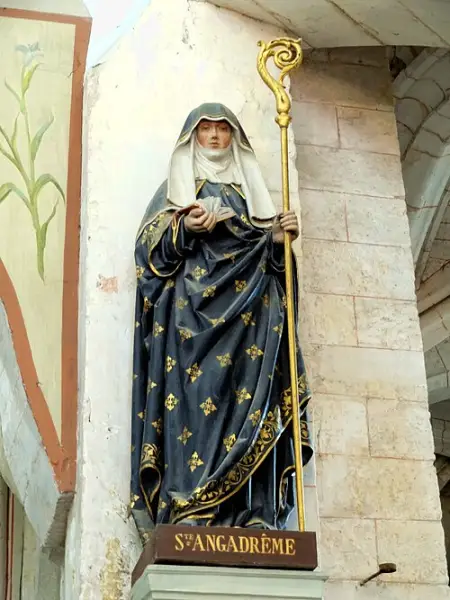
Overview
Angadrisma — also Angadrême, Angadresima, Angadreme, Angradesma, and Andragasyna — was a seventh-century French abbess, the daughter of Robert I, bishop of Tours, of the family of the Counts of Boulogne. Originally from Thérouanne and a cousin of Lambert, bishop of Lyon, she received her schooling at Thérouanne from Lambert and Saint Audomare (Omer). Though she wished to be a nun, she was instead promised in an arranged marriage to Saint Ansbert of Chaussy; tradition relates that she prayed for deliverance and was stricken with leprosy — and that the cure came once she was permitted at last to take the veil as a nun from Archbishop Ouen of Rouen. Around 660, a Benedictine monastery was built for her by her father at Oroër-des-Vierges near Beauvais, and there she became abbess, ruling for more than thirty years. She died on 14 October, around 695, having lived past her eightieth year. In art her face appears pitted with the scarring of leprosy; she is honored as patroness of the diocese of Beauvais and invoked against drought and fire.
The Complete Life
Early Life
Angadrisma was originally from Thérouanne, the episcopal town of the Pas-de-Calais, and belonged to the family of the Counts of Boulogne — the high Frankish aristocracy from which the seventh-century church drew so many of its bishops and abbots. Her father was Robert I, bishop of Tours; she was a cousin of Lambert, bishop of Lyon, and it was by Lambert and Saint Audomare (Omer), the apostle of the Morini, that she was educated at Thérouanne. Her world was thus one in which sanctity, rank, and office were woven together, and in which a daughter's vocation was a family matter, to be arranged like any other alliance. Her biography rests almost entirely on the memory Beauvais preserved: the diocese's own record names Angadrême its principal patroness, and the family, the schooling under Omer, and the abbacy stand or fall with that local tradition.
§ Life
Vocation and Deliverance
Though the cloister was what she wanted, Angadrisma was given in marriage by her family's arrangement to Saint Ansbert of Chaussy — a man himself later numbered among the saints. Tradition has it that, seeking a way out, she prayed fervently, and leprosy struck her. The disease, in the economy of her legend, was the answer to a prayer: the suitor's family withdrew, and the plan collapsed. The cure, the same tradition holds, came when she was at last permitted to take the veil as a nun from Archbishop Ouen of Rouen, the foremost prelate of her age. The harshness of the story — a girl asking God for a disfigurement rather than a wedding — preserves the memory of how costly a woman's refusal could be, and how completely her desire for the cloister had to be proved before it was granted. The leprosy, the cure, and the veil — the story marks what a daughter's refusal cost, and what her desire for the cloister had to be worth.
§ Life
Abbess of Oroër
It was her father who, around 660, built a Benedictine monastery for her at Oroër-des-Vierges, near Beauvais in Picardy, and she became its abbess. The house took its name from the virgins — les Vierges — who formed its community, and under Angadrisma it became one of the religious centers of the Beauvaisis. She ruled for over three decades, into extreme old age, dying on 14 October around 695 at more than eighty years of age. An abbess in seventh-century Neustria governed a small society — lands, tenants, schools, an infirmary, and a choir — and her long rule represents the quiet institutional work by which the Frankish countryside was fully Christianized. Her abbacy survives in outline only, yet the outline held: a diocese that still keeps its principal patroness, an October feast thirteen centuries running, and farmers who still ask her against drought and fire. For a house whose early records are gone, the devotion of the Beauvaisis is the evidence.
§ Life
Veneration
Angadrisma belongs to the pre-congregation saints of northern France. She is venerated in the Roman Catholic Church and the Eastern Orthodox Church, with her feast on 14 October, and she is the patroness of the diocese of Beauvais — Noyon and Senlis — one of the few women to head a diocese's patronage. Her statue in the church of Notre-Dame de Marissel at Beauvais and her images in the art of the region show her praying and marked by her leprosy, the wound of her vocation carried into her glory. The faithful of the Beauvaisis invoke her against drought and fire, the twin threats of a farming country. The praying leper is her recorded type in the region's art — the wound of her vocation carried visibly into her glory — and Beauvais has never replaced her. The praying leper is her recorded type in the region's art — the wound of her vocation carried visibly into her glory — and Beauvais has never replaced her, thirteen centuries on.
§ Introduction
Legacy
Angadrisma's legacy lives chiefly in the Beauvaisis, where her patronage of the diocese continues and her October feast has been kept for thirteen centuries. Beyond her region she is studied as an example of the arranged-marriage legends of Merovingian female saints — the girls who prayed for leprosy, muteness, or a goiter to escape weddings — which historians now read both as hagiographic convention and as real evidence of the pressure on devout daughters. Her name in its many forms runs through the local place names and calendars of Picardy, and her image, face pitted and hands raised, remains one of the most affecting of early French saints' portraits. The vocation story did its work: a community that kept a patroness for thirteen centuries judged the cost of the daughter's refusal worth remembering.
§ Introduction
Timeline
- 660
Her father builds her a Benedictine monastery at Oroër-des-Vierges near Beauvais, where she becomes abbess
§ Life
- 14 Oct 695
Dies on 14 October, aged over eighty, after ruling the monastery for more than thirty years
§ Life
The Record
- Patron of
- The Diocese of Beauvais-Noyon-Senlis·Invoked against drought and fire
- Symbols
- Praying leper·Face pitted by leprous skin
- Canonization
- Pre-congregation; ancient cult at Beauvais
Prayer
Bibliography
Show 2 sources
- 1 2 "Ste Angadrême, vierge; Patronne principale de Beauvais", Le diocèse de Beauvais, Noyon et Senlis [ link removed ] (in French)
- 1 2 3 4 Baudoin, Jacques (2006). Grand livre des saints: culte et iconographie en Occident (in French). Nonette, FR: Editions CRÉER. p. 90. ISBN 9782848190419 .
Profile text adapted from the Wikipedia article, licensed CC BY-SA 4.0.
Pray with this saint every day
Save St. Angadrisma to your favorites, read the full profile, and get feast-day reminders in the Saints app.
Get the Saints AppFree on the App Store for iPhone and iPad