
1474-1540·Feast January 27
St. Angela Merici
Foundress of the Company of St. Ursula
Overview
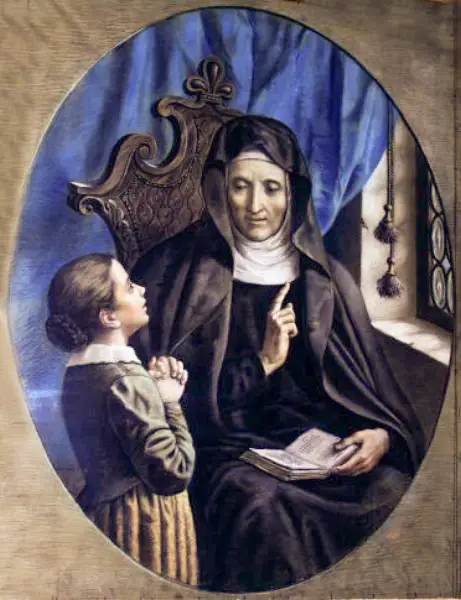
Angela Merici, born on 21 March 1474 on a farm near Desenzano del Garda on Lake Garda, founded the Company of St. Ursula at Brescia in 1535, the first teaching institute of women religious, from which the Ursuline order later grew. Orphaned at ten and raised by an uncle at Salò, she was grief-stricken when her sister died without the last rites, until a vision assured her that her sister was in heaven among the saints. She joined the Third Order of St. Francis, and after her uncle's death returned to Desenzano, where a further vision revealed her work: an association of virgins devoted to the Christian education of girls. Invited to Brescia, she gathered twelve companions on 25 November 1535 near the church of St. Afra and founded the Company of St. Ursula, under the patronage of the medieval universities' patroness. Her aim was to elevate family life through the education of future wives and mothers. The members wore no habit, took no formal vows, kept to celibacy, poverty and obedience while remaining in their own homes, and taught the girls of their own neighborhoods. Elected Mother and Mistress in 1537, she wrote the Rule, approved by Paul III in 1544. She died on 27 January 1540, leaving twenty-four communities.
The Complete Life
Early Life
Angela Merici was born on 21 March 1474 at a farm close to Desenzano del Garda, a small town on Lake Garda's southwestern shore in Lombardy, into the Italy of the high Renaissance, a few decades before the Reformation would break over the church she served. Her family were farming people of modest means, and her childhood was shattered early: at ten, she and Giana Maria, her older sister, were left orphans, and the two girls were sent to live with an uncle at Salò. There the second blow fell: Giana Maria died suddenly, with no chance to receive the church's last rites, and the young Angela was tormented by the fate of her sister's soul until a vision brought her the assurance that her sister was safe in heaven among the saints. The experience marked her permanently: the concern for the unprepared dead, the confidence in God's mercy, and the habit of taking her direction directly from prayer all date from those Salò years, as does her enrollment in the Third Order of St. Francis, the secular Franciscan life she would keep until her death.
§ Life
Vocation
At twenty, her uncle dead, Angela returned to Desenzano and lived with her brothers on her own property, given her in lieu of a dowry. The decisive vision came in those years: she saw, in the famous image, a company of virgins ascending a ladder between earth and heaven, accompanied by angels, and understood that God was asking her to bring into being an association of women who would consecrate themselves to the religious formation of young girls. She began at once, in the simplest way, gathering the girls of her neighborhood and teaching them the faith, and her success brought an invitation to begin the same work at neighboring Brescia, the city of her maturity. Her path to it ran through the great pilgrimages of the age: in 1524, traveling to the Holy Land, she became suddenly blind on Crete, continued the pilgrimage to Jerusalem anyway, and recovered her sight on the return, at the very place where she had lost it, while praying before a crucifix; in 1525 she went to Rome for the Jubilee, where Pope Clement VII, hearing of her work, invited her to stay. She disliked notoriety and returned to Brescia.
§ Life
The Company of St. Ursula
On 25 November 1535 Angela gathered twelve young women who had joined her work in a small house near the church of St. Afra in Brescia, and together they committed themselves to founding the Company of St. Ursula, placed beneath the patronage of the medieval universities' patroness. Her design was original to the point of audacity: women who consecrated themselves to God by the vows of celibacy, poverty and obedience, but who remained in the world, wearing no habit, living in their own homes, and serving as teachers of the girls of their own neighborhoods. The aim, as she stated it, was to lift up family life by giving future wives and mothers a Christian education; the method was the sanctification of ordinary lay life rather than flight from it. By 1539 the company numbered twenty-eight. Elected Mother and Mistress on 18 March 1537, she governed with a rule she wrote herself and with the famous Counsels, full of practical tenderness, that the Ursulines have never stopped reading. The Rule was approved by Pope Paul III in 1544, after her death.
§ Life
Spirituality
Angela's spirituality was Franciscan, lay and practical. From the tertiary life she took the love of poverty and the habit of penance; from her visions, the conviction that her work was God's work and must be governed by prayer; from her experience as a teacher, the pedagogy of gentleness that the Counsels prescribe: if any are obstinate, use gentleness, be patient with them. She had an unshakable respect for the freedom and dignity of the women she led, leaving them at home in the world, refusing the cloister, insisting that the superior be called by no title of pomp, and trusting conscience formed by instruction rather than rules multiplied. Her theology of the family, that the reform of society must begin with the education of girls, was a century ahead of its time and has proved one of the most fruitful ideas in the history of the church. Modern scholarship has refined the picture, noting that the Company's concentration on the education of the poor developed fully only after her death; but her own design, the consecration of women teachers living in the world, stands as one of the great innovations of Christian life.
§ Introduction
Final Years
Angela died at Brescia on 27 January 1540, about sixty-five years old, leaving the Company she had founded at twenty-four communities serving through the region. Her last years were spent in small rooms beside a priory of the Lateran Canons Regular, and she would often pray at the tombs of the Brescian martyrs in the church of St. Afra, and by her own wish she was buried in that church, clothed in the Franciscan tertiary habit, near the martyrs' remains. Her body remained there until the church was completely destroyed by Allied bombing on 2 March 1945 — a raid that also killed the parish priest and many townspeople; the church rose again and was reconsecrated in the 1950s, and her relics, saved from the ruins, rest there again. Her deathbed counsels to her daughters, preserved in the tradition, kept the tone of her whole life: confidence, gentleness, perseverance.
§ Veneration
Canonization
The cause of Angela Merici was opened after her death and pursued through the seventeenth century, and the confirmation of her cult allowed her beatification; Pope Pius VII canonized her on 24 May 1807. Her feast, long kept on 31 May, was assigned in the modern calendar to 27 January, the day of her death, which the church now keeps. The canonization came, fittingly, at the moment when the movement she had begun had become one of the largest institutions of women religious in the church: the Company of St. Ursula had been transformed after her death into the enclosed Order of St. Ursula and then, at the beginning of the seventeenth century, under Angela's name and example, into the Ursuline teaching congregations of France, whose schools spread over Europe and the missions of North America. The foundress of the uncloistered company was invoked by the cloistered orders that grew from her seed, and the church declared, in canonizing her, that her instinct for the sanctity of ordinary life had been prophetic.
§ Introduction
Legacy
Angela Merici's legacy is the education of girls by women religious, an idea so successful that its originality has been forgotten. From the little company of Brescia came the Ursulines, who at their height taught on every continent; the parochial school systems of North America owe more to her inspiration than to any other single figure. Her vision of consecrated life in the world anticipated by four centuries the modern secular institutes, and her insistence on the education of women as the lever of social reform has been vindicated by the whole subsequent history of the church's mission. Brescia keeps her as its great citizen saint, her house and shrine visited beside the martyrs she loved; Desenzano keeps her birthplace. Teachers, and women teachers above all, invoke her; and the Ursuline family, in its several branches, reads her Counsels each year as a living instruction. She is one of the few founders whose movement outgrew every form she gave it while keeping her spirit intact.
§ Introduction
Timeline
- 21 Mar 1474
Born on 21 March on a farm near Desenzano del Garda
§ Introduction
- 1484
Left an orphan at ten with her sister; the girls go to live with an uncle at Salò
§ Life
- 1495
After her uncle's death returns to Desenzano and joins the Third Order of St. Francis
§ Life
- 1524
Suddenly blinded on Crete while traveling to the Holy Land; sight returns there on her way back
§ Life
- 1525
Travels to Rome for the Jubilee; Pope Clement VII invites her to stay, but she returns to Brescia
§ Life
- 25 Nov 1535
Gathers twelve young women near the church of St. Afra in Brescia to found the Company of St. Ursula
§ Life
- 18 Mar 1537
Elected Mother and Mistress of the Company on 18 March
§ Life
- 27 Jan 1540
Dies at Brescia on 27 January, leaving twenty-four communities of the Company
§ Life
- 1544
The Rule she wrote for the Company is approved by Pope Paul III
§ Life
- 30 Apr 1768
Beatified in Rome on 30 April by Pope Clement XIII
§ Veneration
- 24 May 1807
Canonized in Rome on 24 May by Pope Pius VII
§ Veneration
The Record
- Major works
- Rule of the Company of St. Ursula·Counsels and Legacy (instructions to the Company)
- Patron of
- The Ursuline order·Teachers and educators·Girls' education·The sick and disabled
- Symbols
- Habit of a Franciscan tertiary·Book and ladder (vision of the ladder)
- Canonization
- Canonized 24 May 1807 by Pope Pius VII
Prayer
Bibliography
Show 1 sources
- ↑ In this, they anticipated the secular psys that were approved by the Catholic Church during the 1950s. [ 1 ]
Profile text adapted from the Wikipedia article, licensed CC BY-SA 4.0.
Pray with this saint every day
Save St. Angela Merici to your favorites, read the full profile, and get feast-day reminders in the Saints app.
Get the Saints AppFree on the App Store for iPhone and iPad