
c. 1248-1309·Feast January 4 (January 7 in the United States)
St. Angela of Foligno
Franciscan Tertiary and Mystic, Teacher of Theologians
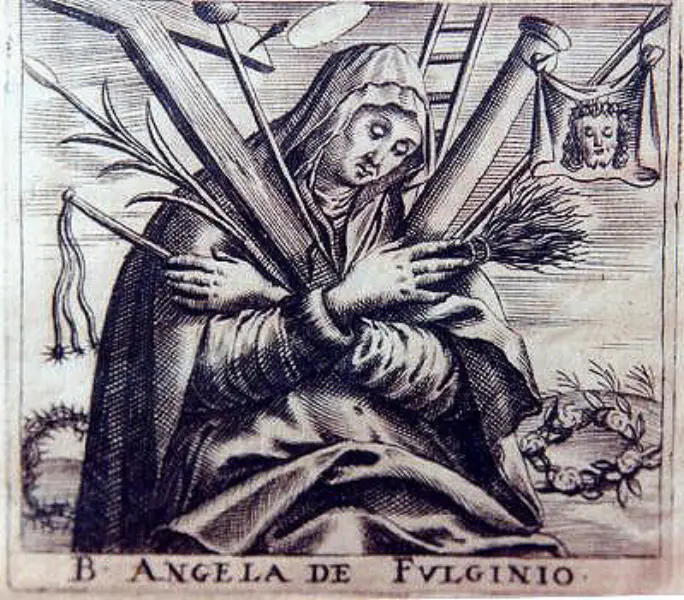
Overview
Angela of Foligno (c. 1248 - 4 January 1309) was an Italian Franciscan tertiary who became known as a mystic through her extensive writings about her mystical revelations — writings so respected in the Catholic Church that she became known as Theologorum Magistra, 'Teacher of Theologians,' a title first used by Maximilian Sandaeus and later cited by Bollandus in the Acta Sanctorum. Her birth, into a prosperous Foligno household in Umbria, was followed by marriage — perhaps while still young — and the birth of several children; by her own account she was in love with the world and its pleasures. At about forty, it is said, Francis of Assisi appeared to her in a vision, and she saw how empty her existence had been; from then on she pursued a more perfect way of life. Three years on, her mother died, and within months her husband and children followed; accompanied only by a serving woman, Masazuola, she set about stripping herself of her goods and living as a penitent. Around 1291, it seems, she entered the Third Order of St. Francis and put herself under the guidance of a Franciscan friar, Arnoldo, who became her confessor. Mystical revelations came to her, it is said, and in the late thirteenth century she dictated them to a scribe: the Memoriale, undertaken about 1292 and rendered into Latin by a friar identified only as Brother A., along with the thirty-six Instructions; the two together are customarily printed as Il Libro della Beata Angela da Foligno. From around 1296 the fame of her sanctity gathered a community of tertiaries, men and women, at Foligno; she founded for the women a community living the Third Order Rule with a common life but refusing enclosure, so that they could devote themselves to works of charity. She died on 4 January 1309.
The Complete Life
Wealth and the Vision of Francis
Angela was born around 1248 into a wealthy family of Foligno, the Umbrian town on the Via Flaminia a few miles from Assisi. She married, maybe while quite young, and bore several children, confessing in her own account a love for the world and its pleasures — the portrait of a comfortable, worldly life in thirteenth-century Italy. Around the age of forty came the break: a vision of Francis of Assisi, and with it the recognition of the emptiness of her life. The call was delayed but not denied; three years later the delayed cost was paid in full, as her mother died and then, a few months afterward, her husband and her children — the whole worldly establishment of her life removed in a single season.
§ Early life and conversion
Penitent and Tertiary
Attended by a single serving woman, Masazuola, Angela started giving away her belongings and living as a penitent — the Franciscan pattern of radical poverty lived out in the world. About 1291 she entered the Third Order of St. Francis and put herself under the guidance of a Franciscan friar, Arnoldo, as her confessor. The Franciscan connection governed her whole afterlife: her spirituality, her writing, her community, and her cult all stand in the penitential tradition that ran from Francis through the towns of Umbria, of which she became the greatest mystical voice.
§ Early life and conversion
The Memoriale and the Mystical Passages
Beginning about 1292, Angela dictated in her Umbrian dialect the story of her spiritual growth, the work we know as the Memoriale, which a Franciscan friar — in the text he is simply Brother A. — rendered into Latin. The work records her conversion and her passage through thirty stages of the spiritual life — the higher and more difficult final ten of which Brother A., unable to understand them fully, condensed into seven 'supplementary stages' that take up the larger portion of the book. By 1298 the text was complete and went to Cardinal James of Colonna and eight Friars Minor, whose approval it received; shortly afterward, in 1299-1300, Brother A. gave it a revision. The final version of her Book appends thirty-six Instructions reflecting her teaching to her followers, more conventional in tone, which may reflect redaction by several hands. The whole — the Memoriale and the Instructions — is the literary monument of one of the greatest of all medieval mystical writers, whose paradoxes of suffering and joy, darkness and union, earned her the title Teacher of Theologians.
§ Works and later life
The Community at Foligno
From about 1296 until her death early in 1309, Angela's reputation for sanctity drew to her side a circle of other tertiaries, men as well as women, who under her guidance pressed on toward holiness — a school of the spiritual life conducted by a woman holding neither office nor theology degree. In time she founded at Foligno a community of women tertiaries who, while declining enclosure, bound themselves to a common life in addition to the Third Order Rule, devoting their days to works of charity. The refusal of enclosure was deliberate and is her institutional legacy: sanctity, in her understanding, was to remain available to the poor at the door.
§ Works and later life
Death and Memory
Angela died on 4 January 1309 at Foligno, in the Papal States, in the odor of sanctity, with her community around her. Her Book circulated widely in the fourteenth century, and the respect it engendered only grew: Maximilian Sandaeus gave her the title Theologorum Magistra, the Bollandists printed her in the Acta Sanctorum, and generation after generation of mystics and scholars found in her dictation the most uncompromising account of the soul's passage into God that the Franciscan tradition produced.
§ Introduction
Beatification and Canonization
Angela was beatified by Pope Clement XI in Saint Peter's Basilica on 11 July 1701. On 9 October 2013 Pope Francis declared her a saint by equivalent canonization — the extension of liturgical veneration to the universal church without executing the ordinary judicial process — from the Apostolic Palace in Vatican City. Her feast is kept on 4 January, and on 7 January in the United States.
§ Introduction
Legacy
Angela's legacy is the Book and the community. As a mystic she stands beside Francis and Bonaventure in the Franciscan tradition and beside Catherine of Genoa and Teresa of Ávila in the wider lineage of the great women writers of the interior life; as a founder she left a model of tertiary life — common, poor, and unenclosed — that anticipated by centuries the active congregations of women. Her title, Teacher of Theologians, is the church's permanent verdict: the learned have sat at the feet of a widow of Foligno who could write only by dictation, and have been taught.
§ Works and later life
Timeline
- 1248
Born into a wealthy family at Foligno in Umbria; the date is not known with certainty.
§ Introduction
- 1291
Joined the Third Order of Saint Francis, placing herself under the direction of Friar Arnoldo.
§ Early life and conversion
- 1292
Began dictating her spiritual autobiography, the Memoriale, transcribed into Latin by Brother A.
§ Works and later life
- 1296
Brother A., her companion scribe, completed his work with her after recording the final supplementary stages.
§ Works and later life
- 1296
Gathered a community of tertiaries at Foligno, living a common life without enclosure for works of charity.
§ Works and later life
- 1298
Finished her Book, which won the approval of Cardinal James of Colonna and eight Friars Minor.
§ Works and later life
- 25 Dec 1308
At Christmas foretold her approaching death and received a vision of Christ promising to take her to heaven.
§ Works and later life
- 3 Jan 1309
Died in her sleep at Foligno, surrounded by her community of disciples.
§ Works and later life
- 11 Jul 1701
Beatified by Pope Clement XI at Saint Peter's Basilica.
§ Veneration
- 9 Oct 2013
Canonized by Pope Francis through equivalent canonization at the Apostolic Palace.
§ Veneration
In Their Own Words
No one can be saved without divine light. Divine light causes us to begin and to make progress, and it leads us to the summit of perfection. Therefore if you want to begin and to receive this divine light, pray.
This world is pregnant with God!
I possessed God so fully that I was no longer in my previous customary state but was led to find a peace in which I was united with God and was content with everything.
No matter how far the understanding of the soul is able to stretch itself, that is nothing in comparison to what it experiences when it is lifted beyond itself and placed in the bosom of God.
I saw a fullness, a brightness with which I felt myself so filled that words fail me, nor can I find anything to compare it with.
I believe there is no quicker or easier way for the soul to obtain this divine grace from God, supreme Good and supreme Love, than by a devout, pure, humble, continual, and violent prayer.
The Record
- Major works
- Memoriale (The Book of Visions and Instructions)·Instructions (thirty-six instructional texts)
- Patron of
- Against the death of children·Against family troubles·Widows·People ridiculed for their piety
- Symbols
- Franciscan tertiary habit·Book of revelations·Cross
- Canonization
- Beatified 11 July 1701 by Pope Clement XI; canonized 9 October 2013 by Pope Francis (equivalent canonization)
Prayer
Bibliography
Show 12 sources
- ↑ Calufetti, Abele (1992). Angela da Foligno mistica dell'Ognibene (in Italian). Paoline. p. 10. ISBN 978-88-315-0656-4 .
- ↑ Sandaeus, Maximilianus (1624). R.P. Maximiliani Sandaei Societatis Jesu Doctoris Theologi, ... Theologiae Pars Prima: Theologia-Varia Ad primam partem Summae D. Thomae Doctoris Angelici. uatuor libris, tum Profanae, tum Sacrae, Theologiae
- ↑ The Canonization of Angela of Foligno - Secular Franciscan
- 1 2 3 4 5 Robinson, Paschal. Bl. Angela of Foligno in The Catholic Encyclopedia , Vol. 1. New York: Robert Appleton Company, 1907. 11 Feb. 2014
- 1 2 Foley OFM, Leonard. Saint of the Day, Lives, Lessons, and Feast , Franciscan Media
- 1 2 McGinn 1998 , p. 143.
- ↑ "Angela of Foligno", Arizona State University Archived 22 February 2014 at the Wayback Machine
- ↑ "Angela of Foligno" . Franciscan Women: History and Culture . St. Bonaventure University . Archived from the original on 14 October 2013.
- ↑ Catherine M. Mooney, Angela of Foligno (2006) in Women and Gender in Medieval Europe: An Encyclopedia , New York: Routledge, p. 21.
- ↑ Holweck, Frederick George. A Biographical Dictionary of the Saints , B. Herder, 1924, p. 75
- ↑ McGinn 1998 , p. 144.
- ↑ Ghezzi, Bert. The Voices of the Saints , Crown Publishing Group, 2002, p. 38 ISBN 9780385507325
Profile text adapted from the Wikipedia article, licensed CC BY-SA 4.0.
Pray with this saint every day
Save St. Angela of Foligno to your favorites, read the full profile, and get feast-day reminders in the Saints app.
Get the Saints AppFree on the App Store for iPhone and iPad