
died 886·Feast July 27 (with the Seven Saints)
St. Angelar
Disciple of Cyril and Methodius, Slavic Enlightener
Overview
Angelar — in Greek, Angelarios; in Bulgarian, Angelariy — was a saint of medieval Bulgaria and a Slavic enlightener, counted among the foremost disciples of Saints Cyril and Methodius. With them, and with Saint Gorazd, Saint Clement of Ohrid, Naum of Preslav and Saint Sava of Bulgaria, he is venerated as one of the Seven Saints, the Sedmočislenici, the fathers of Slavic letters and church life. In Rome in 868, the bishops Formosus and Gauderic ordained him and Saint Sava deacons, while Gorazd, Clement and Naum received priestly ordination at the same hands. After Methodius' death in 885, Pope Stephen V outlawed the Slavic liturgy, and Wiching — installed as Methodius' successor — drove the disciples of the two brothers out of Great Moravia. Angelar escaped with Clement, Naum and other companions to the First Bulgarian Empire, dying there soon afterwards, probably in 886. His memory is kept on 27 July with the Seven Saints by the Bulgarian Orthodox Church and the Catholic Church alike.
The Complete Life
Among the Disciples
Almost everything known of Angelar is a single decade, the 870s and early 880s, seen from the side of his masters. He stood among the foremost of Cyril and Methodius' disciples, the Thessalonian brothers whom the emperor Michael III and the prince Rostislav had called to preach in Slavonic among the Moravians — whether he joined them from the first Moravian mission of 863 or came to them in the course of their work, the sources do not say. He belonged to that circle of younger men whom the brothers trained as the first Slavonic clergy: readers of the new alphabet, singers of the translated liturgy, copiers of the books. In 868 the whole company travelled to Rome, where Pope Hadrian II approved the Slavonic books; in Rome, in that year, the bishops Formosus and Gauderic ordained Angelar and Sava deacons, while priestly ordination at the same hands went to Gorazd, Clement and Naum — the date and ministers of his orders preserved where his birthplace and family are not.
Exile from Moravia
Methodius died in 885, and with him the protection that had held the Slavonic mission together. Pope Stephen V, reversing the policy of his predecessors, forbade the use of the Slavic liturgy; at Velehrad, Wiching, the German-leaning cleric installed as Methodius' successor, moved against the disciples of the dead archbishop, and the company that had made Slavonic a liturgical language were sold as slaves or driven into exile. With Saint Clement, Saint Naum and their companions, Angelar made his way southward into the First Bulgarian Empire, where prince Boris had received baptism and wanted the Slavonic church his teachers had promised. The road from Moravia to Pliska and Preslav was to be the hinge of Slavic civilization; Clement and Naum built at Ohrid and Preslav the schools and scriptoria that produced Cyrillic itself. Angelar reached the promised land only to lose his life in it.
Death in Bulgaria
In Bulgaria, probably in 886, Angelar died soon after his arrival — of the hardships of the flight, the sources imply, though nothing specific is recorded. His death, almost silent in the chronicles, was yet part of the foundation: the first of the exiles to be buried in the land that would carry their work, and a bond of blood between Moravian grief and Bulgarian glory. The survivors went on to immortality of a kind — Clement bishop of Velika and wonderworker of Ohrid, Naum the healer of the same lake country, Gorazd Methodius' designated successor in Moravia — while Angelar remained the quiet seventh. His cult is entirely bound up with theirs. The youngest accounts in the Lives of Clement give Angelar a place among those whom Boris settled near the capital before the schools were distributed, and his resting place was remembered in Bulgarian tradition among the first graves of the Slavonic church. Nothing further was written of him, and his biographers across ten centuries have had to be content with the company he kept and the feast he shares.
The Seven Saints
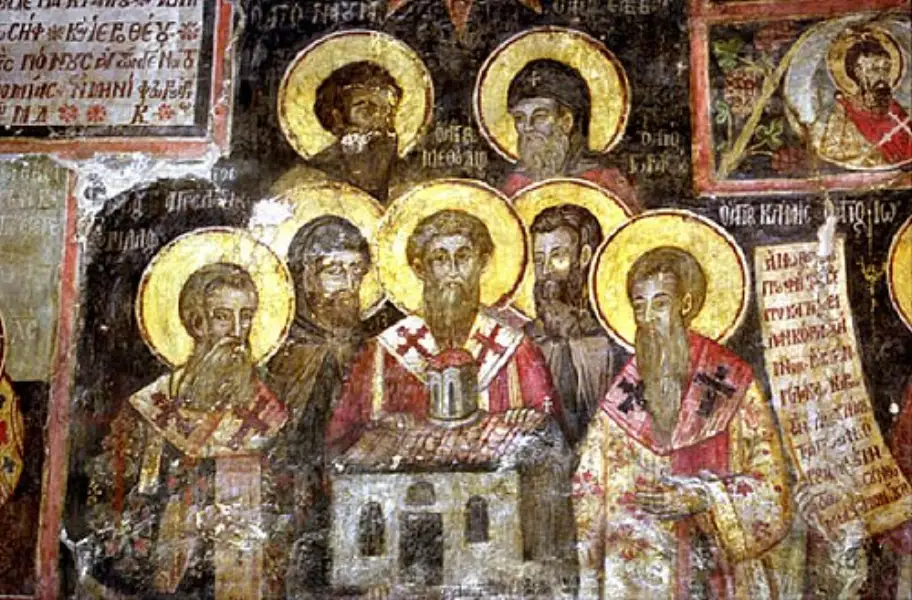
The Bulgarian Church, alongside the Catholic Church, sets 27 July as the day of the Seven Saints, the Sedmočislenici: Cyril and Methodius themselves with their five chief disciples Gorazd, Clement, Naum, Sava and Angelar. The joint feast, instituted in the modern period, gathers into one commemoration the whole invention of Slavic literacy — the alphabet, the translation, the liturgy, the schools, the exile. Frescoes of the seven together, Angelar among them, stand in monasteries from Athos to Ardenica in Albania, the deacon in the company of the bishops and teachers. He is also remembered in secular geography: St Angelariy Peak in Antarctica is named for him as the Bulgarian scholar-disciple of the ninth century. This profile is marked thin_source: his individual record is a few lines, and honesty forbids more.
Timeline
- 868
Ordained deacon in Rome by bishops Formosus and Gauderic
§ Introduction
- 885
Methodius dies; Pope Stephen V forbids the Slavic liturgy; Wiching exiles the disciples from Moravia
§ Introduction
- 886
Flees with Clement, Naum and others to Bulgaria; dies soon after arrival
§ Introduction
The Record
- Patron of
- Slavic letters·Bulgaria
- Symbols
- Deacon's vestments·Slavonic book
- Canonization
- Pre-congregation; honoured among the Seven Saints (Sedmočislenici)
Prayer
Profile text adapted from the Wikipedia article, licensed CC BY-SA 4.0.
Pray with this saint every day
Save St. Angelar to your favorites, read the full profile, and get feast-day reminders in the Saints app.
Get the Saints AppFree on the App Store for iPhone and iPad