
1185 – 1220·Feast May 5
St. Angelus of Jerusalem
Carmelite Priest and Martyr
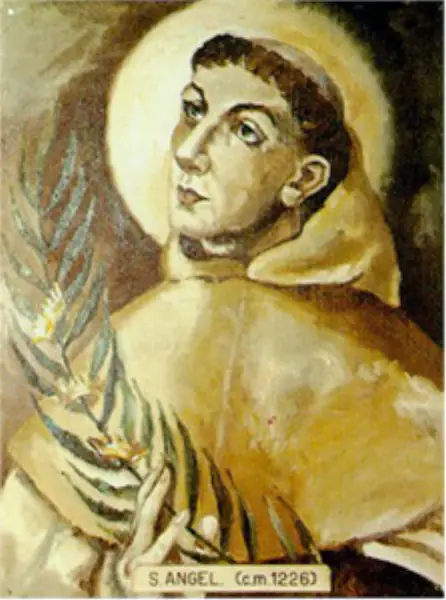
Overview
Angelus of Jerusalem, born in 1185 to Jewish parents in the holy city, was a Catholic convert, Carmelite priest, and martyr, one of the first friars of Mount Carmel to cross to the West. His mother's conversion to Christianity brought the baptism of Angelus and his twin brother John; orphaned as children, the twins were educated under the patriarch Nicodemus until eighteen, then entered the Carmelite convent of Saint Anne near the Golden Gate, gifted in Greek, Latin, and Hebrew. Ordained priest in Jerusalem in 1210 and noted for miraculous cures, Angelus withdrew as a hermit to Mount Carmel when his fame grew, until in 1218 he was instructed to leave for Italy, to preach against the patarini, Albigensians, and Bulgars, and to obtain from Pope Honorius III confirmation of the Carmelite rule. Sailing in April 1219, he preached at Rome's Lateran basilica, meeting Francis of Assisi and Dominic, each foretelling the other's future; healed lepers and the archbishop of Palermo in Sicily; and converted Jews, incurring the hatred of the community he had left. At Licata, attacking the incestuous life of a Cathar knight named Berenger, he was assaulted before the church of Santi Filippo e Giacomo on 1 May 1220 and died of his wounds on the 5th, asking pardon for his murderer. His cult was approved around 1459.
The Complete Life
A Convert's Childhood in Jerusalem
Angelus was born at Jerusalem in 1185, a twin, into a Jewish family of the holy city in the generation after Saladin's reconquest, when the Kingdom of Jerusalem had shrunk to a coastal strip and the city's religious communities lived close and warily together. His mother's conversion to Christianity decided the children's course: she brought them to baptism, Angelus and his brother John entering the Catholic church as their mother had, and when the parents died while the twins were still children, the patriarch Nicodemus took charge of their education, an arrangement that gave the boys both a patron and a formation in the church of the crusader kingdom. At eighteen they received the habit of the Carmelites, the Brothers of Our Lady of the mountain, at the house of Saint Anne by the Golden Gate, the hermits of Carmel being then at the point of becoming a mendicant order. The brothers' gifts were linguistic, Greek, Latin, and Hebrew, the three tongues of their world, and the Hebrew of a convert would prove the most dangerous of the three.
§ Life
Hermit of Carmel and Mission to the West
Ordained priest at Jerusalem in 1210, Angelus traveled and preached in Palestine, and the cures attributed to him began to gather crowds; his acts record that he shrank from renown and went out to a desert hermitage, taking up the solitary life on Carmel itself. The withdrawal ended in 1218 with a double instruction: to go to the Italian peninsula to preach against the patarini, the Albigensians, and the Bulgars, the dualist heresies then troubling the West, and to obtain from Pope Honorius III his confirmation of the order's new and final rule, the confirmation granted at last in 1226. His passage from the East came aboard a Genoese vessel on 1 April 1219, with calls at Messina and Civitavecchia before Rome, where he preached in the Basilica of Saint John Lateran and met Francis of Assisi and Dominic de Osma, the three founders' generation gathered in one city: it is said that Angelus foretold to Francis the stigmata, and Francis foretold to him his death.
§ Life
Sicily
From Rome, Angelus went as a guest of the Basilians at Palermo, staying over a month, and then preached at Agrigento before settling at Licata. His Sicilian ministry has the shape his acts give all his work: healing, seven lepers cured at Palermo, and the archbishop Bernardo de Castanea relieved of illness; preaching against the heresies he had been sent against; and the conversion of Jews, at which he had some success and which earned him the hatred of most of the Jewish community of Palermo, unable, the sources say, to forgive in him the apostate. It is the darkest strand of the legend and must be reported as it stands: a convert's ministry that turned on the community of his birth. His last conflict was with a Cathar knight of Licata named Berenger, whom the tradition describes as living in incest; Angelus persuaded the knight's companion to leave him, and and Berenger, enraged, set upon the friar before the doors of the church of Saints Philip and James, 1 May 1220.
§ Life
Death at Licata
Angelus lingered for some days and died on 5 May 1220, at thirty-five, asking, the tradition insists, that his murderer be spared, and pleading with the faithful to shed no blood for his, the counsel that most clearly fixed his sanctity in the church's memory. His burial took place at Santi Filippo e Giacomo, and from the very first the sepulcher at Licata drew pilgrims. The Carmelites venerated him as a saint from the beginning, the formal record showing the cult among them from at least 1456 and its approval by Pope Pius II during his pontificate, around 1459. The relics had a restless afterlife appropriate to the age: carried from a wooden coffin to a silver urn in 1486, to a yet costlier urn in 1623, and translated into the Carmelite church in 1632; they are now housed at the Santuario della Madonna del Carmine in Catania. When the plague lifted from the Kingdom of Naples in 1656, the deliverance was credited to his intercession, and Palermo claims him as its patron.
§ Veneration
Legacy
Angelus matters in the Carmelite story above all as the link between the first and second ages of the order: a friar actually formed on Carmel, in the Jerusalem of the hermits, who crossed to the West, carried the order's rule to the pope, and died a martyr in Sicily before the order's European transformation was complete. In the order's iconography he is fixed with the instruments of his death, the knife or sword, together with the crucifix and the palm, and the meeting with Francis and Dominic at Rome made him a standing figure in the group-portraits of the thirteenth century's founders. The modern reader must hold two things at once, as the sources hold them: the martyr who forgave his murderer, and the convert whose anti-Jewish preaching the same sources report with an approval the present cannot share. The Carmelites keep his feast on 5 May, and the sanctuary at Catania keeps his relics.
§ Life
Timeline
- 1185
Born in Jerusalem to Jewish parents; his twin brother is John
§ Life
- 1210
Ordained to the priesthood in Jerusalem, then travels and preaches through Palestine
§ Life
- 1218
While a hermit on Mount Carmel, instructed to sail for Italy and seek papal confirmation of the Carmelite rule
§ Life
- 1 Apr 1219
Departs on a Genoese ship, stopping at Messina and Civitavecchia before reaching Rome, where he meets Francis and Dominic
§ Life
- 1220
After stays in Palermo and Agrigento, settles at Licata while crowds flock to the famed healer
§ Life
- 1 May 1220
Attacked by Berenger's men before the church of Santi Filippo e Giacomo at Licata
§ Life
- 5 May 1220
Dies of his wounds within the week, pardoning his attacker and asking that no vengeance be taken
§ Life
- 1459
Pope Pius II grants papal approval to his longstanding cult during his pontificate
§ Veneration
- 1486
His remains are moved from a wooden casket into a silver urn
§ Veneration
- 5 May 1623
His relics are transferred into a more precious urn
§ Veneration
- 4 May 1626
Proclaimed patron saint of Palermo
§ Veneration
- 1632
His relics are translated to the Carmelite Church, now a Catania sanctuary of Our Lady of Mount Carmel
§ Veneration
- 1656
Cessation of a raging plague around Naples is credited to his intercession
§ Veneration
The Record
- Patron of
- Palermo·Converts·Licata
- Symbols
- Carmelite habit and rule·Knife in his head or sword in his breast·Crucifix·Martyr's palm
- Canonization
- Cult approved by Pope Pius II around 1459, after centuries of Carmelite veneration
Prayer
Bibliography
Show 6 sources
- 1 2 3 4 "Saint Angelus of Jerusalem" . Saints SQPN. 5 May 2017 . Retrieved 13 October 2017 .
- 1 2 3 4 5 "Sant'Angelo da Gerusalemme (di Sicilia)" . Santi e Beati . Retrieved 13 October 2017 .
- 1 2 Butler, Alban. "St. Angelus, Carmelite Friar, Martyr", The Lives of the Saints . 1866
- 1 2 3 "St. Angelus", The British Province of Carmelites
- ↑ Drane, Augusta Theodosia. The History of St. Dominic, Founder of the Friars Preachers , Longmans, Green and Company, 1891, p. 161
- ↑ "Celebrating St Angelus, Priest and Martyr", Carmelites of Australia and Timor-Leste, May 5, 2021
Profile text adapted from the Wikipedia article, licensed CC BY-SA 4.0.
Pray with this saint every day
Save St. Angelus of Jerusalem to your favorites, read the full profile, and get feast-day reminders in the Saints app.
Get the Saints AppFree on the App Store for iPhone and iPad