
c. 1280-1368·Feast June 24
St. Anna of Kashin
Right-Believing Princess and Schema-Nun
Overview
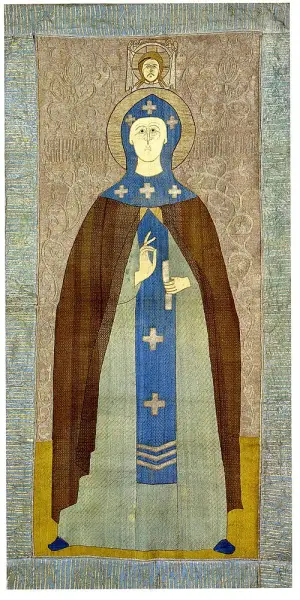
Anna of Kashin, born around 1280, a daughter of Prince Dmitry Borisovich of Rostov, became princess consort of Mikhail of Tver and is venerated as a Right-Believing princess and the patroness of Kashin and Tver. Raised strictly Christian and taught humility and obedience by Bishop Ignatius of Rostov, she married Mikhail on 8 November 1294 in Tver's Transfiguration cathedral and bore five children. Her fate was dramatic: her husband was murdered at the Golden Horde in 1318, and in the internecine strife of the following decades she lost almost all her relatives, including her sons Dmitry and Alexander, both killed in the Horde's struggles with Moscow. Enduring every loss, she ended her life in monasticism, taking the schema with her own baptismal name Anna, and died at Kashin on 2 October 1368, aged about eighty-eight. Her posthumous path was no less complicated: canonized by the Russian Church in 1650, she was decanonized in 1677 amid the schism of the Old Believers — a unique precedent — and her veneration was restored in 1908-1909, with crowded celebrations at Kashin the following year.
The Complete Life
Early Life and Marriage
Anna was a daughter of Prince Dmitry Borisovich of Rostov and a great-granddaughter of Prince Vasily of Rostov, born around 1280 into the highest rank of the northern Russian princely families. From her earliest years she received a strictly Christian upbringing, with humility and obedience held up as the cardinal virtues; Ignatius, bishop of Rostov, was the teacher who formed her — he died in 1288, remembered for strict selflessness and pacifism. Like all royal daughters of her time she learned the different kinds of needlework, the craft of a princess's household. When she grew up, Princess Xenia of Tver, second wife of Grand Prince Yaroslav of Tver, sent ambassadors to Rostov to ask for Anna's hand on behalf of her son Mikhail. The match was made: Anna married Prince Mikhail, and on 8 November 1294 the two were wed in the Preobrazhensky cathedral of Tver; to mark the celebration the dwellers of Kashin built the St Michael Church and triumphal gates from their Kremlin to the Tver road.
§ Life
Wife and Mother
Anna and Mikhail had five children: Feodora, who died in infancy; Dmitry of Tver (1299-1326); Alexander of Tver (1301-1339); Konstantin; and Vasily. Her vocation in those years was the ordinary extraordinary one of a princess: the household of a rival principality in the shadow of the Horde, the raising of sons trained for war and diplomacy, the almsgiving and church-building expected of her rank. The turn came in 1318, when Mikhail went to the Golden Horde to answer the accusations of his enemies and was murdered there — the prince later canonized as a martyr-passion-bearer of Tver. Anna's widowhood lasted fifty years, and it was a Via Crucis: Dmitry was executed at the Horde in 1326, Alexander with his son Fyodor in 1339, and in the internecine strife of the age she lost almost all her relatives. The Russian Church remembers her precisely for this endurance. Kashin's later devotion began with that endurance: the widow-princess who had buried nearly everyone she loved.
§ Life
Monastic Elder and Death
In her last years Anna withdrew to Kashin, the town of her son's principality, and received monastic tonsure, taking the great schema — the fullest angelic image — with her own baptismal name, Anna. The schema-nun princess lived her final year in prayer at Kashin, mute in the tradition of her old age's silence, and died on 2 October 1368, aged about eighty-eight, having outlived husband, sons, and the world's expectation. She was buried in the Dormition cathedral of Kashin, where her relics rested; their opening in the seventeenth century, with the report that her right hand blessed with the two-fingered sign of the old Russian practice, became the center of the controversies that followed her canonization. The blessing hand, opened after her death, would make her relics an argument between churches — but Kashin itself never doubted the princess it had buried.
§ Introduction
Canonized, Decanonized, Restored
Anna's posthumous fate has no parallel. Canonization came from the Russian Orthodox Church in 1650, and at Kashin the young cult grew fast. Then came the struggles of the seventeenth-century church schism, and these led Patriarch Joachim of Moscow to decanonize her in 1677 — the only case of its kind in the story of the Russian Church. The reason was political-liturgical: the Old Believers claimed her incorrupt right hand, preserved blessing with two fingers, as proof of the old rite, and the official church, having changed to the three-fingered sign, suppressed her cult rather than let it serve the schismatics. Her sainthood was officially restored by Nicholas II in 1908, and in the following year Kashin kept crowded festivities to mark the veneration's restoration; the modern calendar keeps her feast on 24 June, the opening of her relics, with 2 October also observed.
§ Introduction
Legacy
Anna of Kashin stands in the Russian Church's memory in two registers at once. As a saint she is the patroness of widows and orphans and of Kashin and Tver, the mother who buried the martyrs of her house and forgave what she could not repair; her icon in the Cathedral of Christ's Resurrection at Kashin is the focus of a living local cult, and pilgrims still come to her relics. As a historical figure she is the unique saint decanonized and re-canonized, her hand made an argument in the liturgy wars of the seventeenth century and her restoration, under the last tsar, a sign of the church's wish to heal those divisions. Her life is a lesson in how sanctity can be inseparable from politics and still remain sanctity. Pilgrims still come to the Cathedral of Christ's Resurrection, and every 12 June a procession carries her icon through the town.
§ Introduction
Timeline
- 1280
Born at Rostov, a daughter of Prince Dmitry Borisovich
§ Introduction
- 8 Nov 1294
Marries Prince Mikhail of Tver in the Preobrazhensky cathedral
§ Life
- 22 Nov 1318
Her husband Mikhail is tortured to death at the Horde
§ Life
- Jul 1319
Learns of her husband's fate and has his remains brought from Moscow to burial at Tver
§ Life
- 1325
Her eldest son Dimitry is tortured to death in the Horde
§ Life
- 1327
Her son Alexander routs a Tartar army; Uzbeg Khan razes Tver in revenge and Alexander takes refuge in Pskov
§ Life
- 1339
Alexander and his son Feodor are killed by the Horde
§ Life
- 1365
Moves to Kashin at her son Vasiliy's urging and receives the schema at the new Uspensky monastery under the name Anna
§ Life
- 2 Oct 1368
Dies of old age at Kashin and is buried in the cathedral church of the Blessed Virgin
§ Life
- 1611
During the Lithuanian siege of Kashin she appears to the sexton Gerasim, and her relics are reported to work miracles
§ Canonization and Veneration
- 1649
A synod of the Russian Orthodox Church finds her relics deserving of universal veneration and glorifies her as a saint
§ Canonization and Veneration
- 1650
Canonized by the Russian Orthodox Church
§ Introduction
- 1677
Patriarch Joachim has her cult suppressed because of the esteem she enjoyed among Old Believers
§ Canonization and Veneration
- Jan 1678
A Grand Synod at Moscow re-affirms her decanonization and forbids asking her intercession
§ Canonization and Veneration
- 7 Nov 1908
An imperial decree given on this date restores church-wide veneration of her
§ Canonization and Veneration
- 1909
A monastic community is dedicated to her at Grozny
§ Canonization and Veneration
- 11 Apr 1909
The Most Holy Synod designates 12 June as her memorial day
§ Canonization and Veneration
- 12 Jun 1909
Crowded celebrations at Kashin, attended by Grand Duchess Elizabeth Feodorovna, mark the restored cultus
§ Canonization and Veneration
- 1910
A church is consecrated in her name at St Petersburg
§ Canonization and Veneration
- 18 Apr 2023
The Tver City Duma names a square before the new Wedding Palace in her honor
§ Canonization and Veneration
The Record
- Patron of
- Widows and orphans·Kashin and Tver
- Symbols
- Princess's robes and monastic schema·Icon showing her blessing with two fingers
- Canonization
- Canonized 1650; suppressed 1677 by Patriarch Joachim; veneration restored in 1908-1909 under Nicholas II
Prayer
Bibliography
Show 8 sources
- ↑ Мария Дегтярёва (3 August 2013). "Святая Анна Кашинская - житие, молитва, в чем помогает, где находятся мощи, икона св. Анны" . www.pravmir.ru (in Russian). И сегодня святая благоверная княгиня Анна Кашинская остается верной спутницей и з
- ↑ Галина Бесстремянная (9 July 2009). " "Радуйся, градов Твери и Кашина и всея земли нашея украшение" " . pravoslavie.ru (in Russian).
- ↑ Greene, Robert H. (2006). "Making Saints: Canonization and Community in Late Imperial Russia" . The Carl Beck Papers in Russian and East European Studies (1801): 67. doi : 10.5195/cbp.2006.130 . ISSN 2163-839X .
- 1 2 3 4 5 Bushkovitch, Paul (1992-05-28). Religion and Society in Russia: The Sixteenth and Seventeenth Centuries . Oxford University Press. ISBN 978-0-19-536152-0 .
- 1 2 Chulos, Chris; Piirainen, Timo (2017-12-01). The Fall of an Empire, the Birth of a Nation: National Identities in Russia . Routledge. ISBN 978-1-351-77892-3 .
- ↑ White, James (2020-11-03). Unity in Faith?: Edinoverie, Russian Orthodoxy, and Old Belief, 1800–1918 . Indiana University Press. ISBN 978-0-253-04971-1 .
- ↑ Tracy, James D.; Ragnow, Marguerite (2004-10-25). Religion and the Early Modern State: Views from China, Russia, and the West . Cambridge University Press. ISBN 978-0-521-82825-3 .
- ↑ "В Твери появилась площадь имени святой Анны Кашинской" . Тверская и Кашинская епархия . 2023-04-24. Archived from the original on 2023-06-02 . Retrieved 2023-06-02 .
Profile text adapted from the Wikipedia article, licensed CC BY-SA 4.0.
Pray with this saint every day
Save St. Anna of Kashin to your favorites, read the full profile, and get feast-day reminders in the Saints app.
Get the Saints AppFree on the App Store for iPhone and iPad