
c. 1563-1601·Feast February 27 (individual); October 25 (Forty Martyrs); August 30 (with Ward and Clitherow)
St. Anne Line
Laywoman and Martyr
Overview
Anne Line, born Alice Higham (or Heigham) around 1563, the eldest daughter of the Puritan William Higham of Jenkyn Maldon in Essex, was an English Catholic martyr executed at Tyburn on 27 February 1601 for sheltering clandestine priests. During the early 1580s she entered the Roman Catholic Church together with her brother William and with Roger Line, whom she wed in February 1583; both men were disinherited for converting, and Alice lost her dowry. Among Catholics the married 'Alice' became known as 'Anne,' presumably a name taken at her conversion. Her husband and brother were arrested together at Mass, imprisoned, and fined; William was released on surety, but Roger was banished to Flanders; from there the King of Spain paid him a small allowance, out of which he sent money to his wife up to his death in about 1594. The newly widowed Anne, despite chronic ill-health, was put in charge of the house of refuge for hiding priests opened by the Jesuit John Gerard, and ran it for about three years while Gerard was in prison — continuing even after his escape from the Tower made her too well known, hiring apartments elsewhere and sheltering priests there. On the feast of the Purification, 2 February 1601, she allowed an unusually large number of Catholics in for Mass; neighbors noticed the crowd, and constables raided the house during the blessing of candles. The priest, Francis Page, escaped through the hiding place she had prepared; Anne Line was arrested. Tried at the Old Bailey on 26 February — fever had left her so weak that she had to be carried into court in a chair — she said her one sorrow was that she had not been able to receive a thousand more such priests. Sir John Popham condemned her to death for the felony of helping a seminary priest, and she went to the gallows at Tyburn on 27 February, immediately before the priests Roger Filcock and Mark Barkworth, declaring at the scaffold that she wished she had entertained a thousand.
The Complete Life
A Puritan's Daughter
Alice Higham was born around the early 1560s, the eldest daughter of William Higham of Jenkyn Maldon in Essex, a Puritan gentleman whose father Roger Heigham had been a Protestant reformer in Parliament under Henry VIII. She was raised a strict Protestant in the heart of the Elizabethan settlement. In the early 1580s, nonetheless, she converted to the old faith, together with her brother William and with Roger Line, whom she married in February 1583 — the conversion and the marriage of a Puritan heiress to a Catholic being apparently of a piece. The cost was immediate and total: Roger Line and William Higham were disinherited, and Alice lost her dowry. Among Catholics she took the name Anne, presumably at her conversion.
§ Biography
Widow and Harborer
The Elizabethan penal laws made the mere presence of a Catholic priest in England a felony, and the sheltering of one the same. Roger Line and William Higham were arrested together at Mass, imprisoned, and fined; Roger was banished and went to Flanders; there the King of Spain paid him a small allowance, out of which he sent money to his wife up to his death in about 1594. The young widow, chronically ill, was then given the most dangerous work the English Catholic underground offered: John Gerard, the Jesuit who organized so much of the mission's logistics, put her in charge of one of his houses of refuge for hiding priests. She ran it for about three years while Gerard was in prison and the Tower, and after his escape — by then too well known to be safe in any house he could visit — she hired apartments in another building and went on sheltering priests on her own.
§ Biography
Candlemas, Trial, and Tyburn
On the feast of the Purification — Candlemas, 2 February 1601 — Anne let in a remarkably large number of Catholics for the rite of candle blessing and the Mass. Neighbors noticed the crowd; the constables burst in during the rite. The priest, Francis Page, slipped into the hiding place Anne had prepared and escaped, but she was arrested, with Margaret Gage, who was later released. Anne was sent to Newgate. Tried at the Sessions House on Old Bailey Lane on 26 February, she was so weakened by fever that she had to be carried into the courtroom in a chair. Her statement to the court was that far from regretting she had concealed a priest, her only sorrow was that she had not been permitted to receive a thousand more. The sentence of death for the felony of helping a seminary priest came from Sir John Popham. The next day, 27 February 1601, she died at the Tyburn gallows just ahead of two priests, Roger Filcock and Mark Barkworth, who had the full sentence — hanging, drawing, and quartering — carried out on them; she repeated her declaration word for word from the scaffold to the crowd.
§ Arrest and execution
Beatification and Canonization
Pope Pius XI beatified Anne Line on 15 December 1929, and Pope Paul VI canonized her on 25 October 1970 among the Forty Martyrs of England and Wales. Her own feast day is 27 February; she is commemorated with the Forty on 25 October, and with Saints Margaret Ward and Margaret Clitherow — the three women of the Forty — on 30 August. She is venerated in the Catholic Church and remembered in the Anglican Communion among the martyrs of the Reformation era. It has even been argued that Shakespeare alluded to her death in his writing, so deeply did the Tyburn executions of 1601 mark the public mind.
§ Introduction
Legacy
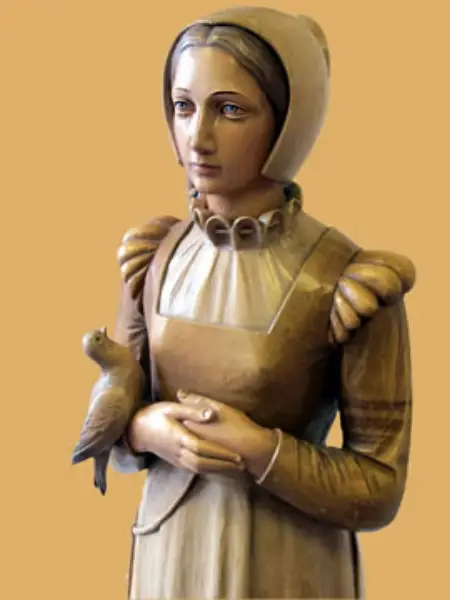
Anne Line's legacy is the laywoman's share in the English martyrdoms: not a priest, not a religious, but a sick and disinherited widow whose house was the church's only refuge in her corner of London. With Ward and Clitherow she represents the women who kept the Catholic mission of England alive at the level of lodgings, landladies, and locked rooms — the infrastructure of persecution. Her statue stands today at the school in Basildon that bears her name, and her dying wish — a thousand priests entertained — is the line by which the tradition has always kept her.
§ Veneration
Timeline
- 1563
Born as Alice Higham in Essex, eldest daughter of the Puritan William Higham, around the early 1560s
§ Biography
- Feb 1583
Converts to Catholicism with her brother William and marries Roger Line, both being disinherited for it
§ Biography
- 1594
Widowed when Roger Line dies in Flanders around this year; John Gerard puts her in charge of a house hiding priests
§ Biography
- 2 Feb 1601
Arrested when constables raid her house during Candlemas Mass; the priest Francis Page escapes through her hiding place
§ Arrest and execution
- 26 Feb 1601
Carried to trial at the Old Bailey too weak with fever to walk; Sir John Popham sentences her to death
§ Arrest and execution
- 27 Feb 1601
Hanged at Tyburn for harbouring a priest, immediately before the priests Roger Filcock and Mark Barkworth
§ Arrest and execution
- 15 Dec 1929
Beatified by Pope Pius XI
§ Veneration
- 25 Oct 1970
Canonized by Pope Paul VI as one of the Forty Martyrs of England and Wales
§ Veneration
In Their Own Words
I am sentenced to die for harbouring a Catholic priest, and so far I am from repenting for having so done, that I wish, with all my soul, that where I have entertained one, I could have entertained a thousand.
The Record
- Patron of
- Childless people·Converts·Widows
- Symbols
- Dove·Noose·Book or Bible
- Canonization
- Beatified 15 December 1929 by Pope Pius XI; canonized 25 October 1970 by Pope Paul VI
Prayer
Bibliography
Show 12 sources
- 1 2 Martin Dodwell, "Revisiting Anne Line: Who Was She and Where Did She Come from", Recusant History , Vol. 31, No. 3 (May 2013), pp. 375-89. London: Catholic Record Society.
- ↑ Conelly, Roland (1997). Women of the Catholic Resistance in England, 1540-1680 . The Pentland Press. pp. 107– 111. ISBN 1858215099 .
- ↑ Robert E. Scully SJ in Weber, Alison (2016). Devout Laywomen in the Early Modern World (Women and Gender in the Early Modern World) . London: Routledge. p. Chapter 13. ISBN 9781472424914 .
- ↑ Kelly, Christine J., "Anne Line" , ODNB; online edition, January 2009, accessed 11 March 2013.
- 1 2 3 Dodwell, Martin. Anne Line: Shakespeare's Tragic Muse . Brighton: The Book Guild, 2013.
- ↑ "Oct 25 - St Anne Line d.1601 - Catholicireland.net" . Catholicireland.net . Retrieved 28 August 2018 .
- ↑ John Gerard S.J. The Autobiography of an Elizabethan , p.84. Oxford: Family Publications, 2006.
- ↑ Quinn, Stanley. "St. Anne Line." The Catholic Encyclopedia . Vol. 9. New York: Robert Appleton Company, 1910. 25 December 2012
- ↑ Times Literary Supplement , 18 April 2003, p.12-14
- ↑ Longworth, Clara, My Shakespeare, Rise! , London: 1935
- ↑ "General Convention Virtual Binder" . www.vbinder.net . Archived from the original on 13 September 2022 . Retrieved 22 July 2022 .
- ↑ "St Anne Line Catholic Junior School – Wickhay, Basildon, Essex SS15 5AF" . www.st-anneline-jun.essex.sch.uk . Archived from the original on 7 April 2016 . Retrieved 28 August 2018 .
Profile text adapted from the Wikipedia article, licensed CC BY-SA 4.0.
Pray with this saint every day
Save St. Anne Line to your favorites, read the full profile, and get feast-day reminders in the Saints app.
Get the Saints AppFree on the App Store for iPhone and iPad