
died 657/658·Feast September 28
St. Annemund
Archbishop of Lyon, Martyr
Overview
Annemund — also Annemundus, Aunemundus, Ennemond or Chamond — was archbishop of Lyon in the turbulent middle decades of the seventh century, a royal counselor who died by political murder. Born into a Gallo-Roman family of the old aristocracy (his father Sigon was a prefect of Lyon, his brother Dalfin count of the city), he succeeded Viventius as bishop between 652 and 654, under Clovis II. He served as a councillor of the young king and was a friend and supporter of the young Wilfrid, the future bishop of York, whom he harbored during the Englishman's first journey to Rome. Caught in the factional warfare around the Merovingian court, he was slandered as a traitor after failing to attend a gathering of officials at Orleans, and on the order — Bede says — of Queen Balthild, at the instigation of the mayor of the palace Ebroin, he was beheaded near Chalon-sur-Saône on 29 September 658. His remains were carried back to Lyon and lie in the church of Saint-Nizier. His cult marked the landscape: Saint-Chamond and Saint-Ennemond in Allier both carry his name, and a tradition credits him with the first idea of calling people to church by ringing bells.
The Complete Life
An Aristocrat of Lyon
Annemund was born into the governing class of seventh-century Lyon. His father Sigon held the prefecture of the city; his brother Dalfin was count of Lyon; later texts add that the brother was prefect of Gaul, though contemporary notices by Eddius Stephanus and Bede do not mention him. The family was Gallo-Roman in self-presentation, though the name itself is Germanic, of the kind common in Burgundy since the late fifth century — a detail that reminds the reader how thoroughly Frankish and Roman families had merged by this date. For such a family the church and the court were the two ladders, and Annemund's climb used both: a see for himself, positions for his kin, and access to the king that made him a political figure as well as a pastor.
Bishop under Clovis II
Annemund received the church of Lyon — the primatial see of Gaul, whose archbishops still claimed a seniority going back to the martyrs of 177 — between 652 and 654, succeeding Viventius during the reign of Clovis II. The kingdom he served was Merovingian in its most dysfunctional period: boy-kings, dominant mayors of the palace, and an aristocracy fighting itself through the institutions of church and state. Annemund became a councillor of Clovis, one of the bishops through whose hands the young king's government actually ran. The tradition also gives him quieter work: the evangelization of the country around Castellum Sancti Admundi, the future Saint-Chamond in the Loire hills, whose church still keeps one of his relics. And it gives him a famous guest: Wilfrid of York, on his first journey to Rome as a young man, whom Annemund befriended and — according to the Life — offered to make an adopted son and advance at court, and whom he protected when the queen-mother took against the traveler.
Murder at Chalon
The end came through faction. Absent from a meeting of Frankish officials at Orleans, Annemund found himself denounced there as a traitor against the king. Ordered to appear before the court, he was taken and beheaded near Chalon-sur-Saône on 29 September 658 by men acting for Ebroin, the ruthless mayor of the palace; Bede records that the order came from Queen Balthild herself. Which of the two drove the killing, and why, the sources do not settle — the politics of the 650s are visible to us only in fragments — but the pattern is a familiar one: a bishop too powerful to leave alive when the balance shifted. His body was brought back up the Saône to Lyon and buried; Genesius succeeded him. The church read his death as martyrdom, and the calendars gave him 28 September, the eve of the day he fell.
Cult
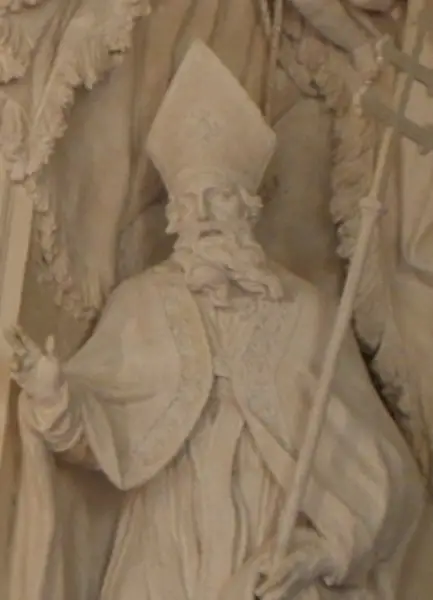
Annemund's cult spread from his tomb at Lyon and from the places that took his name. The church of Saint-Nizier in Lyon kept his body; Bellegarde-en-Forez and Champdieu revered him; the towns of Saint-Ennemond (Allier) and Saint-Chamond (Loire) carry his memory in their very names — a fact that alone secured his survival in the landscape. At Saint-Étienne, in the church of Saint-Ennemond, a statue depicts him wearing episcopal robes and grasping a codex of the Bible. The Roman Martyrology lists him, with his feast kept on 28 September.
Legacy
Two small legends round out his memory. The first credits Annemund with conceiving the ringing of church bells to call the faithful to worship — an anachronism, but one that shows how his cult attached itself to the ordinary furniture of parish life; the same legend says that when his body was brought back to Lyon all the churches rang their bells at once. The second is the honor paid him by his contemporaries: Bede, far away in Northumbria, thought the murder of the Lyon archbishop worth recording. His real legacy is that of the seventh-century episcopate as a whole — Roman aristocrats governing Frankish kingdoms, patronizing saints' cults and foreign pilgrims, and dying, when the politics required it, by the axe at the roadside.
Timeline
- 653
Takes over the church of Lyon from Bishop Viventius, sometime between 652 and 654 under King Clovis II
§ Biography
- 29 Sep 658
Slandered as a traitor after missing an assembly at Orleans and beheaded near Chalon-sur-Saône by men of Ebroin
§ Biography
- 658
His remains are carried back up the Saône to Lyon and enshrined in the church of Saint-Nizier
§ Biography
The Record
- Patron of
- Saint-Chamond·Saint-Ennemond
- Symbols
- Bishop's vestments·Codex of the Bible (as in his statue)·Palm of martyrdom
- Canonization
- Pre-congregation; enrolled in the Roman Martyrology
Prayer
Profile text adapted from the Wikipedia article, licensed CC BY-SA 4.0.
Pray with this saint every day
Save St. Annemund to your favorites, read the full profile, and get feast-day reminders in the Saints app.
Get the Saints AppFree on the App Store for iPhone and iPad