
c. 1010-1075·Feast December 4
St. Anno II
Archbishop of Cologne, Regent of the Empire
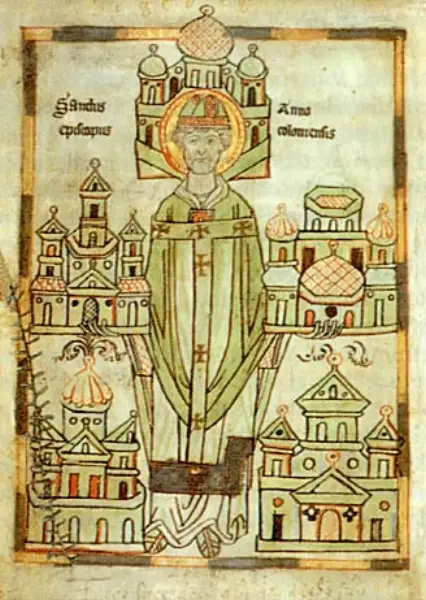
Overview
Anno II, born around 1010 to the edelfrei Steusslingen family at Altsteußlingen in Swabia, was Archbishop of Cologne from 1056 until his death on 4 December 1075, and from 1063 to 1065 regent of the Holy Roman Empire for the minor emperor Henry IV. Educated at Bamberg, where he became head of the cathedral school, he entered the imperial service as chaplain to Henry III in 1046, accompanying the emperor's Hungarian campaigns, and was made provost of the new cathedral of Goslar in 1054 and archbishop of Cologne two years later. His dominant position at court let him place relatives in sees — his nephew Burchard at Halberstadt, his brother Werner at Magdeburg. Contemporaries describe an ascetic life open to reform joined to a fearsome adversarial streak in defence of his church's interests; his attempted seizure of Malmedy failed, but he founded the Benedictine abbey of Michaelsberg at Siegburg, a centre of the Cluniac reform in Germany. After Henry III's death he shared the regency, seizing the young king in 1062 at Kaiserswerth. He died at Siegburg and was canonized in 1183.
The Complete Life
Early Life
Anno was born around 1010 at Altsteußlingen near Ehingen in Swabia, into an edelfrei family — free nobles of the old stamp, neither counts nor ministeriales. His schooling was at Bamberg, the emperor Henry II's great foundation on the Regnitz, then the most modern school in Germany; he rose to head its cathedral school, training boys in the liberal arts he would later patronize with abbey revenues. In 1046 he entered the chapel of Henry III, the Sicilian-born emperor whose reforming court was gathering the best churchmen of the realm. Anno accompanied the imperial campaigns against Andrew I of Hungary in 1051 and 1052, learning the geography of power. In 1054 he was appointed provost of the newly erected cathedral of Goslar, the emperor's favourite foundation at the Harz silver mines, and two years later, with Henry III's death imminent, he was elevated to the archbishopric of Cologne, one of the premier sees of the north.
Reform and Power
As archbishop, Anno showed the double face contemporaries recorded: ascetic in his private life — the sources speak of his fasts and vigils — and open to the reform, yet relentless against anyone seen as endangering the concerns of his see. He deployed his family as instruments: his nephew Burchard became bishop of Halberstadt in 1059 and his brother Werner archbishop of Magdeburg in 1063, a Steusslingen party in the Saxon church. His boldest stroke was the attempt to seize the prosperous monastery of Malmedy, challenging the imperial abbey of Stavelot-Malmedy — a gambit that caused much controversy and, in the end, failed. Against this he set foundations: above all the Benedictine abbey of Michaelsberg at Siegburg, which he endowed richly, settled with monks, and modelled on Fruttuaria in Italy; it became the mother house of a Siegburg congregation and one of the main channels of the Cluniac reform into Germany, inserting strictness into a monastic world grown comfortable.
Regent of the Empire
Henry III died in 1056, leaving a six-year-old heir, and the government of the empire fell to the empress-dowager Agnes and the episcopal factions. Anno took a prominent part, and in 1062 at Kaiserswerth he staged the most notorious act of his career: his men boarded the imperial ship carrying the young Henry IV and carried the boy off — the prince, according to report, leapt into the river and was rescued — giving Anno custody of the king and a leading share in the regency. From 1063 to 1065, with the archbishops of Bremen and Mainz, he effectively ruled the empire, restoring order in the finances and the palace. Henry IV, freed of his minority in 1065, remembered the humiliation; the estrangement between the king and the churchmen who had ruled him fed directly into the great conflict with Gregory VII a decade later, in which Anno, aging, stood apart. The Vikings of the historiography call the coup of Kaiserswerth the original sin of the reign.
Final Years and Death
Anno's last years combined continuing power with the monk's preparation for death. He retired increasingly to Siegburg, his own foundation, living as a patron and partial monk among the brothers whose reform he had imported. In 1074 the citizens of Cologne rose against their archbishop — the great communal revolt of the city — and sacked his palace; Anno escaped, and the rising was crushed with severity, deepening the town's hatred of a prelate who had governed it as a principality. He died at Siegburg on 4 December 1075, aged about sixty-five, and was buried in his abbey church. The Annolied, a Middle High German poem on the world's ages composed at Siegburg soon after his death, makes him the pattern of episcopal greatness; the Vita Annonis, written for the canonization, shows him as ascetic, founder and father. Both pictures, the prince and the monk, are true, and both were needed to make the saint the Church received.
Canonization and Legacy
Anno was canonized by Pope Lucius III on 29 April 1183, his cult promoted by Siegburg and ratified at the highest level within a century of his death. His feast is 4 December, kept in Cologne and at the abbeys of his foundation; his relics rest at Michaelsberg, and the Annales and legends of the Rhineland kept his memory green. Historically he is one of the makers of the imperial church system at its zenith and one of the authors of the tragedy of Henry IV's reign — the churchman whose regency taught the king to distrust churchmen. Religiously he belongs to the reforming line of the eleventh century, the founders of strict monasteries who prepared the ground for Gregory VII; Michaelsberg's monks carried that reform into the north German dioceses for two centuries. The double inheritance is honestly his: a saint whose canon file includes a kidnapping, a suppressed commune and a failed raid on an abbey, and whose abbeys still sing his praise.
Timeline
- 1010
Born at Altsteußlingen in Swabia to the edelfrei Steusslingen family
§ Introduction
- 1046
Becomes chaplain to Emperor Henry III, after heading Bamberg's cathedral school
§ Life
- 1054
Appointed provost of the newly erected Cathedral of Goslar
§ Life
- 1056
Made Archbishop of Cologne; after Henry III's death he takes a leading part in governing the empire
§ Life
- Apr 1062
Leads the party that seizes the young Henry IV in the Coup of Kaiserswerth, depriving Empress Agnes of power
§ Life
- 1063
Becomes regent of the Holy Roman Empire for the minor Henry IV, ruling until 1065
§ Introduction
- May 1064
Declares Alexander II the rightful pope at the synod of Mantua against Antipope Honorius II
§ Life
- 1074
The citizens of Cologne rise against him at Easter; the revolt is crushed within three days
§ Life
- 4 Dec 1075
Dies at Siegburg Abbey on 4 December and is buried there
§ Life
- 29 Apr 1183
Canonized by Pope Lucius III on 29 April
§ Veneration
The Record
- Major works
- Founder of Michaelsberg Abbey, Siegburg, and other houses
- Patron of
- Cologne·Siegburg
- Symbols
- Archbishop's vestments·Model of a monastery
- Canonization
- Canonized 29 April 1183 by Pope Lucius III
Prayer
Profile text adapted from the Wikipedia article, licensed CC BY-SA 4.0.
Pray with this saint every day
Save St. Anno II to your favorites, read the full profile, and get feast-day reminders in the Saints app.
Get the Saints AppFree on the App Store for iPhone and iPad