
c. 285-c. 304·Feast December 1
St. Ansanus
The Baptizer, Apostle and Patron of Siena
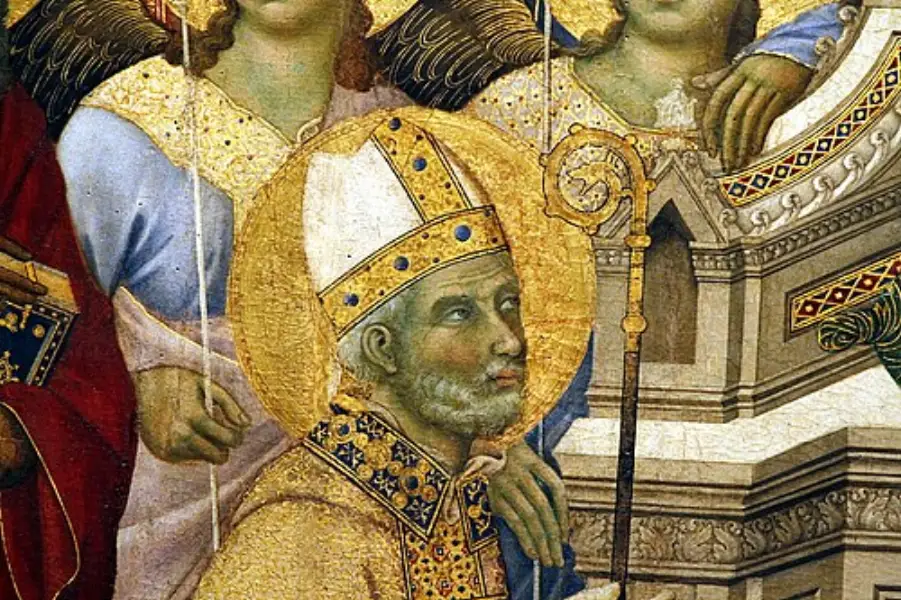
Overview
Ansanus — in Italian, Sant'Ansano — bears the titles The Baptizer and The Apostle of Siena and is venerated as that city's patron; a martyr whose death came around 304 and a scion, the legend claims, of the Anician family of Rome — one of the greatest houses of the late empire. Born of noble Roman parents in the third century, he was secretly baptized as a child by his nurse Maxima — herself venerated as St. Maxima of Rome — and secretly brought up a Christian. At nineteen, during the persecutions of Diocletian, he declared his faith openly. The legend gives him a preacher's career before his passion: he brought the Gospel to Bagnoregio in Tuscany, while the church of Santa Maria delle Carceri just outside the Alban Gate in Rome supposedly rose over the prison where he was held. His own father, in one strand of the story, denounced him to the authorities; Ansanus escaped. He and Maxima were scourged, and she died of it. Ansanus survived the scourging and the next torture — a pot of boiling oil — and was taken prisoner to Siena, where he preached and made many converts before being beheaded by order of Diocletian. Duccio painted him in the Maesta among the patrons of Siena.
The Complete Life
Early Life
The legend makes Ansanus a child of the Anician family of Rome — the senatorial house that would produce, among others, the emperors of the West and, in Christian memory, the nobility of the church. His father, in the hostile strand of the story, was a pagan who denounced him; his nurse Maxima, who secretly baptized him and brought him up a Christian, is herself venerated as St. Maxima of Rome. The pattern — noble child, Christian nurse, secret faith, open confession at maturity — is one of the standard forms of the Roman martyr-legend, a pattern of story rather than of chronology.
§ Legend
Preaching
Ansanus's legend is unusual in giving him a real preaching career before his death. He proclaimed the Gospel at Bagnoregio (ancient Bagnorea) in Tuscany. At Rome, the church of Santa Maria delle Carceri, just outside the Alban Gate, supposedly stood over the prison where he had been held — the city remembering the place of his confinement before the scourging. In one version he escaped his father's denunciation and converted many at Bagnorea; the escapes and the missionary journeys accumulate in the later retellings, as Siena's apostle acquired a wider stage.
§ Legend
Martyrdom
The passion follows the classic escalations. Scourging was inflicted on both Ansanus and Maxima; Maxima succumbed to it, the nurse dying before her nursling. Ansanus came through the scourging and the ordeal that followed — a plunging into a pot of boiling oil — one of his fixed iconographic themes thereafter. Carried off to Siena as a prisoner, he found a way to preach Christianity in the city and gain numerous converts — the seed of the church that would take him as patron. He was beheaded by order of Diocletian, around 304, aged about nineteen.
§ Legend
Cult
Ansanus is a pre-congregation saint, one of the patron saints of Siena — with Savinus, Crescentius and Victor — and in art the front-rank one. Duccio painted him in the Maesta; the banners of Siena's contrade carry his emblem; and the Met's collection preserves his image with the city's arms. His feast, 1 December, is the day of his martyrdom, and he is listed also among the Latin saints honoured by the Orthodox patriarchate of Rome.
§ Introduction
Legacy
For Siena, Ansanus is the founding saint: the young man with the dates and the banner in every civic painting from Duccio to Sassetta, the apostle whose beheading under the empire is the city's birth certificate in grace. His legend, whatever its history, has organized a millennium of Sienese devotion — and given the world some of the most beautiful images of a boy martyr ever painted.
§ Introduction
Timeline
- 285
Born of a noble Roman family; as a child he is secretly baptized and raised a Christian by his nurse Maxima
§ Introduction
- 1 Dec 304
Beheaded at Siena by order of Diocletian after converting many there; his feast keeps this martyrdom date
§ Legend
The Record
- Patron of
- Siena, Italy
- Symbols
- Young man holding a cluster of dates·Heart or liver in hand·Palm of martyrdom·Heart with IHS·Boiling oil or beheading scene·Banner with the arms of Siena·Baptismal cup, fountain
- Canonization
- Pre-congregation
Prayer
Bibliography
Show 3 sources
Profile text adapted from the Wikipedia article, licensed CC BY-SA 4.0.
Pray with this saint every day
Save St. Ansanus to your favorites, read the full profile, and get feast-day reminders in the Saints app.
Get the Saints AppFree on the App Store for iPhone and iPad