
died c. 692–695·Feast February 9
St. Ansbert of Rouen
Bishop of Rouen, Abbot of Fontenelle
Overview
Ansbert — known also as Ansbert of Chaussy — was a Frankish monk who served as abbot and then as bishop of Rouen during the seventh century. Born at Chaussy-sur-Epte in the Vexin to a noble and highly educated family, he made a significant secular career at the Merovingian court of Clotaire III, serving as chancellor and referendary. He was betrothed to Angadrisma, daughter of another chancellor; she prayed for release from the engagement, was struck down with leprosy — which vanished when she entered religion — and the match dissolved. In 673, the year Clotaire died, Ansbert renounced the world and became a Benedictine monk; six years later he was raised to be abbot of Fontenelle (Saint-Wandrille), the illustrious house whose founders Wandrille and Lambert were themselves saints. Under him the abbey prospered: he greatly expanded and refined its library and established local hospitals for the poor, and served as confessor to King Theodoric III. On the death of St Ouen in 683 or 684 he became archbishop of Rouen, consecrated by his old mentor Lambert. About 690, Pepin of Heristal, mayor of the palace, used a false accusation to bring about his removal — his zeal had found little favor and his austere way of living gave offence — and Ansbert was banished to Hautmont, dying there at some point between 692 and 695. His body, translated to Fontenelle, was found fragrant, with the sign of the cross on his arm.
The Complete Life
Chancellor of the Merovingians
The village of Chaussy-sur-Epte, in the Norman Vexin on the river marking the border between Neustria and the duke's lands, was Ansbert's birthplace. His family was noble, and he received the education that such families now gave their sons — the sort that could carry a man to the top of the late Merovingian civil service, the government of scribes and judges that ran the kingdom while the kings decayed. Tradition has it that he stood among the senior figures at the court of Clotaire III, holding the chancellorship and the referendary — direction of the writing office together with the receiving of petitions, a pair of the highest posts open to a layman (or cleric). The king's court of the 660s was the most sophisticated institution in the West, and Ansbert was one of its managers. He was also, at some point, engaged to be married to Angadrisma, daughter of another chancellor; she prayed for release from the obligation and was struck down with leprosy, which disappeared only when she joined a convent — a hagiographic solution that dissolved the engagement without dishonour, and freed them both for other lives. Some sources say Ansbert afterwards took a different bride; if so, the marriage too was dissolved.
§ Early life
Fontenelle
In 673 — the year Clotaire died — Ansbert turned his back on secular advancement and entered the Benedictine order as a monk: a trading of a career at the summit of the state for one at the base of the cloister, that most typical gesture of the seventh-century elite. Six years on, he was raised to head Fontenelle — the abbey afterwards known as Saint-Wandrille — succeeding two saints in the post: Wandrille himself, founder and first abbot, and then Lambert, the second, whose appointment as bishop of Lyon had left the seat open. Under Ansbert's leadership Fontenelle prospered. Among his undertakings were a major enlargement and improvement of the abbey's library — the very collection that ranked Fontenelle among the intellectual centres of its day and preserved much of the Merovingian writing that survives — together with the founding of hospitals for the poor nearby, the house's first recorded charitable endowments. During this time he also served as confessor to King Theodoric III, keeping one foot at court even as abbot.
§ Religious vocation
Rouen and the Fall
After the death of Saint Ouen (Audoin), the great archbishop of Rouen, in 683 or 684, Ansbert was appointed to succeed him, consecrated by his former mentor Lambert, and succeeded as abbot at Fontenelle by Hildebert (died 701), also venerated as a saint. His episcopate was high, eminent — and brief. His removal from the bishopric came around 690: Pepin of Heristal — the powerful mayor of the palace and the real master of the Frankish realm — engineered his dismissal through a false accusation, whether over political opposition or, as the sources phrase it, because his zeal found no favor and the austerity of his life gave offence. He was sent into exile at Hautmont Abbey on the Sambre, where he stayed until his death, between 692 and 695. Pepin at some point apparently reconsidered and agreed to allow his return, but either changed his mind again or the old man died before making the trip. The manner of his end — deposed by a lie, dying in exile, forgiving — became part of his cult.
§ Religious vocation
Translation, Fragrance, and Dispersal
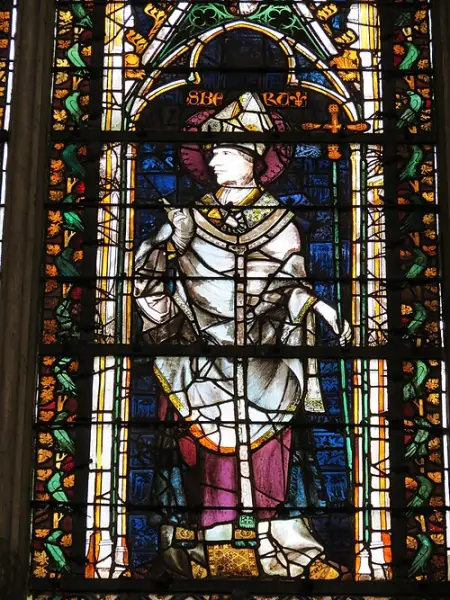
After death his remains were brought to Fontenelle, and the translation account preserves the marvels: opened in expectation of finding corruption, the tomb instead gave out a fragrance sweet and varied like many flowers mingled, while little drops of balsam filled the entire church; and when the brothers changed his clothes they discovered on his forearm the mark of the dominical cross in the likeness of a red colour — taken to signify that in life he had carried the arms of Christ within his heart, so that Christ's stigmata showed themselves upon the dead man's body. His medieval afterlife was troubled. A twelfth-century chronicler, Ordericus Vitalis, recounts how soldiers of Hugh the Great desecrated and scattered remains claimed to be Ansbert's; he maintains, however, that those bones were really another man's — a different Ansbert — while the saint's own lay untouched at Fontenelle. Alban Butler, however, states that the relics were at some point translated to St Peter's Abbey, Ghent, and destroyed by Calvinists in 1578. His feast is 9 February; the collective feast of all the saints of Fontenelle is 1 March, and his stained glass still looks down from Rouen Cathedral.
§ Legacy
Timeline
- 673
Renounces his secular career in the year King Clotaire III dies and becomes a Benedictine monk
§ Religious vocation
- 679
Elevated to abbot of Fontenelle Abbey, after its founder Wandrille and second abbot Lambert
§ Religious vocation
- 684
Appointed archbishop of Rouen after the death of Saint Ouen and consecrated by Saint Lambert
§ Religious vocation
- 690
Removed from the bishopric through a false accusation by Pepin of Heristal and exiled to Hautmont Abbey
§ Religious vocation
- 695
Dies in exile at Hautmont sometime between 692 and 695; his body is afterwards translated to Fontenelle
§ Religious vocation
The Record
- Canonization
- Pre-congregation
Prayer
Bibliography
Show 12 sources
- ↑ A Western Rite Orthodox Martyrology, (St. Gregory the Great Orthodox Church, Washington, D.C.), p. 31
- ↑ Matthew Hartley. Orthodox Normandy, Part 2. Retrieved from: https://orthochristian.com/156173.html
- ↑ https://www.pravenc.ru/text/115676.html
- ↑ Rupin, Ernest (1897). L'abbaye et les cloîtres de Moissac (in French). Paris: A. Picard. p. 27 .
- 1 2 3 4 5 6 7 8 9 Walsh, Michael J. (2007). A New Dictionary of Saints: East and West . Collegeville, MN: Liturgical Press. p. 48. ISBN 9780814631867 .
- 1 2 3 4 5 6 7 8 Butler, Alban (1995) [1756]. Butler's Lives of the Saints . Vol. 2. Collegeville, MN: Liturgical Press. pp. 90– 91. ISBN 9780860122609 .
- 1 2 3 Baudoin, Jacques (2006). Grand livre des saints: culte et iconographie en Occident (in French). Nonette, FR: Editions CRÉER. p. 90. ISBN 9782848190419 .
- 1 2 3 Butler, Alban (1995) [1756]. Butler's Lives of the Saints . Vol. 10. Collegeville, MN: Liturgical Press. pp. 92– 93. ISBN 9780860122593 .
- 1 2 Rabenstein, Katherine I. (2008). "Saint of the Day: February 9" . Saintpatrickdc.org . St. Patrick's Catholic Church, Washington, D.C . Retrieved 25 May 2016 .
- ↑ "Saint Ansbert" . Catholic.org . Catholic Online. 2016 . Retrieved 7 May 2016 .
- ↑ "Saint Ansbert of Rouen" . CatholicSaints.info . 7 February 2010 . Retrieved 23 May 2016 .
- ↑ "Chronologie" . St-Wandrille.com (in French). Communauté des bénédictins de Saint-Wandrille de Fontenelle. 2016. Archived from the original on 16 June 2016 . Retrieved 25 May 2016 .
Profile text adapted from the Wikipedia article, licensed CC BY-SA 4.0.
Pray with this saint every day
Save St. Ansbert of Rouen to your favorites, read the full profile, and get feast-day reminders in the Saints app.
Get the Saints AppFree on the App Store for iPhone and iPad