
1036-1086·Feast March 18
St. Anselm of Lucca
Bishop and Confessor
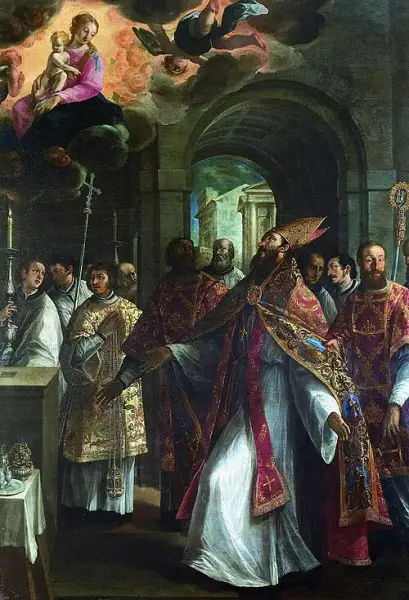
Overview
Anselm of Lucca, born Anselm of Baggio at Mantua in 1036, was a bishop of Lucca and a central figure of the Investiture Controversy, the struggle between the papacy and the empire over the appointment of bishops. His uncle Anselm the Elder became Pope Alexander II in 1061 and designated his nephew to succeed him at Lucca; sent to Germany, the younger Anselm shrank from accepting the insignia of spiritual power at the hands of a temporal ruler and came home without investiture. Named to Lucca again by Gregory VII in 1073, he accepted investiture from Henry IV, then repented so deeply that he resigned his see and became a Benedictine monk at Padilirone. Gregory ordered him back to his cathedral, where he lived as a monk among his canons, attempted to reform them under the Augustinian rule, and was expelled around 1080 after the defeat of his protector, Countess Matilda of Tuscany. He became papal legate in Lombardy, received castles from Matilda against Henry's campaigns, wrote against lay investiture, and compiled in thirteen books a collection of canons that stands first among the Gregorian canonistic collections and fed the later Decretum of Gratian. He died at Mantua on 18 March 1086.
The Complete Life
Early Life
Anselm was born at Mantua in 1036 into the family of Baggio, a Lombard house that had already given the church a bishop: his uncle, Anselm the Elder, held the see of Lucca before being raised to the papacy as Alexander II in 1061. The younger Anselm was educated at Mantua in grammar and dialectic, the standard training of the churchmen of the eleventh-century renaissance, and was marked early for his uncle's former place. Alexander II designated him to succeed at Lucca, elevated him to the cardinalate around 1062, and sent him to Germany with the advice to take investiture, the symbolic gift of the symbols of office, from the emperor Henry IV. The young bishop went, saw what the ceremony meant, and came back without it: he was loath, the sources say, to take up the insignia of spiritual power from any temporal ruler. That stand, taken almost alone in his generation, anticipated by a decade the position for which Gregory VII would excommunicate an emperor.
§ Life
The Bishopric and the Repentance
In 1073 Gregory VII, the great reforming pope, reappointed Anselm to Lucca, advising him this time not to accept investiture from Henry; for reasons the sources leave unclear, Anselm did accept it, and then was seized with such remorse that he resigned the bishopric altogether and entered the Benedictine, Cluniac monastery of Padilirone near Mantua. The gesture was dramatic and characteristic of the age's moral seriousness: the sin was not simony in the gross sense but the symbolic subjection of the church to the crown, and Anselm treated it as incompatible with his office. Gregory, who needed exactly such men in exactly such sees, refused to lose him: he gave the monk his own mitre, an object of lifelong veneration to which later devotion attached miracles, and ordered him back to Lucca. Anselm obeyed reluctantly and on his own terms, continuing to live as a monk while governing the diocese, a combination that made him in practice the model of the Gregorian bishop: poor, celibate, prayerful, and intractable on principle.
§ Life
Reform and War
The mission that followed was the reform of his cathedral and the defense of the church's liberty in war. He attempted to impose the rule of St. Augustine on the canons of Lucca cathedral, most of whom refused to submit though the pope interdicted them; the struggle between bishop and canons was the local face of the European contest. Around 1080, after the defeat of his protector Countess Matilda of Tuscany at the battle of Volta Mantovana, and with the help of Henry IV and the antipope Guibert, Clement III, Anselm was expelled from his city. He fled to the episcopal stronghold of Moriana, in the company of the priest Bardo, who would later compose his life, and withdrew afterward to Canossa to act as the countess's spiritual guide — that Matilda whose castle had been the stage of Henry's famous penance and whose gold and silver, the imperialist bishop Benzo of Alba sneered, were stripped from monasteries and sent to Gregory in Rome with Anselm's help. Gregory then made him papal legate for Lombardy, ruling all the vacant dioceses of the conflict.
§ Life
Final Years and the Collectio canonum
Anselm spent his last years assembling the work for which scholars remember him: a collection of ecclesiastical law in thirteen books, the Collectio canonum, the earliest of the great canonistic collections built to support the Gregorian reform. It gathered the ancient canons, the decretals and the fathers in a systematic order that argued the reformers' case, and it notably revived the Novellae of Justinian, setting in motion the medieval recovery of Roman law; the collection was later incorporated into the Decretum of Gratian, the masterwork of canon law, so that Anselm's learning lies under a millennium of church legal order. He wrote also in direct controversy, against lay investiture and in defense of Gregory against the antipope. He died at Mantua on 18 March 1086, having outlived Gregory by a year, and was buried in his native city, which honors him as patron. The tradition represents him before an army in confusion, because through his prayers, it was said, the enemies of Gregory VII were routed.
§ Life
Canonization
Anselm was canonized with remarkable speed: Pope Victor III declared him a saint in 1087, within a year of his death, a canonization almost contemporary with the man and an index of the esteem in which the Gregorian party held the bishop who had lived their whole program at personal cost. Two biographies were written shortly after his death, Pseudo-Bardo's prose Vita Anselmi episcopi Lucensis and Bishop Rangerius of Lucca's Vita metrica, which give the biography from both sides of the war of investiture and are themselves precious sources for the struggle. His cult was kept at Mantua and Lucca, the two cities of his life, and his feast on 18 March stands in the Roman martyrology tradition. The man whom his canons had expelled and an emperor had driven out was, within a generation, honored by the whole church as a confessor of the liberty of the church.
§ Life
Legacy
Anselm's legacy is institutional and intellectual. Institutionally, he belongs to the small company of bishops of the Gregorian age who lived the reform rather than merely voting it: the refused investiture, the resigned see, the monastic discipline in the episcopal palace, the exile, and the legation in a wasted province. Intellectually, his Collectio canonum is a foundation document of the canon law tradition, the first great systematization of the legal case for church freedom, and the channel through which Justinian's legislation returned to the west; every later canonist, down to Gratian and beyond, worked in his shadow. For the city of Mantua he is the patron, and for Lucca one of its great bishops. Historians of the eleventh century, who must often deal in types and abstractions, value him as a fully documented individual: a man of scrupulous conscience caught in the largest conflict of his age, who managed to lose everything twice and keep his soul.
§ Life
Timeline
- 1036
Born in Mantua and educated there in grammar and dialectic
§ Life
- 1061
His uncle Anselm becomes Pope Alexander II and designates him to succeed as Bishop of Lucca
§ Life
- 1062
May have been elevated to the cardinalate by Alexander II
§ Life
- 1073
Gregory VII reappoints him Bishop of Lucca; he accepts investiture from Henry IV
§ Life
- 1073
Struck with remorse, he resigns the bishopric and becomes a monk at the Cluniac monastery of Padilirone near Mantua
§ Life
- 1077
Back in Lucca at Gregory's command, he begins receiving castles from Countess Matilda (transfers run to 1079)
§ Life
- Oct 1080
Expelled from Lucca after Matilda's defeat at the Battle of Volta Mantovana, and retires to Canossa as her spiritual guide
§ Life
- 18 Mar 1086
Dies at Mantua, leaving the thirteen-book Collectio canonum in support of the Gregorian reforms
§ Life
- 1087
Canonized by Pope Victor III
§ Life
The Record
- Major works
- Collectio canonum (13 books)·Treatises against lay investiture and in defense of Gregory VII
- Patron of
- Mantua·Lucca·Canon lawyers
- Symbols
- Bishop's mitre (the mitre of Gregory VII)·Book of canons
- Canonization
- Canonized 1087 by Pope Victor III
Prayer
Bibliography
Show 7 sources
- 1 2 Ott, Michael. "St. Anselm of Lucca, the Younger." The Catholic Encyclopedia. Vol. 1. New York: Robert Appleton Company, 1907. 10 Mar. 2015
- ↑ Cushing, Kathleen G. (1998). "Anselm of Lucca: A Sainted Gregorian Bishop". Papacy and Law in the Gregorian Revolution . Oxford Historical Monographs. Clarendon Press. pp. 42– 63. doi : 10.1093/acprof:oso/9780198207245.003.0003 . ISBN 0-1
- ↑ This is according to Salvador Miranda . The Cardinals of the Holy Roman Church Other sources consulted do not mention his promotion to the cardinalate. He is not listed among the cardinals of the 11th century in the modern printed prosopo
- ↑ Gaetano Moroni (2025-09-06). "La mitra vescovile, i suoi significati mistici e alcuni aneddoti" . Radio Spada (in Italian) . Retrieved 2026-06-22 .
- 1 2 3 "St Anselm of Lucca", The Concise Oxford Dictionary of the Christian Church , 2nd ed. (E.A. Livingstone, ed.) 2006, OUP, ISBN 9780198614425
- ↑ Butler, Alban. "St. Anselm, Bishop of Lucca, Confessor", The Lives of the Saints . vol. III, 1866 This article incorporates text from this source, which is in the public domain .
- ↑ "Ansèlmo di Lucca, santo nell'Enciclopedia Treccani" . www.treccani.it (in Italian) . Retrieved 2019-07-11 .
Profile text adapted from the Wikipedia article, licensed CC BY-SA 4.0.
Pray with this saint every day
Save St. Anselm of Lucca to your favorites, read the full profile, and get feast-day reminders in the Saints app.
Get the Saints AppFree on the App Store for iPhone and iPad