
801-865·Feast February 3
St. Ansgar
Archbishop of Hamburg-Bremen, Apostle of the North
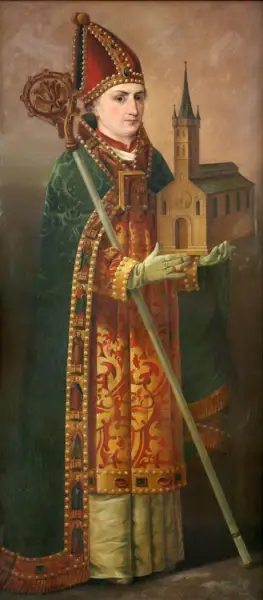
Overview
Ansgar, born on 8 September 801 near Amiens to a noble Frankish family and orphaned of his mother early, became the Apostle of the North, the missionary of Denmark, Sweden and the northern lands. Raised in the Benedictine abbey of Corbie in Picardy, he was changed from a careless boy to a serious one by a vision that his mother was with Mary, the first of the visions his biographer Rimbert considered his main motivation. In 822 he was among the missionaries who founded Corvey, New Corbie, in Westphalia, as teacher and preacher, and from there he went north to Jutland with the baptized Danish king Harald Klak; when Harald fell in 827 the school closed and Ansgar returned. In 829 the Swedish king Björn at Hauge asked for missionaries, and Louis the Pious sent Ansgar, who preached for six months at Birka on Lake Mälaren, converting the widow Mor Frideborg and the king's steward Hergeir. In 831 he was made archbishop of the new see of Hamburg-Bremen, with the mission to evangelize Denmark, Norway and Sweden, and received the pallium from Gregory IV as legate of the North. Danish raiders destroyed Hamburg in 845; he moved to Bremen in 848 and the union of the sees was approved in 864. He died at Bremen on 3 February 865.
The Complete Life
Corbie
Ansgar, also spelled Anskar or Anschar, known also by the Latin form Oscar, was born on 8 September 801 near Amiens, the son of a noble Frankish family. His mother died in his childhood, and he was brought up in the Benedictine abbey of Corbie in Picardy, one of the great schools of the Carolingian church. In the Vita Ansgarii, composed by his pupil, successor and biographer Rimbert, comes the first of the visions that shaped his life: in a dream the child saw his mother welcomed among the company of Mary, the mother of Jesus, and his formerly careless attitude to spiritual things turned to earnestness. These visions, Rimbert held — returning, as they did, at decisive moments — supplied the chief motive power of Ansgar's life, and they lent his career an inner momentum beneath the politics. He grew into a monk of Corbie at the height of the Carolingian reform, in the generation that believed the Christianization of the newly conquered Saxon lands could be extended to the whole North.
§ Life
Jutland and Birka
Ansgar's field work began at Corvey, New Corbie, the daughter house in Westphalia founded in 822, where he went as one of the many missionaries and became teacher and preacher. From there a band of monks, Ansgar among them, travelled north into Jutland alongside King Harald Klak, who had been baptized while an exile in Frankish lands; the mission founded a school for courtiers' sons, but with Harald's downfall in 827 and the death of Ansgar's companion Autbert, it closed and Ansgar returned to Germany. The second opening came from Sweden: in 829 King Björn at Hauge requested missionaries for his people, and Louis the Pious sent Ansgar with friar Witmar. He preached and made converts, above all during six months at Birka, the trading town on Lake Mälaren, where the wealthy widow Mor Frideborg extended hospitality and the king's steward Hergeir became the other pillar of the first Swedish congregation, a tiny church built from two households and a preaching monk.
§ Life
Archbishop of the North
In 831 Ansgar came back to Louis's court at Worms and was named to the newly created Archbishopric of Hamburg-Bremen, a see that took in the bishoprics of Bremen and Verden and bore the right to dispatch missions throughout the northern lands and to consecrate their bishops — a continental base for evangelizing pagan Denmark, Norway and Sweden. Consecrated in November 831 with the approval of Gregory IV, he traveled to Rome and received the pallium directly from the pope's hands, formally named legate for the North, though the division of jurisdiction with Ebbo of Reims, who held a similar commission but never traveled so far, left Sweden formally Ebbo's. Ansgar founded a monastery and school in Hamburg intended to serve the Danish mission, which accomplished little; after Louis the Pious died in 840 Ansgar lost the endowment abbey of Turholt; and in 845 Danish raiders put Hamburg to the torch, and with it all the church's treasures and books, so that the archbishop was left without see or revenue while many of his helpers deserted him.
§ Life
Bremen and the Two Kings
Louis the German did not restore Turholt, but in 847 he named Ansgar to the vacant diocese of Bremen, where he moved in 848, and though the union of Bremen, formerly suffragan to Cologne, with Hamburg presented canonical difficulties, Pope Nicholas I approved it in 864, the year before Ansgar's death. Through all this turmoil the northern work went on. The Danish civil war compelled Ansgar to keep good relations with two kings at once, Horik the Elder and his son Horik II, and both assisted him until his death: he won leave to erect a church at Sleswick, north of Hamburg, and gained recognition for Christianity as a faith tolerated in Denmark, a legal status from which the Danish church would grow. He did not forget Sweden, and spent two years in the 850s on a second northern journey that re-founded the Birka congregation after a relapse, ordaining a priest for it. He died at Bremen on 3 February 865, and Rimbert succeeded him.
§ Life
Legacy
Ansgar's legacy is the Christian North, however long and interrupted the growth proved. He was not the converter of Scandinavia, which took centuries more, but he was the first to plant an organized, legally recognized church presence in Denmark and Sweden, and the see he held, Hamburg-Bremen, remained for two centuries the metropolitan church of the North, from which the archbishops claimed primacy over the missions to Norway, Iceland and beyond. His biography by Rimbert, one of the finest of Carolingian Lives, gives the missions an unusually honest record, full of burned churches, failed schools and tiny congregations as well as visions, and that honesty is the source of his enduring appeal. He is honored as a saint in the Roman Catholic, Orthodox, Anglican and Lutheran traditions, a fitting breadth for the apostle of lands that would become both Catholic and Lutheran, and Hamburg's churches keep his February feast as the city's own founding memory.
§ Introduction
Timeline
- 8 Sep 801
Born on 8 September near Amiens to a noble Frankish family; raised at Corbie after his mother's early death
§ Life
- 822
One of the missionaries sent to found the abbey of Corvey in Westphalia, where he teaches and preaches
§ Life
- 827
After Harald Klak's downfall and his companion Autbert's death, the Jutland school closes and Ansgar returns to Germany
§ Life
- 829
Sent by Louis the Pious to Sweden at King Björn's request; preaches for six months at Birka
§ Life
- Nov 831
Appointed to the new Archbishopric of Hamburg-Bremen, consecrated in November, and named papal legate for the North
§ Life
- 845
Danish raiders destroy Hamburg, leaving Ansgar with neither see nor revenue
§ Life
- 847
Louis the German names him to the vacant diocese of Bremen
§ Life
- 848
Moves to Bremen and spends two years in Sweden re-founding the Birka congregation
§ Life
- 854
Returns to Sweden when King Olof rules at Birka
§ Life
- 864
Pope Nicholas I approves the union of the dioceses of Hamburg and Bremen
§ Life
- 3 Feb 865
Dies at Bremen on 3 February; Pope Nicholas I declares him a saint shortly afterward
§ Death and legacy
The Record
- Major works
- Foundation of the church in the North (attributed foundations at Hamburg and Bremen)
- Patron of
- Scandinavia·Denmark·Missionaries·Hamburg and Bremen
- Symbols
- Archbishop's attire with a model church·Missionary's staff
- Canonization
- Pre-congregation; ancient cult, soon after his death
Prayer
Bibliography
Show 12 sources
- ↑ 16 February / 3 February. https://www.holytrinityorthodox.com/htc/orthodox-calendar/
- 1 2 "Anskar, Bishop and Missionary, 865" . The Episcopal Church . Retrieved 20 July 2022 .
- ↑ "Notable Lutheran Saints" . Resurrectionpeople.org . Archived from the original on 16 May 2019 . Retrieved 16 July 2019 .
- ↑ "Common Worship texts: Festivals" . The Church of England . Retrieved 3 February 2015 .
- ↑ Herbermann, Charles, ed. (1913). "St. Anschar" . Catholic Encyclopedia . New York: Robert Appleton Company.
- 1 2 3 4 5 Fr. Paolo O. Pirlo, SHMI (1997). "St. Ansgar". My First Book of Saints . Sons of Holy Mary Immaculate – Quality Catholic Publications. p. 41. ISBN 971-91595-4-5 .
- ↑ Farmer, David Hugh (1997). The Oxford dictionary of saints (4 ed.). Oxford [u.a.]: Oxford Univ. Press. p. 25. ISBN 0-19-280058-2 .
- ↑ Rimbert, "Life of Ansgar" at p. 1, English translation available at https://sourcebooks.fordham.edu/basis/anskar.asp
- ↑ Wood, Ian. The Missionary Life: Saints and the Evangelisation of Europe, 400–1050. Great Britain: Longman, 2001. pp. 124–125
- ↑ Samuel Macauley, ed. (1914). "Ansgar". New Schaff–Herzog Encyclopedia of Religious Knowledge (third ed.). London and New York: Funk and Wagnalls
- ↑ "St. Mary's Cathedral in Hamburg, Germany" .
- ↑ "The Calendar" . The Church of England . Retrieved 27 March 2021 .
Profile text adapted from the Wikipedia article, licensed CC BY-SA 4.0.
Pray with this saint every day
Save St. Ansgar to your favorites, read the full profile, and get feast-day reminders in the Saints app.
Get the Saints AppFree on the App Store for iPhone and iPad