
died 816·Feast March 13
St. Ansovinus
Bishop of Camerino, Patron of Small Farmers
Overview
Ansovinus was bishop of Camerino in the Marches of central Italy in the early ninth century, and is honored as a patron of agriculture and of small farmers. Educated at the cathedral school of Pavia, he became a priest and then a hermit at Castel Raimondo near Torcello, living in prayer before the world recalled him. He served as confessor to the emperor Louis II, and when the clergy and people of Camerino elected him bishop he at first refused, accepting only when the emperor agreed that his see would be exempt from the conscription of local men into the imperial army — a striking use of episcopal leverage to shield his people. Consecrated at Rome by Pope Leo IV, he later put his signature to the acts of the Roman council of 861 under Pope Nicholas I as Ansuinus Camerinensis. As bishop he was remembered for generosity to the poor and for pacifying the feuding factions of his city. A gift of multiplying food was attributed to him: he is said to have fed thousands of the starving from the granary at Castel Raimondo, and the grain did not run out. He died in 816, and his feast is kept on 13 March.
The Complete Life
Formation at Pavia
Ansovinus received his schooling at the cathedral school of Pavia, then the intellectual center of the Lombard and early Carolingian kingdom of Italy. Such schools trained boys for the church's service — liturgy, letters, and the administration of an increasingly clerical public life — and Pavia placed its graduates across the peninsula. From there Ansovinus proceeded to holy orders and then, decisively, away from the career his education fitted him for: he became a hermit at Castel Raimondo, in the country near Torcello in the Venetian lagoon. The hermitage gave him the reputation for holiness that the world never afterward let him fully enjoy; it also, in the pattern of the age, qualified him for everything that followed. The Church of the early Middle Ages drew its bishops disproportionately from its solitaries.
Confessor of an Emperor
Ansovinus's sanctity brought him to court, where he served as confessor to Louis II, the Carolingian emperor in Italy from 844. The office of royal confessor was spiritual in name and political in fact: emperors needed holy men around them, and holy men at court had access that bishops envied. When the see of Camerino fell vacant and the local church elected the hermit-confessor, Ansovinus declined — and was persuaded only by using his standing with Louis to extract a condition: that the men of his diocese should be exempt from conscription into the imperial army. In an age when bishops were commonly responsible for delivering recruits, the demand was almost unique, and its moral is the one his cult has always drawn: that a bishop's first duty is a shield over his own people. Consecrated at Rome by Pope Leo IV, he signed the acts of a later Roman council of 861 under Pope Nicholas I in his own hand as Ansuinus Camerinensis.
Shepherd and Provider
Two ministries filled Ansovinus's episcopate. The first was civic: the sources remember him for generosity to the poor and for pacifying the factions of Camerino, a city whose noble families made private war with a regularity that bishops were expected to arbitrate. The second was the one that fixed his patronage forever: the multiplication of food. In a time of famine he opened the regional granary at Castel Raimondo and fed thousands of the starving — and the grain, the legend insists, did not run out until the hunger did. The story belongs to the same family as the oil of Saint Nicholas and the bread of other Italian saints: the holy man as the city's granary-guardian, the one whose stores the poor may eat. It made Ansovinus, for every later generation of the Marches, the saint of the harvest and of the men who grow it.
Death and Relics
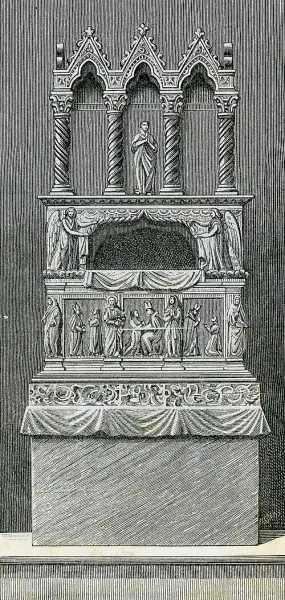
Ansovinus died in 816 — the date the calendars keep, though his attested presence at a council of 861 has made some readers wonder whether two men or two dates have been joined. He was buried in his cathedral at Camerino, where a marble medieval arch of Sant'Ansovino still frames the place of honor, and where a monumental sarcophagus of about 1390 enshrines his remains. For a time Camerino and the nobles of the nearby castles kept his festival — a country feast for a country patron.
Cult
Ansovinus's canonization is the pre-congregation kind: a tomb, a cathedral arch, a regional festival, and eventually the manuals of the saints. His feast is kept on 13 March. The cult spread through the countryside rather than the cities: country churches honoring him stood at Avacelli, Casenove, Bevagna and Monsammartino, while Rome itself has the church of Santi Venanzio e Ansovino bearing his name. His patronage — gardeners, agriculture, small farmers, invoked for good harvests — belongs entirely to the granary legend, and has kept his name alive among the people the miracle was for.
Legacy
Ansovinus's legacy is the pairing of two instincts that the Middle Ages considered inseparable and modern politics does not: the defense of the weak against the state's demands, and the feeding of the hungry from the common store. He remains the patron of small farmers in Italy, invoked in a country where the family farm has been the unit of survival for a hundred generations. The arch in Camerino cathedral and the sarcophagus of 1390 still carry his cult; and every harvest prayer in the Marches that names a saint names, before the others, the bishop who would not let his peasants be soldiers.
Timeline
- 816
Died after serving as bishop of Camerino and confessor to Emperor Louis II
§ Introduction
- 861
Attended the Council of Rome held by Pope Nicholas I, signing the records as Ansuinus Camerinensis
§ Life
- 1390
Monumental sarcophagus erected in Camerino cathedral to hold his relics
§ Veneration
The Record
- Patron of
- Small farmers·Gardeners·Good harvests·Camerino
- Symbols
- Bishop's vestments·Barn or sheaf of grain·Fruit and garden produce
- Canonization
- Pre-congregation; cult at Camerino confirmed by long tradition
Prayer
Profile text adapted from the Wikipedia article, licensed CC BY-SA 4.0.
Pray with this saint every day
Save St. Ansovinus to your favorites, read the full profile, and get feast-day reminders in the Saints app.
Get the Saints AppFree on the App Store for iPhone and iPad