
c. 645-688·Feast October 17
St. Anstrudis
Abbess of the Abbey of St. John, Laon
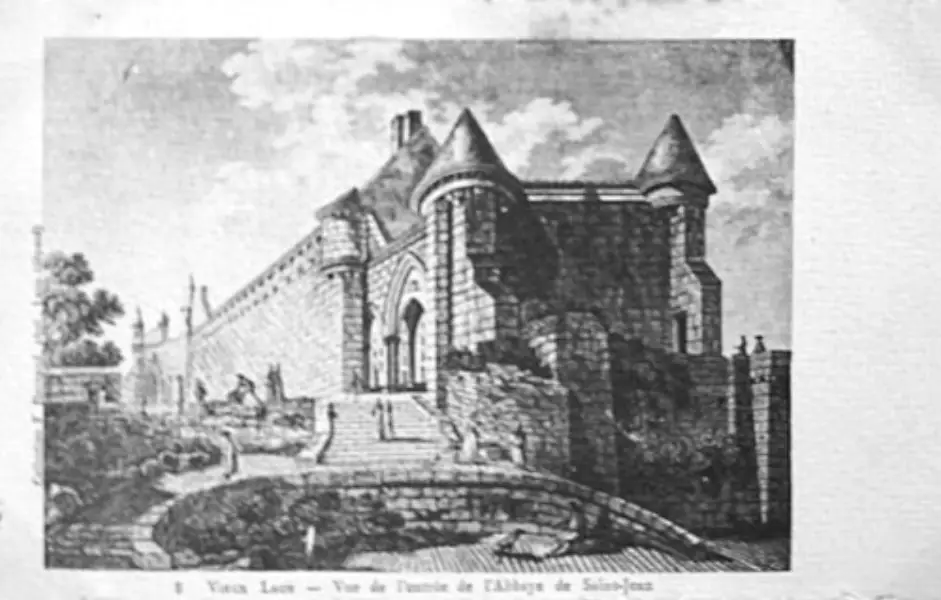
Overview
Anstrudis — also Anstrude, Austru or Austrude — was a Frankish virgin, saint and abbess of the Abbey of St. John at Laon, born about 645 and dying in 688. Her mother was Sadalberga, founder and first abbess of the house; her father was Sadalberga's second husband, Blandius; and she was the third of five children, of whom the youngest, Baldwin, also became a saint. About 657, aged twelve, she took refuge in her mother's abbey to escape a marriage with one Landramnus; when Sadalberga died in 670, the daughter, not yet twenty-one, succeeded her as abbess — the nuns' consent, the royal permission and the bishop's consecration all secured in advance by her far-sighted mother. Her years as abbess fell in the middle of the savage contest for power between Pippinids and Neustrians: Ebroin, an ally of Theuderic III, worked to drive her from her monastery and procured her brother Baldwin's murder. Her vita records her rule — fasting until the psalter was sung, one meal a day at three in the afternoon, night prayer in the church — and credits her with miracles of healing before her death and many more at her tomb after it. She died in 688.
The Complete Life
Early Life
Anstrudis was born about 645 into one of the remarkable monastic families of seventh-century Gaul. Her mother Sadalberga, founder and first abbess of the Abbey of St. John at Laon, had begged God at the basilica of Saint Remigius for children, whom she pledged to the religious life; of their five children Anstrudis came third, with Saretude and Ebana, a boy Eustasius who died in infancy, and Baldwin, the youngest, who later became a saint. Her father was Sadalberga's second husband, Blandinus. According to the Vita she was nurtured with care and led into the Christian religion most diligently, though Yaniv Fox reads between its lines that once her parents embraced the monastic life her early upbringing passed to relatives, who likely arranged her betrothal to a young noble. In about 657, being twelve, she withdrew into her mother's abbey, thereby escaping marriage to a certain Landramnus.
§ Early life
Abbess
Sadalberga's death in 670 brought Anstrudis, then about twenty, to the abbess's seat — a succession arranged beforehand: the Laon bishop and the local aristocracy had counseled Sadalberga to win the nuns' consent to her daughter's elevation, the crown's permission was obtained, and the bishop gave her consecration. Butler's summary has her reluctantly and faithfully following in her mother's steps. Fox's judgment is darker: for Anstrudis life brought little relief, and the hardships Sadalberga had foreseen fell upon her daughter once she became abbess.
§ Early life
Rule of Life
The Vita gives a detailed picture of her observance. On Christmas, Easter and Sundays she fasted and took no water until the psalter's offices were finished, and she stayed awake through vespers; by day she went around the neighboring churches and visited the sick; the evening vigils she attended were beyond counting; her single daily meal came at three in the afternoon, save on Sundays, Christmas Day and fast days; and she spent the night in prayer in the church, allowing herself only brief repose on an uncomfortable seat by the church door. In Butler's estimate, her scrupulous keeping of monastic discipline down to its smallest points, her tender care for her sisters, her open-handed charity toward the poor and her unceasing prayer made her a genuine model of sanctity — no outward employment ever breaking the union of her heart with God.
§ Career
Ebroin and the Murder of Baldwin
The contest between Pippinids and Neustrians ran through her whole abbacy, and Anstrudis with her brothers perhaps threw in their lot with the Pippinids. Ebroin, an ally of Theuderic III of Neustria, worked for her expulsion from the monastery and procured the murder of her brother Baldwin — Baldwin, dispatched to negotiate a settlement over her opposition, was betrayed and cut down by men he had taken for friends of himself and Anstrude. The Vita devotes two pages to her grief, comparing it to Job's. The account also tells how Ebroin stormed into the monastery, ablaze with wrath and ordering the abbess deposed and exiled, only to be turned back by the miraculous gentleness of the nuns' singing and to end in tears of remorse; and how, days afterward, a certain Cariveus attacked her with a sword, finding her standing firm and praying to God with confidence.
§ Career
Cult
Anstrudis died in 688, with numerous miracles and cures ascribed to her. The miracles her vita records mostly happened once she had died, at her tomb: the catalogue runs from paralysis and blindness through muteness, demonic possession, a flow of blood, hydropsy and a wound that would not close; a nun's dream of the abbess prompted the raising of an altar within the monastery's basilica, so that the faithful praying in Jesus' name might receive what they asked. She is honored in the Gallican and Benedictine calendars on 17 October.
§ Introduction
Legacy
Anstrudis is a principal witness to the position of the great abbesses of the Merovingian world: women holding land, office and political allegiance in their own right, exposed to the full violence of the factions around them. Her vita, written in the ninth century from earlier material, is studied today — by Jo Ann McNamara and Yaniv Fox among others — precisely for that window: sanctity recorded amid the hard politics of Neustria.
§ Early life
Timeline
- 645
Born at Laon to Sadalberga and her second husband Blandius
§ Introduction
- 657
Entered her mother's abbey aged twelve to escape a planned marriage to Landramnus
§ Early life
- 670
Succeeded Sadalberga as abbess after her mother's death and was consecrated by the bishop of Laon
§ Early life
- 679
Her brother Baldwin, sent to negotiate with her opponents, was ambushed and murdered
§ Career
- 688
Died at Laon, after which numerous healings were reported at her tomb
§ Death
In Their Own Words
She made every effort to subject herself to all the Lord's precepts so that in no moment of any hour might she be found without some divine work.
The Record
- Symbols
- Abbess's crozier·Reliquary at Laon
- Canonization
- Pre-congregation; honored in the Gallican and Benedictine calendars
Prayer
Bibliography
Show 12 sources
- 1 2 3 4 5 6 7 Fox 2014 , p. 151.
- 1 2 3 4 5 6 7 Butler, Alban (1866). "St. Anstrudis or Austru, Virgin and Abbess at Laon" . Bartleby.com . Retrieved 13 May 2026 .
- 1 2 3 Fox 2014 , p. 85.
- 1 2 3 McNamara, Halborg & Whatley 1996a , p. 289.
- ↑ Hochstetler, Donald (1992). A Conflict of Traditions: Women in Religion in the Early Middle Ages, 500 – 840 . Lanham, Maryland: University Press of America. p. 29. ISBN 978-0-8191-8609-6 .
- ↑ Kreiner, Jamie (2024). "Merovingian Hagiography". In Effros, Bonnie; Moreira, Isabel (eds.). The Oxford Handbook of the Merovingian World . New York: Oxford University Press. p. 510. ISBN 978-0-19-023418-8 .
- ↑ Fox 2014 , p. 82.
- ↑ Vita , translated in McNamara, Halborg & Whatley 1996b , p. 184
- ↑ McNamara, Halborg & Whatley 1996a , p. 290.
- 1 2 3 4 5 6 7 8 9 Vita , translated in McNamara, Halborg & Whatley 1996a , p. 299 .
- ↑ Fox 2014 , p. 150.
- ↑ Fox 2014 , pp. 150–151.
Profile text adapted from the Wikipedia article, licensed CC BY-SA 4.0.
Pray with this saint every day
Save St. Anstrudis to your favorites, read the full profile, and get feast-day reminders in the Saints app.
Get the Saints AppFree on the App Store for iPhone and iPad