
1107-1178·Feast June 26
St. Anthelm of Belley
Carthusian Prior and Bishop
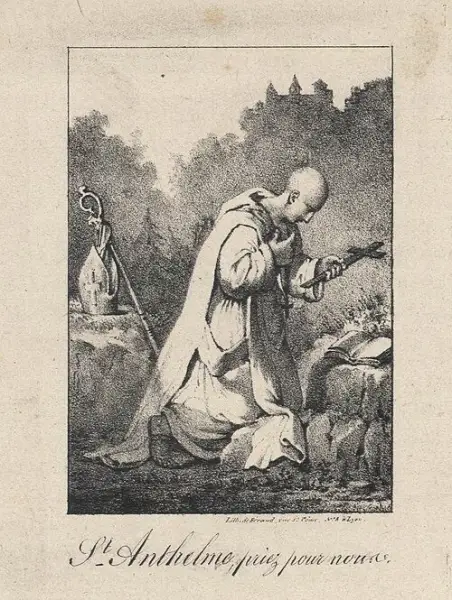
Overview
Anthelm of Belley, born near Chambéry in Savoy on 26 December 1107, was prior of the Carthusian Grande Chartreuse and later bishop of Belley. Receiving an ecclesiastical benefice in the region of Belley, at thirty he gave it up to enter the Carthusians as a monk at Portes, and within two years of his entry the Grande Chartreuse itself, the motherhouse lately damaged, had made him its prior. An effective administrator, he increased the community in numbers and fervor, restored and improved the buildings — constructing a defensive wall and an aqueduct — standardized the order's rules, and opened the Carthusian life to women in houses of their own, bringing the order's other houses into closer alignment with the motherhouse. Among his monks was Hugh of Lincoln. After some years as a hermit and a return to the Grande Chartreuse in 1152, he defended Pope Alexander III against the antipope Victor IV, and in 1163 Alexander appointed him bishop of Belley, where he was fearless and uncompromising in reforming the clergy. He died on 26 June 1178 and was canonized by Urban V in 1368.
The Complete Life
Early Life
Anthelm was born near Chambéry, in the county of Savoy between the French and Italian worlds, on 26 December 1107. His family's position obtained for him an ecclesiastical benefice around Belley — the revenue of a church office held without, at first, much thought of its duties, an ordinary arrangement of the twelfth century and one the age's reformers attacked with growing force. For a time Anthelm lived the ordinary life of a minor ecclesiastic with a private income. At thirty he did what the reform movement preached: he resigned the position and became a Carthusian monk at Portes, in the mountains of the Ain. It was a total break — from provision to poverty, from clerical ease to the most austere observance in the Western Church — and it was made, the sources suggest, deliberately, by a man who had counted the cost. Portes, his first house, sits in the mountains of the Ain — the desert he chose over a private income.
§ Introduction
Prior of the Grande Chartreuse
The speed of his rise is remarkable: scarcely two years had passed from his entry into the order before he was put at the head of the Grande Chartreuse, the motherhouse in the high Alps above Grenoble, which had lately suffered grave damage — an avalanche, by the tradition, had devastated the buildings. Anthelm showed himself an able administrator. Under his leadership the community grew in numbers and fervency; the buildings were repaired and enhanced on his watch, a defensive wall and an aqueduct rising in the desert valley; and he brought order to the order's internal life, standardizing the rules and altering them so that women could enter the order in houses of their own. As well as this, he drew the order's other houses into closer union with the motherhouse, holding together a young congregation at the very moment it might have drifted apart. The monks under his direction included Hugh of Lincoln, the future English saint, who expressed great fondness for Anthelm — the prior's blend of austerity and humanity left its mark on one of the twelfth century's holiest bishops.
§ Introduction
Hermit, Defender, Bishop
Anthelm remained in office for close to twenty-four years in all, interrupted only by a stretch in which he lived as a hermit — the Carthusian's periodic temptation to the yet deeper solitude his vocation was built around. In 1152 he returned to the Grande Chartreuse and was drawn into the greatest crisis of the century: the papal schism that followed Alexander III's election. Anthelm threw his support behind the reigning Pope Alexander III in his struggle with the antipope Victor IV, lending the Carthusians' immense moral weight to the legitimate pope in a dispute that divided kings. In 1163, as much burden as reward, Alexander III named him bishop of Belley — the very region whose benefice he had once resigned — and there he showed himself fearless and unyielding, laboring to reform the clergy and put the affairs of the diocese in order. The same firmness that reformed a diocese excommunicated Count Humbert of Maurienne in 1175 for a priest's murder, and held even when Rome reversed him.
§ Introduction
Spirituality
Anthelm's spirituality was Carthusian: silence, solitude, liturgy, and work, held together by obedience. His emblem in art — a lamp lit by a divine hand — preserves the tradition of heavenly light attending his prayer, the visible sign of an invisible conversation. What his career added to the cloister's pattern was the paradox of administration: the most anti-institutional of orders, built so that men might live alone with God, was saved as an institution by a prior willing to draw up statutes, aqueducts, and walls. The Carthusian formula — never reformed because never deformed — owes more than a little to the standardization he carried out; and his opening of the order to women, in houses of their own, extended the desert's silence to the other half of the Church. The paradox was the man: a hermit at heart who kept an institution alive by statute and aqueduct.
§ Introduction
Final Years
Anthelm governed Belley for fifteen years, dying there on 26 June 1178 at the age of seventy. His last years as bishop continued the work of his priorate — reform of the clergy, discipline of the diocese, and the fearless exercise of justice that his biographers emphasize, even where it cost him the favor of the local lords. He was buried at Belley, and his cult spread through Savoy and Burgundy in the following generations; the Carthusians kept his memory with particular warmth as the restorer of their motherhouse. His shrine at Belley and the calendar of the order preserved his feast on 26 June, the day of his death. The register of his last years holds the famous reconciliation: on his deathbed he received Count Humbert, whose excommunication he had laid on and Rome had lifted, and judged the repentance real.
§ Introduction
Canonization
Anthelm was canonized in 1368 by Pope Urban V — the Avignon pope who was himself a Benedictine monk and a reformer, and who recognized in the twelfth-century Carthusian a model for the fourteenth-century church's needs. The two-hundred-year gap between death and canonization reflects the formalization of process that was then under way; the cult had been steady in Savoy and in the order long before Rome spoke. His feast entered the general calendars, and his name remains in the Carthusian litanies, where he stands beside Bruno and Hugh of Lincoln among the fathers of the Charterhouse. The Carthusians have kept his feast since 1607, and his relics lie enshrined at Belley still — the order never dropped the restorer of its motherhouse. Four centuries after his death the calendar kept what Rome had ratified. Few cults bind an order and a diocese so evenly: the Charterhouse keeps the prior, Belley keeps the bishop.
§ Introduction
Legacy
Anthelm's legacy is the Carthusian order itself, in its surviving medieval shape. The consolidation of the houses around the Grande Chartreuse, the statutes he standardized, and the admission of women to the Carthusian life in their own foundations gave the order the structure that has carried it — through plague, revolution, and suppression — to the present day. For bishops he remains an example of the monk-turned-ordinary: a man who took the desert's austerity into the chancery. And for every administrator who suspects that holiness and paperwork are enemies, the prior with his aqueduct and his lamp lit by a divine hand is the standing contradiction. The statute-book, the aqueduct, and the wall: an order's infrastructure as hagiography — the rare saint whose memorial is a standing building.
§ Introduction
Timeline
- 26 Dec 1107
Born near Chambéry in Savoy
§ Introduction
- 1152
Returned to the Grande Chartreuse after spending some years as a hermit
§ Introduction
- 1163
Appointed bishop of Belley by Pope Alexander III
§ Introduction
- 1175
Excommunicated Count Humbert of Maurienne for imprisoning one priest and killing another
§ Introduction
- 26 Jun 1178
Died at Belley, receiving on his deathbed the repentant Count Humbert
§ Introduction
- 1368
Canonized by Pope Urban V
§ Introduction
- 1607
Carthusians began celebrating his feast annually
§ Veneration
The Record
- Major works
- Standardized constitutions of the Carthusian order
- Patron of
- The Carthusian Order·Bishops and administrators
- Symbols
- Depicted holding a lamp lit by a divine hand
- Canonization
- Canonized in 1368 by Pope Urban V
Prayer
Bibliography
Profile text adapted from the Wikipedia article, licensed CC BY-SA 4.0.
Pray with this saint every day
Save St. Anthelm of Belley to your favorites, read the full profile, and get feast-day reminders in the Saints app.
Get the Saints AppFree on the App Store for iPhone and iPad