
1650-1716·Feast September 27 (Romanian); June 13 (Georgian)
St. Anthim the Iberian
Metropolitan of Wallachia, Printer and Martyr
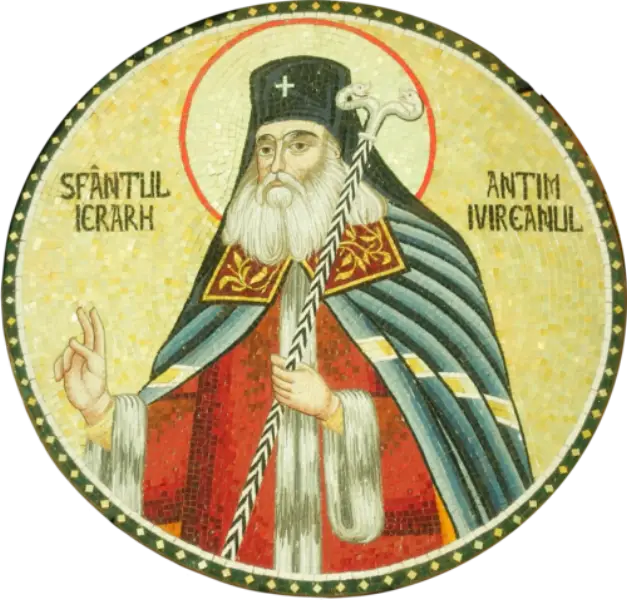
Overview
Anthim the Iberian, in Romanian Antim Ivireanul, in Georgian Antimoz Iverieli, secular name Andria, born in 1650 in the kingdom of Kartli, was a Georgian theologian, scholar, calligrapher and printer who became the greatest ecclesiastical figure of Wallachia in his age and Metropolitan of Bucharest from 1708 to 1715. Seized by Ottoman soldiers and put up for sale in the Constantinople slave market, he learned artisan crafts as a captive — woodcarving, painting, embroidery and calligraphy — before the patriarch of Constantinople ransomed him and brought him into his household, where he entered holy orders. He accompanied Patriarch Dositheos to Iași, where a Greek press had been founded in 1682, and learned printing. In 1689 Prince Constantin Brâncoveanu invited him to Wallachia, and from 1691 he directed the new press at Bucharest, publishing the Gospels in Romanian in 1693 and, over the years, more than fifty books in Romanian, Greek, Arabic and Church Slavonic, the first Arabic fonts in Wallachia among them. He founded Georgia's first printing press at Tbilisi in 1709, cutting with his own hands the type of the first printed Georgian Gospels. His Didache, a book of sermons, castigated the morals of his age. As metropolitan he opposed the Ottoman tutelage, and the new prince Nicholas Mavrocordatos imprisoned and exiled him toward Sinai; Ottoman agents assassinated him on the road in 1716.
The Complete Life
Early Life
Anthim was born in 1650 in the kingdom of Kartli, the Georgian realm the west still called Iberia, and disaster marked his start: Ottoman soldiers seized him and sold him in the Constantinople slave market. The slave's fate, in that city, could include a trade, and Anthim was trained as an artisan, learning wood sculpture, painting, embroidery and above all calligraphy, the fine hand that would define his life. His gifts brought him to notice: the patriarch of Constantinople ransomed him, and Andria, as he had been named in baptism, lived in the patriarchal compound, took holy orders there, and entered the world of Greek learning. When Patriarch Dositheos traveled to Iași, the Moldavian capital, Anthim went with him, and there, at the Greek printing office established in 1682, he found the technology that joined his crafts: the press, needing exactly his hand for cutting type and his eye for the page. The ex-slave had become a printer, and the profession of multiplying books had acquired one of its greatest servants.
§ Early life
The Printer of Wallachia
In 1689 Prince Constantin Brâncoveanu, the cultivated voivode of Wallachia, asked Anthim to settle in his principality, and from 1691 he directed the newly founded printing press at Bucharest. The year 1693 saw the Gospels published in Romanian, a landmark in the making of the Romanian church's vernacular; appointed hegumen of Snagov monastery in 1695, he set up a press there too, returning to Bucharest in 1702. He spoke and wrote Georgian, Greek, Turkish and Arabic, and he acquired Romanian so thoroughly that he became, as much as any single man, the introducer of that language into the official life of the church. His press printed some twenty-five books in Romanian and others in Greek, Arabic and Church Slavonic, often in bilingual volumes such as the Greek-Arabic missal of 1702, which required him to cut the first Arabic fonts used in Wallachia. In 1709 he founded Georgia's first printing press at Tbilisi, training Georgian pupils through his disciple Mihai Iștvanovici and cutting with his own hands the type of the first printed Georgian Gospels of 1710: the man two languages called their own had given both the word of God in their own letters.
§ In Wallachia
Metropolitan and Preacher
Consecrated bishop of Râmnic in 1705 and Metropolitan of Wallachia at Bucharest in 1708, Anthim governed the church while continuing to build and print. He founded the All-Saints Monastery in Bucharest, which the city now calls the Antim monastery in his memory, carving much of its ornament with the artisan's hand the slave market had trained. The Didache, his book of sermons, stands as his literary testament: a stinging attack on the habits and morals of its day — the greed of the wealthy, the drunkenness and violence everywhere in evidence — addressed to a society living under a foreign power and reaching, remarkably, for the pagan philosophers alongside the sources of Christianity. He printed a short catechism to help his priests instruct the people, a small book that tells the whole of his program: a church taught in its own language, from its own books, by pastors who had the tools. That program, vernacular and educational and unapologetically moral, made him both the father of Romanian religious print culture and, inevitably, a critic of the interests that ruled the principalities.
§ In Wallachia
Martyrdom
Because Anthim resisted the Ottoman tutelage over Wallachia, he became an enemy of the Phanariote regime — the arrangement of Greek princes installed by the Porte that had displaced the native voivodes — among them Brâncoveanu, his patron, deposed and beheaded alongside his sons in 1714. The new prince, Nicholas Mavrocordatos, moved against the metropolitan: Anthim was imprisoned, deposed and sentenced to exile at Mount Sinai. Ottoman agents intercepted him on the journey, in the country that is now Bulgaria, and assassinated him, throwing his body into the Maritsa or the Tundzha; contemporaries had no doubt, and historians have not contradicted them, that the murder was ordered by the prince himself. He died in September or October 1716, in his sixties, the ex-slave who had become the metropolitan of a nation, killed by the road on behalf of the powers whose market had once sold him. The Romanian church has always reckoned him a martyr.
§ Death
Canonization
The Holy Synod of the Romanian Orthodox Church canonized Anthim on 27 September 1992, in the first great wave of modern Romanian canonizations, giving the church of the post-communist years a father who was both scholar and martyr. His feast is kept on 27 September in Romania and on 13 June in the Georgian church, the two communions sharing the saint as they share the Antim monastery's mosaic portrait. In 2016, the three hundredth anniversary of his death, the Romanian church declared the year of Saint Anthim the Iberian, with commemorations, exhibitions of his books and conferences on his legacy, and his printed volumes, lovingly catalogued, are treasured as monuments of the Romanian language. The canonization made explicit what the tradition had long held: that the printer killed by the roadside belongs among the hieromartyrs.
§ Introduction
Legacy
Anthim's legacy is written in the libraries of two churches. The Romanian books of his press fixed the liturgical and biblical language of a nation whose church had worshipped largely in Slavonic and Greek, and the Arabic and Greek volumes served communities far beyond the principality; the Georgian Gospels of 1710 began the printed scripture of the Caucasus. The Antim monastery in Bucharest remains one of the city's ecclesiastical centers and keeps his name and image. Modern Romania and Georgia, who have no other figure in common, have made him their symbol of friendship: the Antim Cup, contested annually by the national rugby teams of the two countries, is named for him, an unusual but sincere tribute to a man who belonged to both. For printers, translators and all who work between languages and churches, he is the patron saint of the border-crossing life.
§ In Wallachia
Timeline
- 1650
Born in the Kingdom of Kartli, a Georgian realm then called Iberia in the west.
§ Introduction
- 1689
Invited by Prince Constantin Brâncoveanu to settle in Wallachia.
§ In Wallachia
- 1691
Entrusted with running the newly created Bucharest printing press.
§ In Wallachia
- 1693
Brought out a Romanian edition of the Gospels.
§ In Wallachia
- 1695
Named father superior (egumen) of Snagov Monastery, moving his press to the monastery.
§ In Wallachia
- 1702
Went back to Bucharest; issued a Greek-Arabic Missal in the same year.
§ In Wallachia
- 1705
Became bishop of Râmnic.
§ In Wallachia
- 1708
Elevated to Metropolitan of Wallachia.
§ In Wallachia
- 1709
Established the first Georgian printing house at Tbilisi.
§ In Wallachia
- 1710
Carved the type for the inaugural printed Georgian Gospels.
§ In Wallachia
- 1716
Died in September or October, killed by Ottoman captors while travelling toward Sinai.
§ Death
- 27 Sep 1992
Canonised by the Romanian Orthodox Church, with his feast assigned to September 27.
§ Canonisation
- 2016
Honoured by the Romanian Orthodox Church, which named 2016 a commemorative Saint Anthim year for his death's tercentenary.
§ Canonisation
The Record
- Major works
- Didache (collection of sermons)·Gospels in Romanian (1693)·Greek-Arabic Missal (1702)·Over 25 books printed in Romanian, Greek, Arabic and Slavonic
- Patron of
- Printers and typographers·Romanian and Georgian churches·Translators
- Symbols
- Printing press and type·Hierarch's vestments
- Canonization
- Canonized 27 September 1992 by the Holy Synod of the Romanian Orthodox Church
Prayer
Bibliography
Show 8 sources
- 1 2 Maxim Marian Vlad. (2020). "The Testamentary and Philanthropic Value of the Settlement Bequeathed to All Saints’ Monastery by Its Founder, Saint Anthim the Iberian, Metropolitan Bishop of Wallachia". Technium Social Sciences Journal , 1
- 1 2 Old, Hughes Oliphant and Bulgakov, Sergeĭ Nikolaevich. "Antim of Iveria", The Reading and Preaching of the Scriptures in the Worship of the Christian Church , Vol. 5, Wm. B. Eerdmans Publishing, 2004, p. 376 ISBN 9780802822321
- 1 2 "Anthimus of Iberia", in Encyclopædia Britannica , 2007 edition. Retrieved May 23, 2007 ,
- 1 2 3 One or more of the preceding sentences incorporates text from a publication now in the public domain : Gaster, Moses (1911). " Anthim the Iberian ". In Chisholm, Hugh (ed.). Encyclopædia Britannica . Vol. 2 (11th ed.). Cambridge Unive
- 1 2 3 "St. Antim of Iberia, Martyr Metropolit of Romania (1650-1716)", Saint John the Evangelist Pomanian Orthodox church, Toronto
- ↑ Site-ul oficial al Patriarhiei Române: 2016 – Anul omagial al educației religioase a tineretului creștin ortodox și Anul comemorativ al Sfântului Ierarh Martir Antim Ivireanul și al tipografilor bisericești , accessed 20 November 2016
- ↑ "ურთიერთობები საქართველოსა და რუმინეთს შორის" (in Georgian). Ministry of Foreign Affairs of Georgia . Archived from the original on 17 March 2015 . Retrieved 6 August 2021 .
- ↑ "საქართველოს ნაკრებს ანთიმოზ ივერიელის თასი პრემიერ-მინისტრმა გადასცა (VIDEO)" . MyRugby.ge (in Georgian). 28 March 2021.
Profile text adapted from the Wikipedia article, licensed CC BY-SA 4.0.
Pray with this saint every day
Save St. Anthim the Iberian to your favorites, read the full profile, and get feast-day reminders in the Saints app.
Get the Saints AppFree on the App Store for iPhone and iPad