
died 303 or 311-312·Feast September 3 (Eastern Orthodox); April 24 (Roman Catholic)
St. Anthimus of Nicomedia
Bishop and Hieromartyr
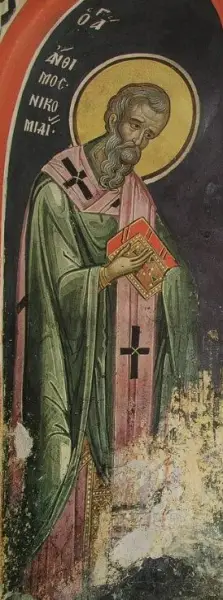
Overview
Anthimus of Nicomedia occupied the episcopal see of Nicomedia in Bithynia and was beheaded there in a persecution of Christians customarily assigned to Diocletian — the persecution in which, following Eusebius, 'rivers of blood' flowed. Nicomedia was Diocletian's chief place of residence and was half-Christian, with the palace itself filled with Christians; Christian sources memorialized the horror as the 20,000 Martyrs of Nicomedia. The city's main church was destroyed on 23 February 303 and the First Edict published the following day; not long afterward fire swept the imperial palace, and the Christians took the blame. In the Christian communities of Bithynia massacres followed: altars had been erected in the marketplaces, and no buying or selling was allowed there until a token sacrifice had been made to the gods and to the daemon of the Augustus. His congregation asked him to withdraw, and Anthimus found shelter in the village of Omana, where he helped the survivors and sent letters urging the Christians to stand firm. Soldiers came looking for him; he received them warmly and fed them before telling them who he was, and struck by his kindness they promised to say they had found no one — yet Anthimus went back with them, converting and baptizing them on the road. The Chronicon Paschale keeps a fragment of a letter written from prison by the presbyter Lucian of Antioch, which names Anthimus as freshly martyred; Lucian died under Maximinus Daia in 311 or 312, so Schaff and Wace reason that, if the fragment is authentic, Anthimus perished not under Diocletian but under Maximinus.
The Complete Life
Nicomedia under Diocletian
Anthimus governed the church of Nicomedia, the city Diocletian had made his chief residence and one of the capitals of the empire. Nicomedia was half-Christian: the sources record that the palace itself was filled with Christians, among them servants of the emperor's household. When the Great Persecution opened there, it did so at the center of imperial power — the persecution's first edict was posted in Nicomedia, and a Christian tore it down in protest and was executed at once, the first martyr of the new era. The Christian memory of what followed was codified as the 20,000 Martyrs of Nicomedia.
§ History
Persecution and Martyrdom
On 23 February 303 the main church of Nicomedia was destroyed, and the First Edict was published the following day: scriptures to be surrendered, churches demolished, Christian worship forbidden. Shortly afterward fire broke out in the imperial palace and was blamed on the Christians. Then came the altar test through the Bithynian marketplaces — no buying or selling allowed until a token sacrifice had been made to the gods and to the daemon of the Augustus — and the massacre of those who refused. At his people's urging Anthimus hid in the small village of Omana, tending the survivors and dispatching letters that urged the Christians to stand firm — a bishop shepherding from hiding. Soldiers dispatched to hunt him down were welcomed and fed by him before he told them who he was; in their amazement they promised to say they had found nothing — yet Anthimus chose to go back with them, and on the road converted and baptized his own escort. At Nicomedia he was beheaded. The tradition places the death under Diocletian in 303, but the soldiers are said to have been sent by Maximinus — and the fragmentary prison letter of Lucian of Antioch preserved in the Chronicon Paschale, which mentions Anthimus as just martyred, points to 311 or 312 under Maximinus Daia. Schaff and Wace concluded the persecutions have been conflated.
§ History
Veneration
Anthimus is a pre-congregation hieromartyr, venerated in the Eastern Orthodox Church on 3 September, in the Roman Catholic Church on 24 April, and in the Oriental Orthodox churches. His attribute in the calendars of martyrs is the 20,000 Martyrs of Nicomedia, the company of the dead of his city whose bishop he was.
§ Introduction
Legacy
Anthimus's legacy rests on two images the tradition has never released: the bishop in hiding, feeding the soldiers sent to arrest him, and the letters that kept a scattered flock standing while the altars stood in the marketplaces. His uncertain date — Diocletian or Maximinus — is itself part of what he represents: the persecution of Nicomedia ran so long and so bloody that its martyrs' calendars merged. The church he led at the center of the empire's first comprehensive assault on Christianity has kept his memory for seventeen centuries.
§ History
Timeline
- 23 Feb 303
Demolition of the main Christian church of Nicomedia, the emperor's residence city
§ History
- 24 Feb 303
Publication of the First Edict against Christians at Nicomedia, the day after the church's demolition
§ History
- 303
A fire in the imperial palace is blamed on Christians, and massacres sweep Bithynia
§ History
- 303
Beheaded at Nicomedia during the persecution, traditionally placed under Diocletian
§ Introduction
- 311
A prison letter of Lucian of Antioch, if genuine, records Anthimus as just martyred, favouring 311-312
§ History
The Record
- Major works
- Letters of exhortation to the persecuted Christians of Bithynia (lost)
- Symbols
- Bishop's vestments·Sword of his beheading
- Canonization
- Pre-congregation; venerated in the Eastern Orthodox, Catholic, and Oriental Orthodox Churches
Prayer
Bibliography
Show 7 sources
- ↑ Martyrologium Romanum (2004) . Vatican City: Administrationem Patrimonii Sedis Apostolicae in Civitate Vaticana. 2004. pp. 251– 252 . Retrieved 19 April 2026 .
- ↑ Schaff and Wace, Nicene and Post-Nicene Fathers, Series II, Vol. I: Book VIII, chapter VI
- ↑ Monks of Ramsgate. “Anthimus”. Book of Saints, 1921. CatholicSaints.Info. 21 July 2012.
- ↑ Amore, Agostino. "Sant 'Antimo of Nicomedia", Santi e Beati, November 19, 2001
- ↑ "About Saint Anthimus of Nicomedia", GreekBoston.com
- ↑ "Hieromartyr Anthimus the Bishop of Nicomedia", Orthodox Church in America
- ↑ "Anthimus, Bishop of Nicomedea", Greek Orthodox Archdiocese of America
Profile text adapted from the Wikipedia article, licensed CC BY-SA 4.0.
Pray with this saint every day
Save St. Anthimus of Nicomedia to your favorites, read the full profile, and get feast-day reminders in the Saints app.
Get the Saints AppFree on the App Store for iPhone and iPad