
died 303·Feast May 11
St. Anthimus of Rome
Priest and Martyr
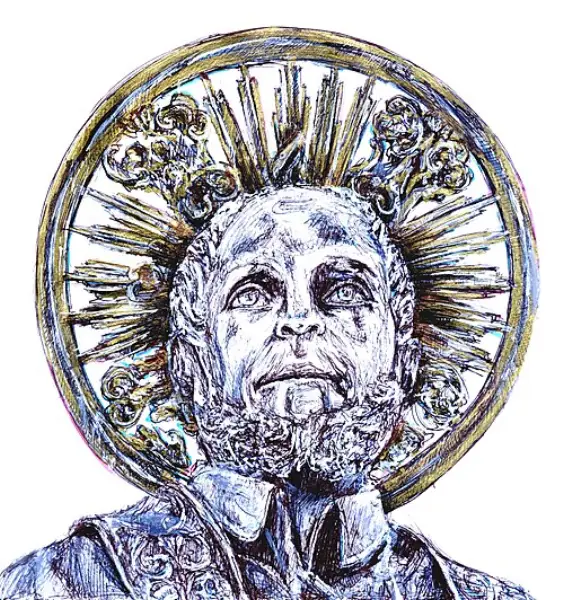
Overview
Anthimus of Rome — Sant'Antimo in Italian — is a Christian saint said to have been born in Bithynia and martyred in 303. A priest, he was imprisoned for the faith under the Emperors Diocletian and Maximian, and his surviving life, which its own editors admit is largely composed of legend, tells a romantic tale of the Great Persecution. Illness struck Pinianus, the Roman governor of Bithynia; Lucina, his Christian wife — famed for her charity toward Christians in prison and a niece of Emperor Gallienus — went to find Anthimus in prison, and through the priest's prayers the governor was both converted and healed. Pinianus in gratitude freed all the Christian prisoners of his province and hid Anthimus in his villa on the Via Salaria. Operating from Italy, tradition credits Anthimus with numerous converts and boundless miracles — among them the conversion of a priest of Silvanus together with the man's whole household; charged with smashing the god's image, he was hurled into the Tiber, a stone fastened about his neck, saved — so the legend runs — by an angel, seized once more, and put to the sword on the consul Priscus's orders. His burial took place in the oratory that had been his usual place of prayer. His tomb at Montemaggiore drew pilgrimage, and in the Carolingian era his body was translated to Tuscany, where the abbey of Sant'Antimo stands over the relics.
The Complete Life
A Bithynian Priest Under the Persecution
Bithynia — the Roman province of Asia Minor whose Christian communities were old and numerous by the third century; the tradition gives no family or see. He was a priest — not a bishop, whatever later confusion may suggest — he was jailed on account of his faith under the Emperors Diocletian and Maximian — that is, in the opening years of the Great Persecution of 303. The acts that survive for him belong to the legendary stratum of persecution literature: the preface to his passio is honest about this, and modern notices begin with the same caution. Yet the frame is historical — priests of Bithynia were in fact arrested in these years, and the machinery of trial, imprisonment, and execution that the legend describes is the real machinery of 303. Bithynia's church had already given the age its confessors, and the persecution's edicts of 303 reached the province's priests within months of publication.
The Governor's Villa on the Via Salaria
The legend's central episode is a domestic one. The Roman governor of Bithynia, Pinianus, was stricken with illness; Lucina — Lycinia in certain texts — his wife, a Christian celebrated for aiding Christians held in prison and related to Emperor Gallienus as a niece, tracked Anthimus down in his cell. Pinianus came to the faith through Anthimus, and his cure followed. What followed was public and astonishing: every Christian prisoner in the governor's province went free at Pinianus's hand, and Anthimus was given shelter in the governor's own villa on the Via Salaria, in Italy. The legend reckons that from this retreat the priest won over many and performed miracles without number — his tally including a priest of the god Silvanus along with that pagan priest's whole household — the sort of statistic by which the passio measured an apostolate. The setting of the mission — a governor's household, a wife's charity, a villa on the Via Salaria — reads as a domestic romance built around the stock figures of the passio.
The Tiber and the Sword
Anthimus's success caught up with him. Charged with smashing the simulacrum of Silvanus, he was cast into the Tiber, a stone tied about his neck; the legend relates an angel's miraculous rescue, a second arrest, and finally execution by beheading at the command of the consul Priscus. The sequence — drowning, deliverance, sword — follows a familiar martyrological grammar in which the first execution fails so that the confessors may speak once more before the second succeeds. The oratory that had seen his daily prayer received his body for burial, and his commemoration on 11 May found its way into the martyrologies, among them the Roman Martyrology of Gregory XIII. The sequence of drowning, deliverance, and the sword follows the familiar martyrological grammar in which the first execution fails so that the confessor may speak once more. The pilgrims who came to Montemagiore, and the Tuscans who received the relics in the Carolingian era, fixed his cult in two provinces of Italy.
From Montemaggiore to Sant'Antimo
Montemagiore was the original resting place of Anthimus's tomb, a goal of pilgrims and of veneration from very early on. During the time of Charlemagne his body was translated to Tuscany, near Montalcino, where the abbey of Sant'Antimo now stands — one of the loveliest Romanesque churches of Italy, named for the saint whose relics it was built to hold. One seventeenth-century Bollandist scholar advanced the idea that Pope Hadrian I handed over the relics of Saint Sebastian and of Anthimus to Charlemagne, who presented them to the abbey at its founding; the theory, as the modern notice concedes, has not been verified. What is certain is that the Tuscans believed it, and that the saint of the Via Salaria has been for a thousand years a saint of the Val d'Orcia. The Bollandists of the seventeenth century, who edited his acts, already distrusted the translation story, and the modern notice repeats their caution.
Timeline
- 303
Imprisoned as a Christian priest during the reign of Diocletian and Maximian
§ Introduction
- 303
After the Silvanus accusation and an angelic rescue from the Tiber, he was beheaded on the consul Priscus's orders and buried in his oratory
§ Legend
The Record
- Patron of
- Sant'Antimo, Tuscany·Prisoners
- Symbols
- Priest's vestments·Stone and rope·Palm of martyrdom
- Canonization
- Pre-congregation (ancient cult; relics at the abbey of Sant'Antimo, Tuscany)
Prayer
Profile text adapted from the Wikipedia article, licensed CC BY-SA 4.0.
Pray with this saint every day
Save St. Anthimus of Rome to your favorites, read the full profile, and get feast-day reminders in the Saints app.
Get the Saints AppFree on the App Store for iPhone and iPad