
1807-1870·Feast October 24 (23 October in older calendars)
St. Anthony Mary Claret
Archbishop of Santiago de Cuba, Founder of the Claretians
Overview
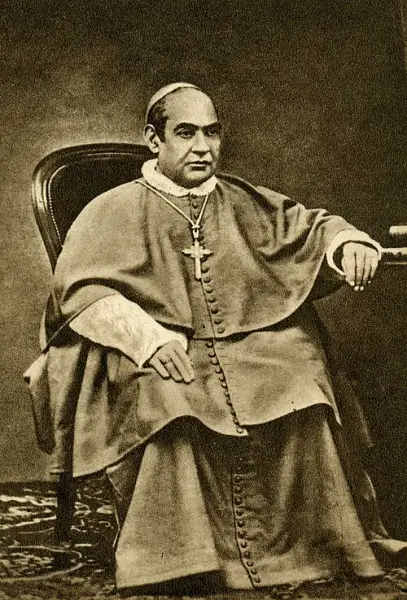
Antoni Maria Claret i Clarà, born at Sallent in the province of Barcelona on 23 December 1807, fifth of the eleven children of a wool manufacturer, became a missionary archbishop, founder of the Claretians, confessor of Queen Isabella II, and a saint of the modern Church. A weaver at twelve and a specialist on Jacquard looms in Barcelona by eighteen, he abandoned the trade for Vic's seminary in 1829, receiving priestly ordination on 13 June 1835. After parish work, Rome and an aborted Jesuit novitiate broken by ill health, he became an apostolic missionary throughout Catalonia, walking from mission to mission, preaching in Catalan to crowds who filled the plazas, and spending long hours in the confessional. Threatened by anti-clericals in 1848, he gave retreats in the Canary Islands for fifteen months. On 16 July 1849 he brought his Congregation — the Missionary Sons of the Immaculate Heart of Mary, the Claretians — into being, and established Barcelona's great religious library, which still carries his name. Named Archbishop of Santiago de Cuba by Pius IX in 1849 at the Spanish crown's request, he reorganized the seminary, validated over nine thousand marriages, visited the whole diocese three times, founded hospitals, schools, credit unions and, with Maria Antonia Paris, the first women's institute in Cuba, and was stabbed in the cheek at Holguín by a would-be assassin whose death sentence he obtained commuted. Recalled to Spain in 1857 as the Queen's confessor, he died in exile at Fontfroide, near Narbonne, on 24 October 1870.
The Complete Life
Weaver and Seminarian
Antoni Maria Claret i Clarà first saw the light on 23 December 1807 at Sallent, in the county of Bages, province of Barcelona — fifth among the eleven children of Juan and Josefa Claret, the father a maker of woolen cloth. As a child he loved the pilgrimages of the neighborhood, especially to the shrine of Our Lady of Fussimanya. His schooling was elementary, and at twelve he entered the weaving trade; at eighteen he went to Barcelona to specialize as a Jacquard loom programmer, the high technology of the textile industry, remaining there until twenty while teaching himself Latin and French and learning engraving. The work captured him, and he later confessed that he was frightened to find his love of active life and design becoming an obsession that burned him out; feeling the pull to religion, he left Barcelona. His first wish was to join the Carthusians; instead he enrolled at the diocesan seminary in Vic in 1829, and on 13 June 1835 — the feast of St Anthony of Padua, whose name he later wove into his own religious name — he was ordained.
§ Life
Missionary of Catalonia and the Canaries
After ordination Claret held a benefice in his native parish and studied theology there until 1839, but missionary work drew him, and he set out for Rome, entering the Jesuit novitiate, which ill health forced him to leave. Returning to Spain, he exercised a startling pastoral ministry in Viladrau and Girona on behalf of the poor, and was then sent by his superiors as an apostolic missionary throughout Catalonia, a countryside still suffering from the effects of the French invasions. He went on foot from mission to mission. An eloquent preacher fluent in Catalan, he drew people from miles around, and after long hours in the pulpit he spent longer ones in the confessional. Anti-clericals threatened his life in 1848, and he was dispatched to the Canary Islands; for fifteen months he preached retreats there to congregations so vast that an improvised pulpit in the plaza outside the church often had to serve. The pattern of his life was set: preaching, printing, organizing, always on foot among the ordinary people.
§ Life
Founder and Archbishop
Back on the mainland he brought his Congregation — the Missionary Sons of the Immaculate Heart of Mary, the Claretians — into existence on 16 July 1849, Our Lady of Mount Carmel's feast, and set up Barcelona's great religious library, the Librería Religiosa that is today the Librería Claret, enlisting the press in the mission's service. In the same year Pius IX, at the request of the Spanish crown, appointed him Archbishop of Santiago de Cuba; he was consecrated at Vic in October 1850, after three pilgrimages, to the Pillar at Zaragoza, to Montserrat, and to Fussimanya near his village. His episcopate in Cuba amounted to reform on every front: the seminary reorganized, clerical discipline tightened, more than nine thousand marriages validated within two years, a hospital and many schools built, the diocese in its entirety visited three times over, trade schooling set up for disadvantaged children along with credit unions serving the poor, and books on rural spirituality and agriculture written and tried out on his own land. With Maria Antonia Paris he founded the Religious of Mary Immaculate on 25 August 1855, considered the first women's religious institute in Cuba.
§ Archbishop
Confessor, Exile, Death
Opposition gathered around his work; at Holguín a would-be assassin drove a blade into his cheek, though Claret managed to have the man's death sentence commuted to imprisonment, and the scarred archbishop simply carried on with his rounds. February 1857 brought his recall to Spain at Queen Isabella II's summons: she took him as her confessor, a court post accepted under protest and held while the liberal press attacked without pause, unable to forgive a preacher of his politics dwelling so close to the throne. He obtained permission to resign the Cuban see and was appointed to a titular see, continuing to preach, publish and direct his growing congregation, whose rules he drew up along with those of several communities of religious sisters. With the revolution of 1868 he accompanied the Queen into exile and followed the Council fathers to Rome, where he defended, among other things, the definition of papal infallibility he did not live to see proclaimed. He died at the Cistercian abbey of Fontfroide near Narbonne in France on 24 October 1870, at sixty-two.
§ Introduction
Canonization and Legacy
Claret was beatified by Pius XI on 25 February 1934 and canonized by Pius XII on 7 May 1950, his feast kept on 24 October, and on 23 October in the older calendar. His congregation, the Claretians, grew after his death into one of the large missionary families of the Church, with over 450 houses and 3,100 members in the early twenty-first century and missions on five continents, and the institute of the Religious of Mary Immaculate and the other communities he founded or formed continue his work. He is the patron saint of weavers and textile merchants, an unusual patronage carried forward from the looms of Barcelona. His combination of popular missionary and publishing entrepreneur has made him a model for modern evangelization, and his life, from the Jacquard loom to the First Vatican Council, spans the whole transition of the Spanish church from the old regime to the modern world.
§ Introduction
Timeline
- 23 Dec 1807
Born at Sallent near Barcelona, fifth of eleven children born to Juan and Josefa Claret
§ Life
- 1819
Becomes a weaver at twelve; at eighteen he moves to Barcelona to specialize on Jacquard looms
§ Life
- 1829
Enters the diocesan seminary at Vic, having abandoned an earlier plan to become a Carthusian
§ Life
- 13 Jun 1835
Ordained a priest on the feast day of Saint Anthony of Padua
§ Life
- 1839
After studying theology, proceeds to Rome and enters the Jesuit novitiate, but leaves because of ill health
§ Life
- 1848
His life threatened by anti-clericalists, he is sent to the Canary Islands, where he gives retreats for fifteen months
§ Life
- 1849
Appointed Archbishop of Santiago de Cuba by Pope Pius IX at the request of Queen Isabella II
§ Archbishop
- 16 Jul 1849
Founds the Claretians (Missionary Sons of the Immaculate Heart) on the Carmelite feast of Our Lady of Mount Carmel
§ Claretians
- Oct 1850
Consecrated bishop at Vic before making three pilgrimages and embarking for his Cuban see
§ Archbishop
- 25 Aug 1855
Founds the Religious of Mary Immaculate with Maria Antonia Paris, the first women's institute in Cuba
§ Archbishop
- Feb 1857
Recalled to Spain by Queen Isabella II as her confessor; resigns his Cuban see for the titular see of Trajanopolis
§ Archbishop
- 22 Dec 1865
Pope Pius IX grants papal approval to the Claretian congregation
§ Claretians
- 1868
A revolution exiles the queen; his own life in danger, he accompanies her to Paris and then goes to Rome
§ Archbishop
- 1869
Travels to Rome to make ready for the upcoming First Vatican Council
§ Last years
- 24 Oct 1870
Dies aged 62 at the Cistercian abbey of Fontfroide near Narbonne, after withdrawing to the French Pyrenees
§ Last years
- 1897
His relics are transferred to the mission house at Vic, where his heart is found incorrupt
§ Veneration
- 1899
Declared venerable by Pope Leo XIII
§ Veneration
- 24 Feb 1934
Beatified in Rome by Pope Pius XI
§ Veneration
- 7 May 1950
Canonized by Pope Pius XII sixteen years after his beatification
§ Veneration
- 1960
Pope John XXIII adds him to the General Roman Calendar with a feast on 23 October
§ Veneration
- 1969
The calendar revision transfers his feast to 24 October, the anniversary of his death
§ Veneration
The Record
- Major works
- The Claretian founding documents·Librería Religiosa (religious library and publications)·Books on rural spirituality and agriculture·Catechisms and preaching collections
- Patron of
- Weavers·Textile merchants·The Claretian family·Cuba (by tradition)
- Symbols
- Bishop's robe and crozier·Open book and catechism·Two students beside him
- Canonization
- Beatified 25 February 1934 by Pope Pius XI; canonized 7 May 1950 by Pope Pius XII
Prayer
Bibliography
Show 1 sources
- ↑ In this Catalan name , the first or paternal surname is Claret and the second or maternal family name is Clarà ; both are generally joined by the conjunction "i".
Profile text adapted from the Wikipedia article, licensed CC BY-SA 4.0.
Pray with this saint every day
Save St. Anthony Mary Claret to your favorites, read the full profile, and get feast-day reminders in the Saints app.
Get the Saints AppFree on the App Store for iPhone and iPad