
c. 983–1073·Feast July 10 / 23 (Julian; Gregorian); May 7 (Roman Martyrology)
St. Anthony of Kiev
Founder of the Kiev Caves Lavra, Father of Russian Monasticism
Overview
Anthony of Kiev, also Anthony of the Caves (Antoniy Pecherskyi), born Antipas at Liubech around 983, was the founder of the monastic tradition in Kievan Rus and co-founder, with Theodosius of Kiev, of the Kiev Pechersk Lavra, the Monastery of the Caves. A pull toward the spiritual life showed itself in him early: he sailed for Mount Athos and entered the Greek monastery of Esphigmenou, where he lived as a hermit in a cave overlooking the sea. Around 1011 the abbot sent him back to his native Kiev — newly Christian after the conversion of Vladimir — to expand monasticism there. Finding the princely monasteries not austere enough for his Athos-formed standards, he settled in a small cave dug by the presbyter Hilarion, eating rye bread every other day and drinking little water. The princes' fratricidal war after Vladimir's death in 1015 drove him back to Athos; sent again with the prophecy that many monks would join him, he gathered disciples — the priest Nikon first, then Theodosius — dug the great cave, and founded what became the Lavra. He gave the abbacy first to Barlaam, then to Theodosius, and withdrew again to a solitary cave (the first of the Far Caves). He opposed the princes when they deserved it, was banished to Chernigov, was recalled, blessed the foundation of the Lavra's great stone church, and died in 1073 at about ninety, asking that his remains be hidden forever — they never have been found.
The Complete Life
Antipas of Liubech, Monk of Athos
Anthony was born at Liubech on the Dnieper, in the principality of Chernigov, around 983 — a generation before the official baptism of Rus in 988, though his own town's region was among the first touched by Christianity from the south. He was baptized with the name Antipas. The same attraction to the spiritual life appeared in him early, and he did what only the most serious of the early Russian ascetics did: he went to the source. He traveled to Mount Athos, the Holy Mountain newly taking shape as the monastic republic of the Orthodox world, and joined the Greek monastery of Esphigmenou, on the peninsula's northeastern shore. There he lived as a hermit in a secluded cave overlooking the sea — a cave which, the tradition notes, is open to visitors today. The pattern of his whole life was set on Athos: the cave, the solitude, the austerities, and the conviction that monasticism meant something harder than what he would find when he went home.
§ Early life
Planting the Caves
Around 1011 his abbot at Esphigmenou dispatched Anthony to spread monasticism in his native Kiev, a city whose conversion to Christianity had only just begun. Back home he discovered a number of monasteries founded at the command of the local princes, none of them as severe as the Athos life he had known. He chose instead a small cave dug by the presbyter Hilarion, and lived there alone. The war of Vladimir's sons after the great prince's death in 1015 interrupted the work and drove him back to Athos; when the conflict ended, the abbot dispatched him to Kiev once more, with the prophecy that crowds of monks would attach themselves to him when he returned. That prophecy proved true. His strict asceticism — rye bread every other day, a little water — became known in the city, and people came for his blessing, then to stay. The first was the priest Nikon; the second was Theodosius, the future co-founder and organizer. They dug a large cave, built a church and cells within it, and laid the foundation of what became the Kiev Caves Lavra.
§ Establishment of Kiev Pechersk Lavra
Withdrawing from His Own Foundation
Anthony, committed to the solitary-hermit ideal of his namesake Anthony the Great, would not govern what he had gathered. He appointed Barlaam of Kiev as first abbot; when Barlaam was called away to head St Demetrios, the new monastery by the city gates, the monks turned to Anthony for a successor, and he gave them Theodosius — the administrator and lawgiver whose partnership with the hermit made the Lavra work. Anthony left his cave for a nearby mountain and dug another for himself, which became the first of the Far Caves. He never shrank from opposing the mighty: when Iziaslav required the monastery to expel a wealthy boyar's son — one of the prince's own retainers — Nikon replied that he could not strip the King of Heaven of his soldiers, and Anthony judged it prudent to withdraw until the prince's anger cooled. When Iziaslav and his brothers, facing an uprising of the Cumans, came for his blessing, he refused it and foretold their defeat for their sins.
§ Establishment of Kiev Pechersk Lavra
The Stone Church and the Hidden Tomb
Political suspicion finally forced him out: Iziaslav, suspecting Anthony of sympathizing with the opposition, arranged to banish him on his return — but Iziaslav's brother Sviatoslav had him secretly taken to Chernigov, where Anthony dug himself yet another cave, on the site of the Eletsky Monastery. Reconciliation followed and he came back to Kiev, where he and Theodosius determined to build a larger stone church for the ever-increasing number of monks. Anthony did not live to see it built. His death came in 1073, when he was about ninety, not long after he had blessed the laying of the new church's foundations. Knowing it was near, he gathered the monks, comforted them for what they were about to lose, and asked that his body be concealed for all time — and so it was done. They laid him to rest in his cave, and no relics have ever been found — the founder of Russian monasticism, who asked to disappear, has succeeded in it permanently, and the pilgrims who come to the cave to pray have reported healings there for nine centuries.
§ Exile and return
Legacy
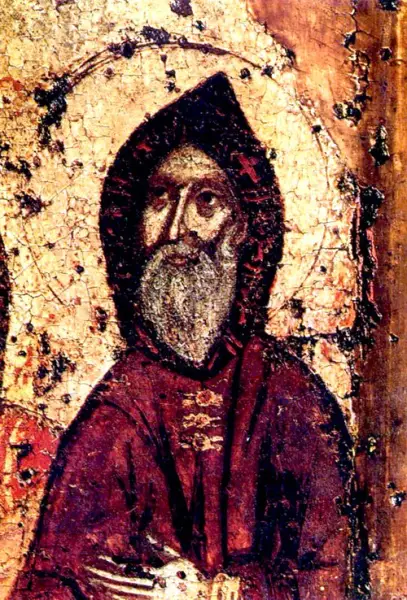
Anthony is venerated as the founder of monasticism in Kievan Rus — the beginning of the tradition that produced the Trinity-Sergius Lavra, the startsy of Optina, and the whole vast family of Russian and Ukrainian monasticism. His feast is 10 July (23 July Gregorian) in the Orthodox churches that follow the Julian calendar; the Roman Martyrology keeps him on 7 May, one of the few Kievan saints in the Western book. His major shrine is the Svensky Monastery, and his icon, of which a fragment of 1288 survives, is among the oldest monastic images of Rus. The Lavra he founded became the spiritual and intellectual centre of the Rus church — its crypt, its Paterikon, its chroniclers — and the Near Caves in which he was buried remain the goal of pilgrimage. The model he set — the founder who refuses office, the hermit who generates community — remained the ideal of Eastern monasticism ever after.
§ Introduction
Timeline
- 983
Born at Liubech in the Chernigov principality and baptized with the name Antipas
§ Introduction
- 1011
His abbot at Esphigmenou on Mount Athos entrusts him with expanding monasticism in Kiev
§ Early life
- 1015
Returns to Mount Athos when Vladimir the Great's death sparks a fratricidal war among his sons
§ Return to Kiev
- 1073
Dies in Kiev aged about ninety, soon after blessing the foundation of the great stone church
§ Exile and return
The Record
- Patron of
- Ukrainian and Russian monasticism (founder)·Svensky Monastery
- Symbols
- Monastic habit, sometimes with an abbot's paterissa (crozier)
- Canonization
- Pre-congregation; glorified in the Orthodox tradition, listed in the Roman Martyrology
Prayer
Bibliography
Show 3 sources
Profile text adapted from the Wikipedia article, licensed CC BY-SA 4.0.
Pray with this saint every day
Save St. Anthony of Kiev to your favorites, read the full profile, and get feast-day reminders in the Saints app.
Get the Saints AppFree on the App Store for iPhone and iPad