
d. 8 October 1232·Feast October 8
St. Anthony of Novgorod
Archbishop of Novgorod (secular name Dobryna Yadreykovich)
Overview
Anthony of Novgorod, born Dobryna Yadreykovich into a wealthy Novgorod family — his father Yadrey, a governor of Novgorod, lost his life in 1194 while campaigning against Yugra — was archbishop of Novgorod in two terms, 1210-1218 and 1225/1226-1228. Around 1190 he entered Khutyn, the great monastery Varlaam had founded outside the city. In 1200 he made the pilgrimage to Constantinople, recording the journey in his Pilgrim's Book — a work historians prize for its picture of the city's churches and holy places on the eve of the Fourth Crusade's sack. When Novgorod's archbishop was banished in 1210, Anthony stepped into the position on a temporary basis, handing the see back once his predecessor was allowed to return; he resumed the archbishopric in 1225/1226 and remained in it until 1228, when bad health forced his retirement. Around 1220 he may have served as bishop of Przemysl in Galicia. He died on 8 October 1232, having been rendered mute by disease, and was canonized locally in 1439.
The Complete Life
Early Life
Anthony was born Dobryna Yadreykovich into a wealthy family of Novgorod, the merchant republic of the Russian north. His father, Yadrey, governed Novgorod and lost his life in 1194 while on campaign against Yugra, the fur-bearing lands beyond the Urals — service on that frontier carried off so many Novgorod grandees. Around 1190 the son joined the monastery of Khutyn, the house founded by Varlaam of Khutyn in the pine woods on the Volkhov outside the city, then the newest and most fashionable center of Novgorod piety. The monastic name Anthony replaced the pagan-sounding Dobryna, and the young monk's family wealth and education marked him early for the church's service. Around 1190 he took the habit there under the monastic name Anthony, laying aside the secular name Dobryna as he crossed from Novgorod's governing class into the cloister. The city would twice call him out of that cloister to its see.
§ Life
Vocation: The Pilgrim
In 1200 Anthony undertook what every monk of his age dreamed of: a pilgrimage to Constantinople, the New Jerusalem of the Orthodox world. He recorded the journey in his Pilgrim's Book, which survives and is of quite extraordinary interest to historians — a portrait of the city, its religious monuments, and its public worship: the relics, icons, and processions of a Constantinople at the very height of its medieval splendor, captured by an eyewitness barely four years before the Fourth Crusade carried so much of what he had seen off to Venice and the West. His account of the city's churches is one of the most important witnesses to Byzantine Constantinople as it existed, and it made a Novgorod monk the involuntary archivist of a lost world. The Pilgrim's Book even travels alone: his account of Hagia Sophia circulates as a free-standing extract for readers who want his Constantinople in miniature.
§ Life
Two Terms as Archbishop
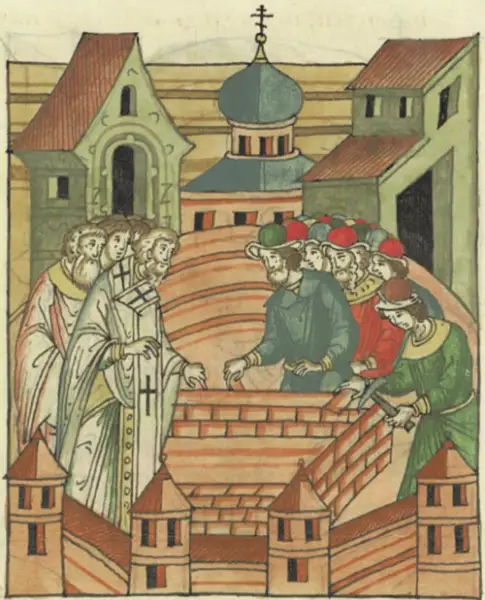
Anthony's public career was twice interrupted and twice resumed. When Novgorod's archbishop was banished in 1210 amid one of that city's perpetual political storms, Anthony stepped into the position on an interim basis, and gave the see back once his predecessor was allowed to come home — an act of self-effacement that the chronicles note without comment. Around 1220, during Mstislav Mstislavich's rule in Galicia, he may have held the bishopric of Przemysl, if some Russian sources are right. He took up the archbishopric of Novgorod once more in 1225/1226, holding the post until 1228, when ill health made him step down. This second term saw church-building in Novgorod — the miniature tradition shows him laying the foundation of a church — and the ordinary round of a hierarch's arbitration in the republic's affairs. Through both terms he remained at bottom the monk of Khutyn, the Pilgrim's Book author now wearing an archbishop's orders.
§ Life
Final Years
Anthony's retirement in 1228 was forced by illness, and the disease that drove him from the see eventually rendered him mute — a cruel providence for a man whose first fame had been as a writer, and a silence the Russian tradition received as a final asceticism. He died on 8 October 1232 at Novgorod, four years after laying down his office, and was buried in the cathedral of Holy Wisdom among his predecessors. His death fell on the eve of the century of catastrophe — the Mongol invasions, the Swedish and German attacks — that would test everything he and his generation had built. The sixteenth-century Illustrated Chronicle of Ivan the Terrible pictured him laying the foundation stone of a church, the image by which later Russia remembered its mute archbishop. His muteness makes the chronicle's choice of image — foundation stone, not sermon — all the more telling.
§ Introduction
Canonization
Anthony's canonization as a local saint came in 1439, part of the program by which the maturing church of Novgorod gathered up its episcopal memory. Archbishop Euthymius II of Novgorod instituted a feast on 10 February in honor of Novgorod's princes and saints; when the calendars of the seventeenth and eighteenth centuries drew up a Synaxis of Novgorod Saints, Anthony stood among them, his place in the city's liturgical memory secure. His individual feast on 8 October, the day of his repose, is kept in the Russian Church's calendars. The 1439 act was a local canonization — a city honoring its own archbishop rather than a church-wide decree — and so he is kept in character: on 8 October in the Russian calendars, and named again in the February Synaxis of Novgorod's saints, his memory always tied to the city itself.
§ Introduction
Legacy
Anthony's most tangible legacy is a book. The Pilgrim's Book has been edited, translated, and quarried by every historian of Byzantine Constantinople, because it records, building by building and relic by relic, the imperial city as it stood in 1200; scholars reconstruct the lost monuments of Byzantium partly through a Novgorodian's eyes. In Novgorod itself his memory is that of the archbishop of two terms, the man who took the see, gave it back, took it again, and laid it down when his body failed. The illustrated chronicles of the sixteenth century show him with his foundation stone; the church keeps him with the saints of the city in February and alone in October. From the Brockhaus and Efron dictionary onward, the reference literature has never lacked an article on Anthony, remembered chiefly as the man whose book preserved Constantinople. The book did what no chronicle entry could: it kept the archbishop himself before the reader's eye.
§ Life
Timeline
- 1190
Entered the monastery of Khutyn near Novgorod
§ Life
- 1200
Undertook a pilgrimage to Constantinople and recorded it in his Pilgrim's Book
§ Life
- 1210
Became archbishop of Novgorod temporarily after the incumbent was banished, and gave back the see on his return
§ Life
- 1220
May have served as bishop of Przemysl while Galicia was under Mstislav Mstislavich, per some Russian sources
§ Life
- 1225
Became archbishop of Novgorod for a second term in 1225/1226
§ Life
- 1228
Retired from the see for health reasons
§ Life
- 8 Oct 1232
Died at Novgorod, his speech having been lost to disease
§ Life
- 1439
Canonized as a local saint of the Russian Orthodox Church
§ Veneration
The Record
- Major works
- The Pilgrim's Book (Kniga palomnik), an account of Constantinople c. 1200
- Patron of
- Novgorod and its saints
- Symbols
- Archbishop's vestments·Pilgrim's staff
- Canonization
- Canonized as a local saint in 1439
Prayer
Bibliography
Show 6 sources
- 1 2 3 4 5 Nazarenko, A. V. (2001). "Антоний". Православная энциклопедия — Т. II: Алексий, человек Божий — Анфим Анхиальский . Православная энциклопедия. pp. 600– 601. ISBN 5-89572-007-2 .
- 1 2 Keck, Karen Rae (1998), "Anthony of Novgorod" , The Ecole Initiative , archived from the original on 2012-04-07 , retrieved 2011-10-21
- 1 2 Walsh, Michael (2007), A New Dictionary of Saints: East and West , Liturgical Press, p. 54, ISBN 0-8146-3186-X
- 1 2 3 Majeska, George P. (2016), "Politics and Hierarchy in the Early Rus' Church: Antonii, a 13th-century Archbishop of Novgorod" , Tapestry of Russian Christianity: Studies in History and Culture. , retrieved 2019-02-01
- ↑ Geary, Patrick J. (1994), Living with the dead in the Middle Ages , Reference, Information and Interdisciplinary Subjects Series, Cornell University Press, p. 223, ISBN 0-8014-8098-1
- ↑ Karpov, A. Антоний, архиепископ Новгородский [ Anthony, Archbishop of Novgorod ] (in Russian). www.portal-slovo.ru. Archived from the original on 4 May 2009.
Profile text adapted from the Wikipedia article, licensed CC BY-SA 4.0.
Pray with this saint every day
Save St. Anthony of Novgorod to your favorites, read the full profile, and get feast-day reminders in the Saints app.
Get the Saints AppFree on the App Store for iPhone and iPad