
1195-1231·Feast June 13
St. Anthony of Padua
Priest and Doctor of the Church
Overview
Fernando Martins de Bulhões entered the world in Lisbon in 1195, born to a family of wealth and standing who sent him to the cathedral school and then, at fifteen, into the Canons Regular of the Holy Cross. Seeking quiet for study, he transferred to the great priory at Coimbra, where he was ordained and served as guestmaster. Everything changed when the bodies of five Franciscans beheaded in Morocco were brought home for burial: moved by their witness, the young canon obtained leave to join the eleven-year-old Order of Friars Minor, taking the name Anthony after the hermitage chapel. His plan to die for the faith in Africa collapsed in illness; a storm drove his return ship to Sicily, and obscurity at a rural hermitage ended when he was pressed to preach at an ordination at Forlì in 1222 and stunned the room. Francis of Assisi himself soon handed him the theological formation of the friars. Anthony taught at Montpellier and Toulouse, preached through France and Italy against heresy with a memory so steeped in Scripture that Gregory IX called him the Ark of the Testament, and in 1228 was commissioned to gather his sermons for the Church. Made provincial of northern Italy, he settled near Padua, where Lenten preaching in 1231 drew crowds so vast he collapsed afterward. Eaten by ergotism, he died that June at Arcella, aged thirty-five, and was canonized within the year.
The Complete Life
Early Life
Fernando Martins de Bulhões was born in Lisbon on 15 August 1195 into a family that later tradition makes wealthy and noble — fifteenth-century writers name his parents Vicente Martins and Teresa Pais Taveira, though the historian Niccolò Dal-Gal judged such genealogies less than certain. His family had him taught at the cathedral school of the city, and at fifteen he was received among the Canons Regular of the Holy Cross at Saint Vincent's abbey on the edge of Lisbon. The young canon soon found the constant visits of family and friends a distraction from study, and in 1212 asked to be transferred to the congregation's motherhouse, the Monastery of the Holy Cross at Coimbra, then the capital of Portugal. There he studied theology and Latin in earnest, was ordained priest, and at only nineteen was named guestmaster of the abbey, placed in charge of hospitality. It was a quiet, promising clerical career — all of it about to be set aside.
Conversion and Vocation
Two things converged at Coimbra to change his direction. The first was the arrival of Friars Minor, who settled at a small hermitage outside the city dedicated to Saint Anthony the Great; Fernando was strongly drawn to their simple, evangelical manner of life, in an order then only eleven years old. The second was news from Morocco: five Franciscans had been beheaded there, the order's first martyrs, and King Afonso II ransomed their bodies to be buried as martyrs in the monastery where Fernando lived. Their example decided him. Fernando got leave from the church authorities to quit the Canons Regular and join the Franciscans, taking the name Anthony from the chapel of the hermitage at Olivais. He then set out for Morocco to preach, fell seriously ill, and sailed home; the ship was blown off course to Sicily. Making his way to Tuscany, he was received without enthusiasm on account of his sickly appearance and was assigned, as much for his health as anything, to the rural hermitage of Montepaolo near Forlì in Romagna, where he kept a cell in a cave, giving himself to prayer and study in obscurity.
Mission and Ministry
The obscurity ended at Forlì in 1222. At an ordination attended by Dominican friars, confusion arose about who was to preach; the Dominicans had come unprepared, and the superior of the hermitage, doubting any of his own friars could manage it, called on Anthony to say whatever the Holy Spirit should put in him. His impromptu sermon — rich voice, deep knowledge of Scripture, arresting substance — created so deep an impression that he was sent to the province of Romagna, and soon came to the attention of Francis of Assisi himself. Francis had distrusted theological studies in his brotherhood, fearing they would erode poverty and service; in Anthony he found a kindred spirit who could also teach the friars seeking ordination, and in 1224 he entrusted their studies to Anthony's care. Anthony taught briefly at Montpellier and Toulouse, but preaching remained his supreme gift: his method wed allegory and symbolic explanation of Scripture, and contemporaries said he preached the grandeur of Christianity. In 1226, after the general chapter at Arles and missions in Provence, he was appointed provincial superior of northern Italy and chose Padua as his base. In 1228 he served as envoy to Pope Gregory IX, whose court hailed his preaching as a jewel case of the Bible; the Pope called him the Ark of the Testament and commissioned his Sermones in Festivitates, Sermons for Feast Days.
Spirituality and Teaching
Anthony's spirituality joined the Franciscan love of poverty to an Augustinian seriousness about learning, and his sermons show both. He read Scripture as a vast system of signs in which every detail of the text could open onto Christ, and he taught his hearers — often the poor, sometimes heretics, once, famously, the fish of Rimini — to find the Gospel written through the whole of creation. The favourite of his miracles among the people belongs to his teaching life: a novice leaving the order took with him Anthony's psalter, hand-copied and annotated for his students and, under a vow of poverty, nearly irreplaceable; Anthony prayed, and the thief was moved not only to return the book but to return to the order. The book is said to be preserved at the Franciscan friary in Bologna, and the episode is the origin of the custom of praying to Anthony for lost things. His collected sermons, ordered by Gregory IX, remained in use for centuries, and earned him the title Doctor of the Church — the Evangelical Doctor, for a teaching that never strayed far from the plain Gospel.
Trial and Final Years
Anthony's trial was exhaustion rather than persecution. In 1231, sick with ergotism, he withdrew to the woods of Camposampiero with two brother friars, living in a cell built for him among the branches of a walnut tree. His health failing, he set out for Padua and died on the way, at the Poor Clare monastery of Arcella, on 13 June 1231, aged thirty-five. As he had asked, he was buried in the little church of Santa Maria Mater Domini beside a convent he had founded in 1229. His fame drew such crowds that construction of a great basilica over the site began around 1232, the older church surviving within it as the Chapel of the Dark Madonna; the basilica is known to Paduans simply as Il Santo. Accounts surround his death — children crying in the streets, bells ringing of their own accord — and his relics tell their own story: when the body was exhumed thirty years later it had turned to dust, but the tongue glistened as if living, a sign, devotees said, of his gift for preaching.
Canonization
Anthony's canonization was among the fastest in the Church's history. The inquiry into his life and virtues opened within months of his death at the request of Pope Gregory IX, who had heard him preach, and on 30 May 1232 — not quite a year after he died — Anthony was declared a saint, on the strength of a reputation that was already European. The speed reflected both the force of his reputation and the politics of a papacy eager to honour the new mendicant orders; Gregory IX, who had heard him at court and given him his nickname, was the pope of record. In 1946 Pius XII declared him a Doctor of the Church with the title Doctor Evangelicus. His feast on 13 June is kept throughout the Roman rite, and his tomb at Padua remains one of the most visited shrines in the world, drawing pilgrims of every nation to the city he chose as his base.
Legacy
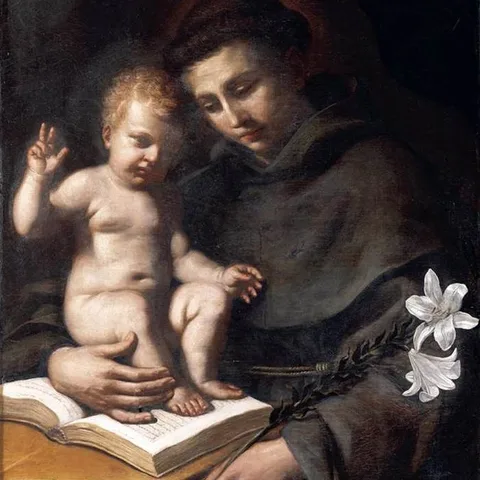
Anthony is, after Francis himself, probably the most invoked of all Franciscan saints. He is the patron of Padua, of Lisbon (his birthplace, where he is also called Anthony of Lisbon), of lost objects, of travellers, of the poor, and of amputees and those with skin complaints, the latter from the ergotism of his last illness. The custom of Saint Anthony's bread — alms given in thanksgiving for favours received through his intercession — has fed the poor for centuries. His sermons are still read for their method, and his image — the Franciscan holding the Child Jesus — is among the most reproduced in Christian art. and the Basilica of Padua, with its pilgrim crowds, keeps his cult at a scale few saints enjoy. In art he appears as a Franciscan with the Child Jesus, who according to a late tradition appeared to him, or with a book, a lily, and a burning heart.
Timeline
- 15 Aug 1195
Born Fernando Martins de Bulhões in Lisbon
§ Introduction
- 1210
Received at fifteen into the Canons Regular of the Holy Cross at the Abbey of Saint Vincent outside Lisbon
§ Early years
- 1212
Transferred to the congregation's motherhouse, the Monastery of the Holy Cross in Coimbra, where he studied theology and Latin
§ Early years
- 1214
Ordained a priest and named guestmaster of the abbey at nineteen
§ Joining the Franciscans
- 1222
An impromptu sermon at an ordination in Forli made his preaching famous
§ Preaching and teaching
- 1224
Francis of Assisi placed the theological training of the order's friars in his care
§ Preaching and teaching
- 1226
After the general chapter at Arles and preaching in Provence, appointed provincial superior of northern Italy and chose Padua
§ Preaching and teaching
- 1228
Served as envoy of the general chapter to Pope Gregory IX and was commissioned to write his Sermons for Feast Days
§ Preaching and teaching
- 1229
Founded a convent near the church of Santa Maria Mater Domini in Padua
§ Death
- 13 Jun 1231
Died at the Poor Clare monastery at Arcella, aged thirty-five, while returning to Padua from Camposampiero
§ Death
- 1232
Construction of the Basilica of Saint Anthony began on the site of his grave
§ Death
- 30 May 1232
Canonized by Pope Gregory IX at Spoleto, less than a year after his death
§ Canonisation and title
- 1261
His body, exhumed thirty years after death, was found dust except for the tongue
§ Death
- 16 Jan 1946
Declared a Doctor of the Church by Pope Pius XII
§ Canonisation and title
- 1 Jan 1981
Pope John Paul II authorized scientific examination of the relics, and the tomb was opened five days afterward
§ Death
In Their Own Words
The saints are like the stars, who, in His providence, Christ hides under a seal, lest they appear whenever they wish. Instead, they are always ready to disembark from the quiet of contemplation into the works of mercy at the time decided upon by God, whenever their heart should hear the word of command.
Just as the root feeds the tree, so humility feeds the soul. The spirit of humility is sweeter than honey, and whoever is fed by this sweetness produces fruit.
Solicitude for material things rends the soul; thus distracted, it divides it. The devil seizes the divided soul and thereby kills it.
Just as a tower defends a fortress, so humility of heart defends bodily chastity from the darts of fornication.
The Record
- Major works
- Sermones in Festivitates (Sermons for Feast Days)·Sermons for Sundays and the feasts of the saints (commissioned by Gregory IX)
- Patron of
- Recovery of lost items·Padua·Portugal and the former Portuguese empire·Marriage (in Portugal, Spain and Brazil)·The poor and the sick
- Symbols
- Book·White lily·The Infant Jesus·Bread (the Saint Anthony bread charity tradition)
- Canonization
- Canonized by Pope Gregory IX at Spoleto on 30 May 1232, less than a year after his death; declared Doctor of the Church (Doctor evangelicus) by Pope Pius XII on 16 January 1946
Prayer
Bibliography
Show 12 sources
- ↑ Portuguese : António/Antônio de Pádua ; Italian : Antonio di/da Padova ; Latin : Antonius Patavinus
- ↑ Portuguese : António/Antônio de Lisboa ; Italian : Antonio da/di Lisbona ; Latin : Antonius Olisiponensis
- ↑ Purcell 1960 , pp. 19, 275–276.
- ↑ Foley & McCloskey 2013 .
- 1 2 3 4 Dal-Gal 1907 .
- 1 2 3 Monti 2008 .
- ↑ Silva 2011 , p. 1.
- 1 2 3 "Anthony of Padua: The Italian Years – June 2007 Issue of St. Anthony Messenger Magazine Online" . 30 June 2007. Archived from the original on 30 June 2007.
- 1 2 Foley, Leonard. "Who Is St. Anthony?" . American Catholic. Archived from the original on 17 October 2000 . Retrieved 27 June 2011 .
- ↑ "Finding the Real St. Anthony: Devotion to St. Anthony of Padua" . 8 December 2000. Archived from the original on 8 December 2000.
- ↑ "When Anthony spoke again" . Messenger of Saint Anthony . Archived from the original on 2 April 2015 . Retrieved 21 March 2015 .
- 1 2 3 Arnald 2010 , pp. 122–125.
Profile text adapted from the Wikipedia article, licensed CC BY-SA 4.0.
Pray with this saint every day
Save St. Anthony of Padua to your favorites, read the full profile, and get feast-day reminders in the Saints app.
Get the Saints AppFree on the App Store for iPhone and iPad