
1067-1147·Feast January 17 and August 3
St. Anthony the Roman
Monk and Founder of the Antoniev Monastery
Overview
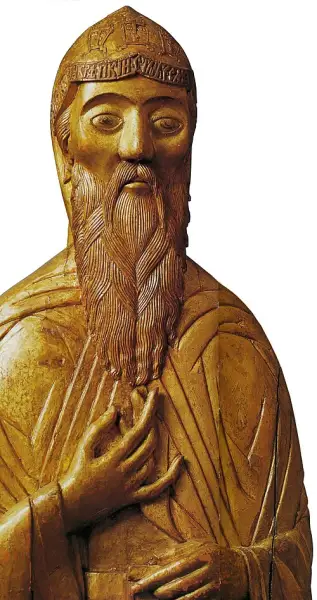
Anthony the Roman, known in Russian as Antony Rimlyanin, died on 3 August 1147; he established the Antoniev Monastery — also called St. Anthony's — at Novgorod. The hagiographic account of his life is known only from the second half of the sixteenth century and is legend in its outline: born in Rome in 1067 to an Orthodox family, he became a monk there, and when persecution of Orthodox believers began he departed the city and settled on the coast, where a storm one day raised the stone he was praying on and bore him across the sea, on that improbable raft, to the neighborhood of Novgorod. Not speaking Russian, he was informed by a Greek merchant where he was, presented himself to Bishop Nikita of Novgorod, and received permission to found a monastery at the very spot where the stone came ashore. The monastery church, the nativity of the Mother of God, was long said to have been consecrated in 1119, but the evidence suggests that Anthony became hegumen only in 1131 or 1132, after Niphont's installation as bishop, a delay perhaps reflecting frictions inside Novgorod's hierarchy. His death came on 3 August 1147, and he was buried in the monastery he had founded. Russian Orthodoxy has numbered him among the saints since 1597.
The Complete Life
The Legend
The life of Anthony is known only from a hagiographic account first recorded in the second half of the sixteenth century, four centuries after his death, and it must be read as Novgorod's memory rather than as a contemporary record. The legend tells that his birth took place at Rome in 1067, into a family of the Greek rite, and that he became a monk in that city; that when persecution of the Orthodox began, after the breach between the churches, he left and settled on the seashore in penitential solitude; and that one day, as he prayed upon a great stone, a storm rose, the sea lifted the stone with the monk upon it, and carried it across the waters until it grounded near Novgorod. The tale belongs to a family of floating-saint legends in which God carries his servants where they are needed; behind it historians have suspected a real biography, of a monk from the Roman or more likely the southern Italian Greek world who made his way, by more ordinary conveyances, to the Russian north in the generation after the schism, bringing with him the customs and the stories of the older church.
§ Introduction
Vocation
Arrived, by whatever means, the monk without Russian was identified by a Greek merchant who happened to be at the landing place, and was brought to Bishop Nikita of Novgorod, the learned hierarch of the young republic. Anthony asked for, and received, permission to found a monastery at the spot where the stone had come ashore, and there, close by the Volkhov, the Antoniev monastery arose, its church of the Nativity of the Mother of God traditionally consecrated in 1119. The reality beneath the dates was more complicated: the evidence of the chronicles suggests that Anthony became hegumen only in 1131 or 1132, immediately after Niphont was installed as bishop of Novgorod, a delay of some years that presumably reflects frictions within the Novgorodian church hierarchy, perhaps over the status of a house founded by a foreigner. His vocation, in any case, was that of the monastic colonist of the Russian north, of which Novgorod was the great center: to establish a house of prayer on land nobody wanted, and to make it permanent.
§ Background
The Monastery
The Antoniev monastery became one of the significant houses of Novgorod, the merchant republic whose churches and monasteries are among the glories of medieval Russian art. Its foundation in the first decades of the twelfth century belongs to the great age of Novgorodian monasticism, when the city's spiritual and civic life poured itself into stone; the monastery stood near the Yuriev house founded by Abbot Anthony's contemporary and possible acquaintance, and the two houses shared in the building boom that gave Novgorod its silhouette. For Anthony personally, the mission was the ordinary sanctity of a founder: governing the brethren, maintaining the office, receiving the townspeople, and embodying in the Russian north the memory of the universal church, for a monk called the Roman, whatever his actual origin, kept before Novgorod's eyes the breadth of the Orthodox world. He ruled the house until his death on 3 August 1147 and was buried within it, his tomb becoming the center of the local cult that grew over four centuries.
§ Introduction
Canonization
Anthony's formal veneration dates from 1597, when the Russian church, in the era of Metropolitan Job's consolidations, added his name among the saints of Novgorod, an act that both ratified the long local cult and fixed the liturgical commemoration. His feast is kept twice, on 17 January with the synaxis of the Novgorod fathers and on 3 August, the day of his death. The sixteenth-century life, with its stone and its storm, belongs to the same era of codification, the age that wrote down the traditions the monasteries had kept orally; the church received the legend with the saint, and the iconography of Anthony has always shown him with the stone. His shrine in the Antoniev monastery drew pilgrims until the monastic life of Novgorod was suppressed in the twentieth century; the buildings, among the oldest in the Russian north, survive as monuments of pre-Mongol architecture.
§ Introduction
Legacy
Anthony's legacy is the monastery that keeps his name, whose cathedral of the Nativity, with its twelfth-century walls, stands among the earliest surviving buildings of Novgorod and is treasured in the history of Russian architecture. The legend of the stone has entered Russian religious imagination, retold to children and painted on panels, the wanderer carried by God to a far country with nothing but the rock he prayed on. For Novgorod he is one of the founding fathers of the city's monastic landscape, honored in the synaxes of its saints. And for the church at large he is a small standing lesson in the international character of medieval Orthodoxy, which in the twelfth century still moved monks from the Mediterranean to the Baltic without a sense of border: the Roman in Novgorod, praying in his own tongue on a Russian river.
§ Introduction
Timeline
- 1067
Born in Rome to a Greek Orthodox family and becomes a monk there, according to his hagiography
§ Background
- 1131
Made hegumen of the Antoniev Monastery immediately after Niphont is installed as bishop of Novgorod
§ Background
- 3 Aug 1147
Dies and is buried in the monastery he founded
§ Background
- 1597
Honored as a saint by Russian Orthodoxy from this year; his feasts fall on 17 January and 3 August
§ Background
The Record
- Patron of
- Novgorod·Refugees and exiles by sea
- Symbols
- The stone on which he floated·Monk's mantle
- Canonization
- Venerated as a saint since 1597 by the Russian Orthodox Church
Prayer
Bibliography
Show 2 sources
- 1 2 3 4 Nazarenko 2001 , pp. 675–677.
- 1 2 3 Tradigo 2006 , p. 354.
Profile text adapted from the Wikipedia article, licensed CC BY-SA 4.0.
Pray with this saint every day
Save St. Anthony the Roman to your favorites, read the full profile, and get feast-day reminders in the Saints app.
Get the Saints AppFree on the App Store for iPhone and iPad