
1478-1556·Feast December 7 (with the Synaxis of the Northern saints)
St. Anthony of Siya
Founder of the Antonievo-Siysky Monastery
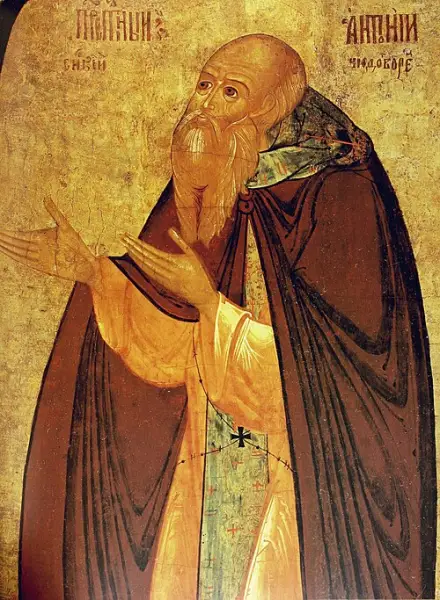
Overview
Anthony of Siya — in Russian, Antony Siysky — was a monk of the Russian Orthodox Church, a peasant's son born in 1478, who established the Antonievo-Siysky Monastery on the Siya, a river flowing into the Northern Dvina in the far north of Russia, in what is now Arkhangelsk Oblast. His early life was that of an ordinary peasant of the northern countryside: he married while still young and worked his farm until his wife died. Afterward he joined the monastery at Kargopol, though he remained only briefly before setting out as a wandering monk along the Arctic shore — one of those solitaries of the Russian North whose hermitages eventually seeded the great monasteries of the White Sea region. In 1520 he founded his monastery, having received permission from Grand Prince Vasily III to erect monastic buildings on state land. The house stood, for ecclesiastical purposes, under the archbishop of Novgorod within the Russian Church, and Anthony argued loudly for keeping villages under monastic control — the economic policy of the great monasteries of his age. He died in 1556. His vita was written by the monk Jonah in 1578, and also, remarkably, by a grandson of Vasily III — Ivan, of the royal house — and in 1610 his name was added to the ranks of the nation's most important saints. He is remembered today as the last significant monastic saint of the Russian medieval tradition.
The Complete Life
Peasant and Widower
Anthony was born a peasant in 1478, into the world of the Russian North — a country of forest, river, and long winter that was still being monastically colonized in his lifetime. His path to sanctity ran through the most ordinary of Russian lives: he married while young and lived as a normal peasant until the death of his wife. Widowhood turned him to the monastery at Kargopol; but the settled monastic life did not hold him, and he went off to wander as a monk along the Arctic shoreline — the porphyry of the northern hermits, the path of Sergius's successors carried to the White Sea.
§ Life
Foundation on the Siya
In 1520 Anthony established the monastery that carries his name, on the Siya River, which flows into the Northern Dvina, in today's Arkhangelsk Oblast. Vasily III gave him leave to put up monastic buildings on state land — a cooperation of grand-princely power that underwrote the whole monastic colonization of the North. Ecclesiastically the house answered to the archbishop of Novgorod, in whose enormous northern diocese the White Sea monasteries lay. Anthony personally championed keeping the villages under monastic control — the policy by which the great houses of his era — Joseph of Volokolamsk's above all — argued that monasteries needed landed wealth to sustain their charity and their prayers.
§ Introduction
Death and Vitae
Anthony died in 1556 at his monastery, the classic northern abbot-founder. His memory was unusually well served: the monk Jonah wrote a vita of him in 1578, within living memory, and a second life was written by Ivan, a grandson of Vasily III — a royal author for a peasant saint, and evidence of the standing the Siya monastery had reached. His Life and Miracles, in the northern hagiographic manner, opens with an account of a priest whose lack of faith brought a vision of Anthony as punishment, followed by healing on condition that he honor him.
§ Legacy
Canonization
The year 1610 saw Anthony counted among the saints of nationwide importance, in the wave of all-Russian glorifications that followed the Makaryev councils and the Troubles. He is counted the last significant monastic saint of the medieval Russian tradition — the end of the line of northern founder-hermits that runs from Sergius of Radonezh through Kirill of Beloozero and Savvaty of Solovki to the Siya.
§ Introduction
Legacy
Anthony's legacy is the Antonievo-Siysky Monastery, which became one of the considerable houses of the Russian North and carries his name and his cult. As 'the last significant monastic saint' of old Russia he marks the close of the great age of monastic foundation that opened the northern forests to Christianity; his life — peasant, widower, wanderer, founder — is a summary of that age's ideal, in which the hermitage preceded the abbey and the abbey the settled holy land. In the modern church of Russia, restored after decades of suppression, the memory of the northern saints, Anthony among them, has returned to honor.
§ Introduction
Timeline
- 1478
Born a peasant in the Russian North
§ Life
- 1520
Founds the Antonievo-Siysky Monastery on the Siya River, with Vasily III's leave to build on state land
§ Life
- 1556
Dies
§ Life
- 1578
The monk Jonah writes a vita of Anthony
§ Legacy
- 1610
Recognized as a saint of national importance
§ Legacy
The Record
- Patron of
- The Russian North
- Symbols
- Monk's habit·The Siya River wilderness
- Canonization
- Recognized as a saint of national importance in 1610
Prayer
Bibliography
Show 3 sources
- 1 2 3 4 Bushkovitch 2021 , p. 102.
- 1 2 3 Bushkovitch, Paul (28 May 1992). Religion and Society in Russia: The Sixteenth and Seventeenth Centuries . Oxford University Press. p. 14. ISBN 978-0-19-536152-0 .
- ↑ Rock, Stella (10 September 2007). Popular Religion in Russia: 'Double Belief' and the Making of an Academic Myth . Routledge. ISBN 978-1-134-36978-2 .
Profile text adapted from the Wikipedia article, licensed CC BY-SA 4.0.
Pray with this saint every day
Save St. Anthony of Siya to your favorites, read the full profile, and get feast-day reminders in the Saints app.
Get the Saints AppFree on the App Store for iPhone and iPad