
c. 251-356·Feast January 17 (Tobi 22 in the Coptic calendar)
St. Anthony the Great
Father of All Monks, Abbot in the Desert
Overview
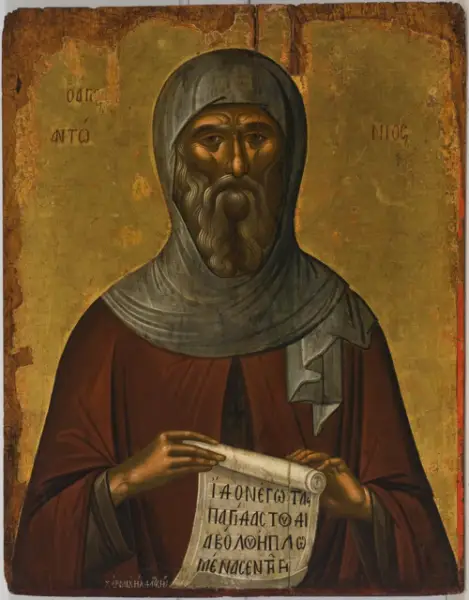
Anthony the Great, known also as Anthony of Egypt, Anthony of the Desert, Anthony the Anchorite and the Father of All Monks, was born at Koma in Lower Egypt around 251 to wealthy landowning parents. About the age of twenty, orphaned and responsible for an unmarried sister, he heard in church the Gospel command to sell all, give to the poor and follow Christ, took it literally, disposed of the family property, placed his sister with a community of virgins, and set out for the ascetic life. After fifteen years as disciple of a local hermit he went into the desert proper, about the year 270, first to the Nitrian desert west of Alexandria, then to a mountain fort by the Nile, and finally, around 311, to Mount Colzim by the Red Sea, where he lived in solitude and where a monastery still bears his name. Athanasius of Alexandria's Life of Anthony, written around 360 and translated into Latin before 374, made him the most famous monk of antiquity, though Anthony was not the first ascetic, only the most renowned to withdraw into the wilderness. He endured the famous supernatural temptations that have filled art ever since, visited Alexandria during the persecution, supported Athanasius against the Arians, and died on 17 January 356, aged about 105.
The Complete Life
Koma and the Gospel Heard
Anthony was born at Koma in Lower Egypt around 251, the child of wealthy landowner parents who raised him as a Christian in a village world of Coptic speech. He was about twenty when his parents died, leaving him the care of an unmarried sister and a considerable estate. The decisive moment of his life is one of the best-known scenes in Christian biography: entering a church, he heard the Gospel of the day, if you would be perfect, go, sell what you possess and give to the poor, and come, follow me, and took it as a command addressed to himself. He handed the family lands over to his neighbors, disposed of the rest of the property, and gave what it raised to the poor, keeping back only a little for his sister; then, when he soon afterward heard another text about taking no thought for the morrow, he let go of even that remainder and settled his sister among a community of Christian virgins — one of the earliest references to any community of the kind. He then apprenticed himself to an ascetic in the neighborhood, beginning fifteen years of discipline.
§ Introduction
Into the Desert
Anthony is often called the first monk, but his own biographer knew better: there were ascetics before him, the Therapeutae described by Philo, hermits on the outskirts of the towns, loosely organized communities around Lake Mareotis, and figures such as Thecla who withdrew to solitary places. What distinguished Anthony was that he surpassed the tradition and went into the desert proper. After his years of discipleship he crossed into the alkaline Nitrian desert, later the site of the great monasteries of Nitria, Kellia and Scetis, west of Alexandria, then lived for some twenty years in an abandoned mountain fort by the Nile, taking bread only through a opening and fighting, in the tradition, the demons that assailed him there, the temptations that became one of the great subjects of Christian art. Drawn out by the persecution of Diocletian, he came to Alexandria in 311 to encourage the confessors in prison, coveting martyrdom without being granted it, and then withdrew again, about 311, to the inner mountain at Colzim by the Red Sea, where he spent his last forty-five years.
§ Hermit
The Sayings and the Spirit
Anthony probably spoke only Coptic, though his sayings circulated in Greek and he dictated letters in Coptic, seven of which survive, addressed to communities and concerned with the interior battle against the passions and the demons. The Sayings of the Desert Fathers preserve the tradition of his conversations: short, sharp answers about temptation, discernment, prayer and humility, spoken with an authority that made younger monks travel days to put a question to him. His spirituality was practical and fierce rather than speculative: the monk's work is to know himself, to resist the thoughts at their first appearance, and to hold the memory of Christ continually in the heart. He was suspicious of his own reputation and, in one of the most quoted anecdotes, asked God how anyone could be saved amid the world's snares, and received the answer, humility. Athanasius's Life presents him as an unlettered man in absolute harmony with the divine truth, and the picture, whatever its artistry, fixed the ideal of the holy simple monk for both East and West.
§ Life of Anthony
Colzim and Death
In his last decades at Mount Colzim Anthony was not strictly alone: disciples settled around the mountain, and he served them as a father, organizing their life, arbitrating disputes and traveling when asked. He came out twice more for the Church's sake: during the persecution, to stand with the confessors, and in 338, to appear publicly in Alexandria against the Arians, supporting Athanasius, an old hermit intervening in the theology of the empire. When he felt death near he directed two disciples to bury him secretly in the desert, without ceremony, in the earth he had prayed on, asking them to give his one garment to Athanasius and his sheepskin to Serapion, legacies of an empire of almost nothing. He died on 17 January 356, at about 105 years of age. His tomb remained hidden as he wished for almost two centuries, until his relics were translated to Alexandria in 561, and from there, in the middle ages, his cult traveled to Constantinople, to Dauphiné and to Rome, where the Order of Saint Anthony served plague victims under his patronage.
§ Introduction
Legacy
Anthony's legacy is monasticism itself, or rather monasticism's imagination: the picture of the man who renounces everything and goes into the desert to fight the demons and find God descends from the Life by Athanasius, which became a best seller of late antiquity, was translated into Latin by Evagrius of Antioch before 374, and shaped ascetic ideals in both halves of Christendom. Augustine's conversion story turns on a reading of that Life; the desert movement it publicized filled Egypt and then the whole Mediterranean world with monks and nuns. The Monastery of Saint Anthony at Colzim, founded over his mountain, is the oldest continuously inhabited Christian monastery in the world, and Saint-Antoine-l'Abbaye in France preserves the medieval cult of his relics. His January feast opens the liturgical year's parade of the fathers, his tau-shaped cross and the pig and bell of later iconography make him one of the most recognizable saints in art, and his sayings are still the first reading of every novice.
§ Introduction
Timeline
- 12 Jan 251
Born at Koma in Lower Egypt to wealthy landowner parents
§ Introduction
- 270
Orphaned at about twenty, he gives away his inheritance, places his sister with Christian virgins, and withdraws to begin an ascetic life
§ Early years
- 285
After some fifteen years among local ascetics, he retires into an abandoned Roman fort at Pispir by the Nile
§ Hermit
- 305
Emerges from some twenty years of strict enclosure to guide the colony of disciples that has formed around his mountain
§ Hermit
- 311
During the Diocletianic persecution he goes to Alexandria to console imprisoned confessors
§ Hermit
- 338
Leaves the desert temporarily to visit Alexandria and help refute the teachings of Arius
§ Father of Monks
- 17 Jan 356
Dies at about one hundred five and is secretly buried beside his cell on his mountain
§ Final days
- 360
Athanasius of Alexandria writes his biography in Greek about this time, spreading monastic ideals across the West
§ Life of Anthony
- 361
His remains are reportedly discovered and transferred to Alexandria
§ Veneration
- 1297
The church housing his relics at La-Motte-Saint-Didier is completed, making the site a pilgrimage centre renamed Saint-Antoine-l'Abbaye
§ Veneration
In Their Own Words
Oh good Lord, who may escape from these snares?
If we would despise the enemy, our thoughts must always be of God and our souls always glad with hope.
Just as fish die if they are on dry land for some time, so do monks who loiter outside their cells or waste time with worldlings release themselves from the tension of hesychia. So we should hasten back to the cell (like the fish to the sea) lest while loitering outside we forget to keep a watch on the inner self.
A time is coming when people will rave, and when they see somebody who is not raving, they will attack him, saying: 'You are raving [mad]'; for he is not like them.
He who is hammering a piece of iron first takes note in his logismos what he is going to make: a scythe, a sword, or an axe. So ought we to consider what kind of virtue we are seeking, so that we do not labor in vain.
The Record
- Major works
- Seven extant letters (dictated in Coptic)
- Patron of
- Monks and religious·Skin diseases and shingles (by tradition)·Butchers (by tradition)·Grave diggers (by tradition)
- Symbols
- Anthony's cross (tau-shaped)·Bell and pig (later iconography)·Desert and demons·Book of the Gospels
- Canonization
- Pre-congregation; Father of monasticism, venerated in East and West from the fourth century
Prayer
Bibliography
Show 1 sources
- ↑ Ancient Greek : Ἀντώνιος ὁ Μέγας , romanized : Antṓnios ho Mégas ; Arabic : القديس أنطونيوس الكبير ; Latin : Antonius ; Coptic : Ⲁⲃⲃⲁ Ⲁⲛⲧⲱⲛⲓ .
Profile text adapted from the Wikipedia article, licensed CC BY-SA 4.0.
Pray with this saint every day
Save St. Anthony the Great to your favorites, read the full profile, and get feast-day reminders in the Saints app.
Get the Saints AppFree on the App Store for iPhone and iPad