
d. c. 127·Feast December 13
St. Antiochus of Sulcis
Martyr of Sardinia
Overview
Antiochus of Sulcis, martyred around 127, belongs to the earliest Christian witnesses of Sardinia, and the town of Sant'Antioco takes its name from him, as does the island itself. His legend presents him as a physician under the reign of Hadrian whose preaching won many converts in Cappadocia and Galatia, and who was tortured and exiled in return. Condemned to work the mines of the island then called Plumbaria, after its lead — the Romans sent prisoners of war and Christians to such mines — he converted his jailer Cyriacus and built a small underground oratory on the island, and was therefore condemned to death there. Some sources place his martyrdom with Cyriacus at Sebaste rather than Sardinia, and the Roman Martyrology dates it 'around the fourth century,' but Sardinian devotion has kept him, since the fifth century, in the catacomb beneath the basilica of Sant'Antioco. He is the patron of Sant'Antioco, Sardinia, with feasts on 13 December in Catholicism and 16 July in Orthodoxy.
The Complete Life
Origins
Antiochus is a figure of the second century whose legend is older than its written forms. His birthplace is given as Mauretania or Sebastea in Cappadocia, and his profession as medicine; the tradition of the physician-martyr, common in the early acta, fits a man remembered for healings and conversions. The sources place his activity under the emperor Hadrian, and his preaching in Cappadocia and Galatia, provinces of Asia Minor where the Church was already strong enough to attract official attention. What the legend preserves most clearly is the pattern: a doctor who could not stop healing souls, a preacher who converted too many, and the state's answer of torture and exile. He belongs to the generation of healer-missionaries whose lives came to be written long after their cures: the oldest Christian memory on Sardinian record is of a doctor whose patients became congregations, and whose conversions were the crime the empire punished.
§ Introduction
The Mines and the Oratory
Antiochus's story is bound up with the Sardinian mines where Roman power drew out minerals and precious metals; into these workings the state sent condemned prisoners of war and Christians, and the island's lead enjoyed wide fame. Condemned to the mines on the island then called Plumbaria, after its lead, Antiochus found the inhospitable and isolated rock a mission field: he converted his jailer Cyriacus and built a small underground oratory on the island — the seed of the catacomb church that still bears his name. For this, the legend says, he was condemned to death there, and killed; some sources state he was martyred with Cyriacus at Sebaste rather than at Sardinia, a variant that shows the legend circulating in more than one tradition. The oratory cut into the island rock outlasted the mine that held him, and Cyriacus, the jailer he converted, is remembered with him in the same early cult.
§ History and legend
Veneration
The cult of Antiochus is among the oldest in the western Mediterranean. The church in the island capital, the town now named Sant'Antioco after him, was dedicated to him in the fifth century, and his tomb was in the catacomb beneath it; the Basilica di Sant'Antioco Martire stands today over the early Christian necropolis where his memory has been kept for sixteen centuries. The Roman Martyrology, cautious as always with the early acta, places the martyrdom around the fourth century rather than the second; the Sardinian church keeps his feast on 13 December, while Eastern Orthodoxy commemorates him on 16 July. The island of Sant'Antioco itself carries his name permanently. Whichever date is right, the fifth-century dedication over his catacomb tomb fixed the site for good: the Basilica di Sant'Antioco Martire crowns the early Christian necropolis, and the town and island that carry his name have kept the martyr's grave at the center of their devotional life for sixteen centuries.
§ Introduction
Legacy
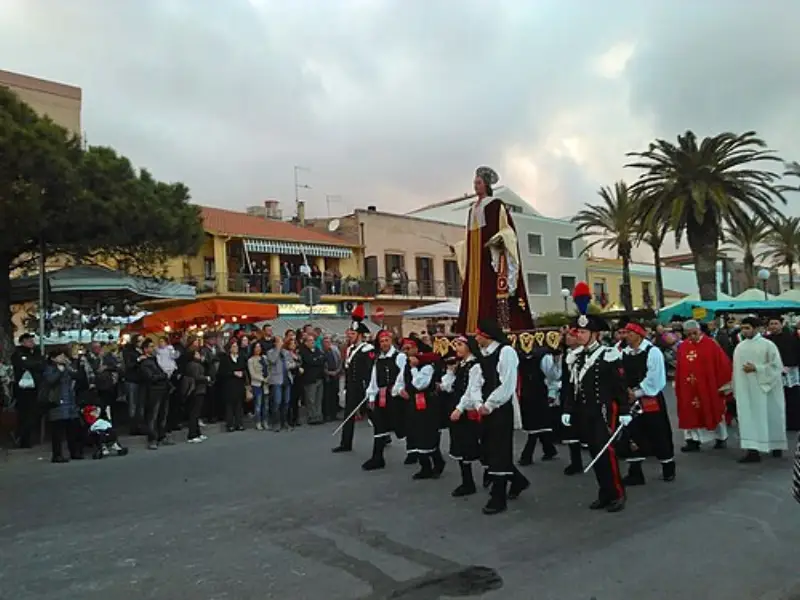
Antiochus's legacy is geographic and liturgical: an island, a town, a basilica, and a catacomb all bear his name, and the procession of Saint Antiochus through Sant'Antioco each year is one of Sardinia's oldest religious festivals, drawing the island's communities to the martyr's shrine. For historians he is evidence of the Christianization of the Roman penal system's destinations — the mines and islands where condemned Christians gathered, prayed, and converted their keepers. The underground oratory attributed to him stands among the earliest testimonies of Christian worship on Sardinian soil. A condemned miner who converted his keeper is now the intercessor invoked for prisoners, and the island that served Rome as a place of exile now serves the church as a place of pilgrimage. His emblem is the palm, and devotion at his shrine long predates any documentation that could have proved it — the islanders kept the grave before anyone wrote the life.
§ Introduction
Timeline
- 100
Born in the first century, in Mauretania or at Sebastea in Cappadocia, according to varying traditions
§ Introduction
- 127
A physician under Hadrian, he is tortured and exiled to the lead mines of Plumbaria in Sardinia for his many conversions
§ History and legend
- 127
Converts his jailer Cyriacus and builds a small underground oratory, for which he is condemned to death
§ History and legend
- 301
The Martyrologium Romanum places his martyrdom, shared with Cyriacus at Sebaste in some sources, around this century
§ Veneration
- 400
The church at Sant'Antioco on the island bearing his name is dedicated to him; his tomb lies in the catacomb beneath
§ Veneration
The Record
- Patron of
- Sant'Antioco, Sardinia·Miners and prisoners
- Symbols
- Palm of martyrdom
- Canonization
- Pre-congregation; ancient Sardinian cult
Prayer
Bibliography
Show 1 sources
Profile text adapted from the Wikipedia article, licensed CC BY-SA 4.0.
Pray with this saint every day
Save St. Antiochus of Sulcis to your favorites, read the full profile, and get feast-day reminders in the Saints app.
Get the Saints AppFree on the App Store for iPhone and iPad