
1st century·Feast April 11
St. Antipas of Pergamum
Bishop and Martyr
Overview
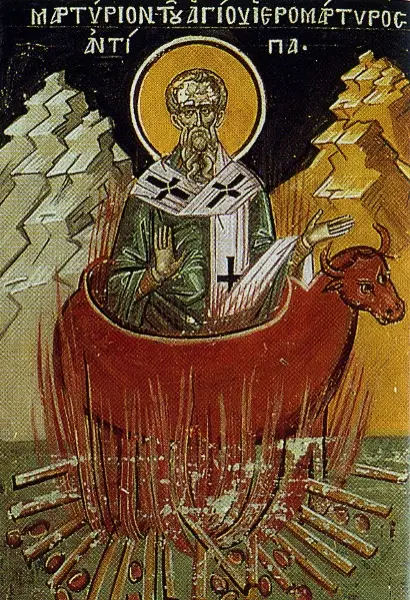
Antipas was bishop of Pergamum in Asia Minor and is the one martyr of the apostolic age whose death scripture itself records: in Revelation 2:13 the risen Christ tells the church of Pergamum that he knows their works and where they dwell — at the very seat of Satan — and praises them for holding fast to his name and not denying their faith even in the days when Antipas, his faithful martyr, was slain among them where Satan holds sway. The tradition, recorded by Andreas of Caesarea in his commentary on the Apocalypse, holds that Antipas was ordained bishop of Pergamum by John the Apostle, and that he was put to death under Nero or Domitian, cast into a brazen bull-shaped altar heated to death, for casting out the demons the local population worshipped. A tradition of holy oil, the manna of the saints, secreted from his relics is recorded in the eastern sources, and he is invoked against toothache, a patronage traced to a form of his acts in which he prayed that those suffering from the teeth might find relief at his tomb. His feast in the East is 11 April.
The Complete Life
The Scriptural Witness
Antipas holds a unique position among the martyrs: his death is witnessed by scripture. Writing to the church of Pergamum in Revelation's second chapter, scripture calls him my faithful martyr, slain among you where Satan dwells — words that anchor him in the earliest Christian memory with an authority no later act could supply. The epistle's setting explains the wording: Pergamum, the administrative capital of the province of Asia, was the seat of the imperial cult and the possessor of the great altar of Zeus, whose white bulk on the acropolis seemed to the author of the Apocalypse a throne of the adversary; where Satan's seat is and where Satan dwelleth are the letter's way of saying that the church of Pergamum lived at the very center of the idolatrous establishment. In that city one of their number had already been killed for the faith, and the risen Christ honors him by name. Who Antipas was before that death, scripture does not say; the name is a common one, shortened from Antipatros, father's likeness.
§ Introduction
Bishop and Confessor
The tradition supplies what the epistle presupposes. Andreas of Caesarea, whose commentary on the Apocalypse is the principal eastern source, relates that Antipas was ordained bishop of Pergamum by John the Apostle himself, and that he shepherded the church of the capital in the dangerous years when the imperial cult demanded what conscience could not give. His title, faithful martyr, implies the confession that preceded his death: he held fast the name of Christ and did not deny the faith, in the epistle's own words, precisely in the days when denial was the price of safety. The brazen bull of the tradition, into which the bishop was cast and heated, was an instrument of execution older than Rome, remembered from the tyrants of Sicily, and its use in the story expresses, in the martyrological language of the east, both the cruelty of the persecution and the completeness of the sacrifice: the bishop was offered whole, as the victim of the altar that was not God's.
§ Introduction
The Demons of Pergamum
The acts add the reason for his sentence: he had cast out the demons the local population worshipped. The claim belongs to the theology of the acts of the Asian martyrs, for which the gods of the pagans were realities to be confronted rather than customs to be tolerated, and the missionary bishop's triumph over them, by exorcism and by the conversion of their devotees, was the practical cause of the conflict. Pergamum, the city of the serpent-god Asklepios whose temple drew the sick of the whole Mediterranean, of the temples of Athena and Dionysos, and of the imperial cult's temple of Augustus, offered the preacher of Christ a full theater of exactly such confrontations. The tradition's picture of Antipas, the bishop who freed the possessed and died in consequence, is the picture the whole Apocalypse paints of the church of Pergamum: holding the faith in the city where the powers were most concentrated, and paying with a life for the holding.
§ External links
Canonization and Cult
Antipas' canonization, if the word may be used, was performed by the Apocalypse itself: no church could hesitate to honor a martyr whom the risen Christ had named. His cult is ancient both East and West, with his feast on 11 April in the eastern calendars and his name in the martyrologies of the Latin church; the Roman Martyrology keeps his commemoration on the same day. The eastern tradition records the manna of the saints, a holy oil secreted from his relics, a phenomenon associated with several of the great shrines of the Orthodox world, and the same tradition supplies his best-loved patronage: the Bollandists quote a version of his acts in which the martyr asked that all who suffered toothache might find relief at his tomb, and for eighteen centuries the afflicted have invoked him for it, one of the most durable of all the saints' practical patronages.
§ Introduction
Legacy
Antipas' legacy begins in the text: every reading of Revelation, every commentary, every liturgy of the churches of Asia carries his name, and the letter to Pergamum is heard annually in the lectionaries of East and West. For the churches of Turkey, the ancient sees of Asia, he is a father and a founder, the first bishop of one of the seven churches, and the modern town of Bergama keeps his memory in a land where his church has almost vanished. The patronage of toothache has carried his invocation through the ordinary suffering of the Christian people, a small and endearing immortality. Historians value him as a fixed point: a named Christian martyrdom of the first century, attested within the New Testament, in the city where the imperial cult was strongest, evidence that the conflict the Apocalypse describes was not literary invention but the real experience of the Asian church.
§ Introduction
Timeline
- 54
Ordained bishop of Pergamon by the Apostle John, according to tradition dating to Nero's reign
§ Introduction
- 68
Burned to death in a brazen-bull altar at Pergamon; traditions set his martyrdom under Nero in 68 or under Domitian in 92
§ Introduction
In Their Own Words
Thou holdest fast my name, and hast not denied my faith, even in those days wherein Antipas was my faithful martyr, who was slain among you, where Satan dwelleth.
The Record
- Patron of
- Against toothache·Diseases of the teeth·Pergamum and Bergama
- Symbols
- Brazen bull·Bishop's vestments
- Canonization
- Pre-congregation; named in the book of Revelation
Prayer
Bibliography
Show 4 sources
- 1 2 3 "Hieromartyr Antipas, Bishop of Pergamum and Disciple of Saint John the Theologian" . www.oca.org . Retrieved 2022-12-27 .
- ↑ "St Antipas of Pergamon" . Archived from the original on 2007-09-30 . Retrieved 2007-12-21 .
- ↑ James, M. R. (1898). "Antipas" . In James Hastings (ed.). A Dictionary of the Bible . Vol. I. p. 107. According to one form of his Acts (quoted by the Bollandists from a Synoxarion), he prayed that those suffering from toothache might be
- 1 2 "CATHOLIC ENCYCLOPEDIA: Oil of Saints" . www.newadvent.org . Retrieved 2022-12-27 .
Profile text adapted from the Wikipedia article, licensed CC BY-SA 4.0.
Pray with this saint every day
Save St. Antipas of Pergamum to your favorites, read the full profile, and get feast-day reminders in the Saints app.
Get the Saints AppFree on the App Store for iPhone and iPad