
555 or 556-625·Feast February 14
St. Antoninus of Sorrento
Abbot, Hermit and Protector of Sorrento
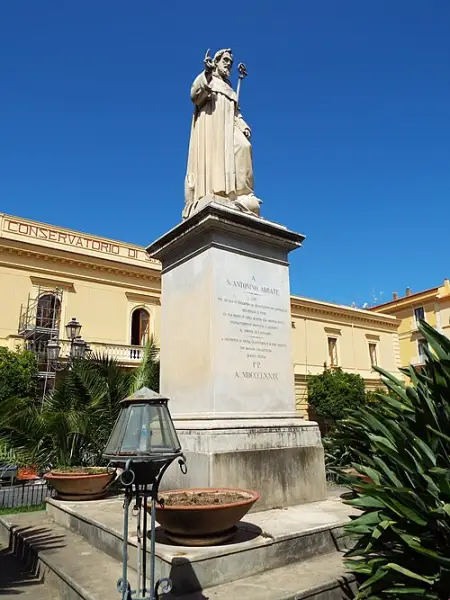
Overview
Antoninus of Sorrento, born in 555 or 556 at Campagna and dying at Sorrento in 625, was an Italian abbot and hermit. He went out from his native town to take the habit at Monte Cassino, then in the first flower of its prestige; but the Lombard invasions that forced the monks of Monte Cassino to flee to Rome under Pope Pelagius II swept Antoninus away too — though he headed instead for Campania, ending at Castellammare di Stabia. There Saint Catellus was bishop. Wishing to be a hermit, Catellus gave up his office and entrusted the town's care to Antoninus; he withdrew to Monte Aureo, and the arrangement lasted until Antoninus's own desire for solitude led him to persuade Catellus to return to his see. Antoninus then retired to Monte Aureo himself, living in a natural grotto. An apparition of Saint Michael, the tradition says, moved the two to raise the stone church known today as Monte San Angelo or Punta San Michele. In time the Sorrentines prevailed on Antoninus to settle among them, and he became the abbot of San Agrippino, a Benedictine monastery whose previous superior was Boniface. His cult at Sorrento credits him with saving the city from a Moorish naval invasion, plague, cholera and other dangers; one miracle has him rescue a child swallowed by a whale.
The Complete Life
Early Life
Antoninus was born at Campagna, in the hills east of Salerno, in 555 or 556. His leaving home for Monte Cassino — the monastery of Benedict, then in its first great age — was the standard path of a southern Italian boy called to God in the sixth century. His time there was cut short by history: Italy was suffering the Lombard wars; the Lombards plundered Monte Cassino, and its monks fled to Rome for shelter under Pope Pelagius II. Antoninus did not go north with them; he turned west into Campania and came to Castellammare di Stabia, the Roman Stabiae buried by Vesuvius five centuries before.
§ Introduction
The Two Solitaries of Castellammare
What follows is one of the odder pastoral arrangements in hagiography. The bishop of Castellammare, Saint Catellus, longing for the hermit's life, resigned his see and placed the town in the care of the newly arrived Antoninus, while Catellus himself withdrew to Monte Aureo — the golden mountain above the bay. In time Antoninus's own desire for the hermit life led him to persuade Catellus to take the see back. Antoninus then retired to Monte Aureo himself, living in a natural grotto; Catellus followed him back to the mountain, attending to his diocese only now and then. An apparition of Saint Michael, the story goes, then induced the two to raise the stone church known today as Monte San Angelo or Punta San Michele, a building that still rises over the water.
§ Introduction
Abbot at Sorrento
The inhabitants of Sorrento, meanwhile, convinced Antoninus to settle among them. He took the abbacy of San Agrippino, a Benedictine monastery, in succession to Boniface — the house attached to Sorrento's cathedral, where the abbot-monk who had twice fled office finally held one and kept it to his death in 625.
§ Introduction
Cult
The people of Sorrento raised a crypt and basilica in Antoninus's honour, and his cult is civic above all. Above all he is honored as the city's deliverer from many perils: a Moorish naval invasion; the rising of the Sorrentine leader Giovanni Grillo against Spanish rule; demonic possession; bubonic plague; and cholera. One typical miracle tells of him rescuing a young child from a whale that had swallowed it — the episode, and the sea-church culture behind it, fixed him in local art as a marine thaumaturge. The principal source for his life is F. Gibbone's 1885 vita of the saint.
§ Veneration
Legacy
Antoninus remains a working patron: the saint invoked against the epidemics and sea-raids that were Sorrento's historic lot, the abbot whose feast on 14 February the city keeps with processions. Historically he is a window on the monastic world of sixth-century Campania — Monte Cassino sacked, bishops turning hermit, hermits building churches on mountains named for the archangel, and everywhere the two callings trading places.
§ Introduction
Timeline
- 555
Born at Campagna (sources give 555 or 556)
§ Introduction
- 625
Dies at Sorrento, where he had served as abbot of the Benedictine monastery of San Agrippino
§ Introduction
The Record
- Major works
- Co-founded the church of Monte San Angelo / Punta San Michele at Castellammare
- Patron of
- Campagna·Sorrento
- Symbols
- Benedictine holding a standard and the city wall·Child rescued from a whale
- Canonization
- Pre-congregation
Prayer
Bibliography
Show 1 sources
- 1 2 3 F. Gibbone, La vita del Santo Abate Antonino, 1885
Profile text adapted from the Wikipedia article, licensed CC BY-SA 4.0.
Pray with this saint every day
Save St. Antoninus of Sorrento to your favorites, read the full profile, and get feast-day reminders in the Saints app.
Get the Saints AppFree on the App Store for iPhone and iPad