
died 24 September 1637·Feast September 28 (with the martyrs of Japan)
St. Antonio González
Dominican Priest and Martyr of Japan
Overview
Antonio González, a Spanish Dominican priest martyred in Japan, was born at Leon in Spain and entered the Dominican Order at sixteen. Peter of Verona, the Dominican order's protomartyr, was the saint he most loved, and his religious fervour bred in him a living desire for martyrdom. Once his studies were done he was ordained priest and appointed to Piedrahita as professor of theology; when word went round the convents seeking volunteers for mission work in the Far East, González put his name forward eagerly among the first. Japan was his destination, but the mission's preparation was in the Philippines: he arrived at Manila in May 1632 and served as professor and acting rector of the University of Santo Tomás, one of the church's great colleges of Asia. In 1636 he was finally able to fulfil his dream of going to Japan, where the fierce persecution of the Tokugawa shogunate made missionary work capital. After a year of clandestine ministry he was arrested, wearing his habit openly to signify that he had come for the gospel's sake. After tremendous torture he was discovered dead in his cell at daybreak on 24 September 1637. He was canonized with his companion martyrs in 1987.
The Complete Life
Early Life
Antonio González was born at Leon in the old kingdom of Castile, and entered the Dominican Order at the age of sixteen. The detail his biographers keep from his youth is his devotion: his favourite saint was Peter of Verona, the order's protomartyr, killed by heretics' assassins in 1252, and the boy's enthusiasm for the martyr gave rise, in the phrase of the accounts, to a living desire for martyrdom — a vocation within the vocation, common in the Spain of the Golden Age and rarely so literally fulfilled. After completing his studies González was ordained priest and sent to Piedrahita as professor of theology, the normal first career of a promising Spanish Dominican. When the invitation circulated to the convents asking for volunteer missionaries for the Far East — the Spanish crown and the order recruiting for the Philippines and the hidden churches of Japan and the Indies — González was among those who eagerly volunteered, and was accepted for the hardest of the destinations, Japan.
Manila
The road to Japan ran through the Philippines, and González arrived at Manila in May 1632. There the Dominicans assigned him the work reserved for their finest: González became professor and acting rector of the University of Santo Tomás, the college the order had founded in 1611, which trained the clergy of the Spanish Philippines and the missionaries of the neighbouring missions. His years at Manila were thus years of teaching rather than of the field — the preparation, in theology and administration, of the men who would carry the faith outward, and of himself for the work he had asked for. He is remembered as one of the Thomasian martyrs, the group of alumni and teachers of Santo Tomás who died for the faith in Japan, Formosa and Vietnam, a roll the university keeps as its own necrology of honour. Through these years the news kept arriving from Japan of arrests, tortures and apostasies, and the more terrible the reports, the more certain his resolve.
Japan and Martyrdom
In 1636 González finally sailed for Japan, entering a country where Christianity had been outlawed for a generation, where the shogunate's apparatus of registration, informers and the pit had dismantled the church of a hundred thousand, and where missionaries arrived as condemned men. He spent about a year in clandestine work, moving among the hidden Christians, saying mass in cellars, administering the sacraments at risk of the cross or the pit. Arrested, he wore his habit proudly — the accounts say he kept it on to show that he had come to Japan for the gospel's sake, turning down the disguise that might have saved him. After tremendous torture, meant to break him or force him to name his accomplices, he was discovered dead in his cell at daybreak on 24 September 1637, killed by what he had endured, a martyr without an executioner's stroke. His body joined the roll of the dead of Nagasaki.
Canonization
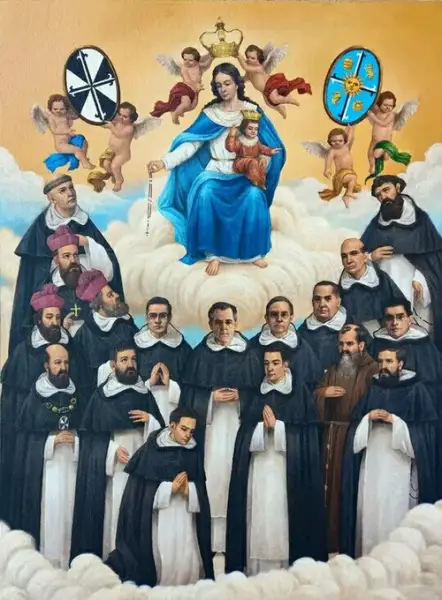
The martyrs of Japan of the great persecution — Jesuits, Franciscans, Dominicans and the Japanese laity, from the twenty-six of 1597 to the hundreds of the seventeenth century — were raised to the altars in successive groups. Antonio González, with his Dominican and Japanese companions of the 1633-1637 years, was beatified by Pope John Paul II at Luneta Park in Manila on 18 February 1981, the first beatification celebrated in Asia's largest Catholic country, and canonized by the same pope in Rome on 18 October 1987 as one of the sixteen martyrs of Japan. His feast with the group is kept on 28 September. For the University of Santo Tomás he is the teacher-martyr, his statue among the university's memorials of its dead; for the Dominican order, one of the sons who asked for what Peter of Verona had received, and was answered.
Timeline
- May 1632
Arrives in Manila to prepare for the Japan mission and becomes professor and acting rector of the University of Santo Tomas
§ Antonio González
- 1636
Finally fulfils his dream of going to Japan as a missionary
§ Antonio González
- 24 Sep 1637
After arrest and torture he is found dead in his cell, still proudly wearing his Dominican habit
§ Antonio González
- 18 Oct 1987
Canonized by Pope John Paul II together with his companion martyrs
§ Antonio González
The Record
- Patron of
- The Dominican missions·University of Santo Tomas (among the Thomasian martyrs)
- Symbols
- Dominican habit·Martyr's palm·Cross of the Japanese mission
- Canonization
- Beatified 18 February 1981 at Manila by Pope John Paul II; canonized 18 October 1987 by Pope John Paul II
Prayer
Profile text adapted from the Wikipedia article, licensed CC BY-SA 4.0.
Pray with this saint every day
Save St. Antonio González to your favorites, read the full profile, and get feast-day reminders in the Saints app.
Get the Saints AppFree on the App Store for iPhone and iPad