
died c. 304·Feast December 30
St. Anysia of Thessalonica
Virgin and Martyr
Overview
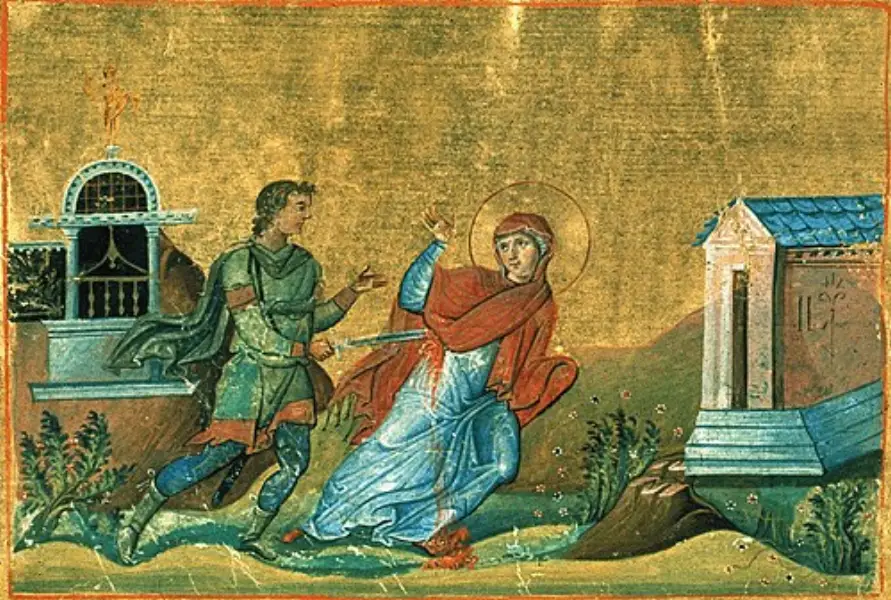
Anysia of Thessalonica was a virgin and Christian martyr who lived in the early fourth century; her story is told by Symeon the Metaphrast in the tenth century, a biography that, as Alban Butler observed, lacks historical confirmation, though it carries an old tradition. She was born at Thessalonica of pious and affluent parents, who raised her in Christian piety and died while she was young, leaving her their wealth. She distributed the inheritance among the poor and embraced a life of strict fasting, vigil and prayer. During the persecution of Diocletian, as she was on her way to church, she was stopped at the Cassandriote Gate by a soldier who demanded to know where she was going. Frightened, she signed her forehead with the cross, and when she confessed she was a Christian going to the assembly of the Lord, he tried to force her to sacrifice to the Roman gods; in the struggle, as he attempted to pull away her veil, she spat in his face in defiance, and he pierced her body with his sword. The Christians laid her to rest close by the gate, and once the persecution had ended they raised a chapel above her grave. Her feast is kept on 30 December in the Byzantine calendar.
The Complete Life
Early Life
Anysia was born at Thessalonica, the great metropolis of Macedonia, into a family the sources call pious and affluent, and the two words together explain her whole story. Wealthy Christian parents of the late third century raised their daughter, the tradition says, in Christian piety, and died while she was still young, leaving her their estate. Her response was the one the church of her age most admired in an heiress: she distributed the wealth to the poor and kept nothing, consecrating her virginity and giving her days to fasting, vigil and prayer. The choice set her free of the ordinary protections of a woman of property, the household, the slaves, the marriage that would have closed the account, and placed her among the visible Christians of the city: a solitary woman, known to be devout, walking to the assemblies of an illegal religion. Thessalonica in the persecution of Diocletian was a garrison city of the tetrarchic system, full of soldiers enforcing the edicts, and it was at its gate that her freedom and the empire's discipline met.
§ Introduction
The Conflict at the Gate
The acta, as Metaphrast gives them, compress the martyrdom into a few minutes at the Cassandriote Gate. On her way to church, Anysia was stopped by a soldier who demanded her destination; frightened, she signed her forehead with the cross, the instinct of a Christian under interrogation, and then answered the question: she was a servant of Christ, going to the assembly of the Lord. The answer converted the idleness of a checkpoint into a trial. The soldier seized her and tried to force her to sacrifice to the gods; in the struggle he attempted to strip the veil from her head, and she, resisting the outrage of her consecration, spat in his face. The gesture, remembered by the church with a certain grim affection, was her last act of freedom: the soldier drew his sword and ran her through. The elements of the scene, the cross, the confession, the refusal, the assault on the veil and the death by the sword, are the standard furniture of the virgin-martyr acts, and Metaphrast, the great compiler, may well have arranged them so; but the outline, a woman killed at the gate of Thessalonica for confessing Christ, carries the memory of the real persecution.
§ Introduction
Burial and Cult
The Christians of Thessalonica laid Anysia to rest beside the gate at which she died, and after the persecution had ended they raised a chapel above her grave, the ordinary sequence by which the church of Macedonia honored its dead. Her cult grew in the city that was also the city of Demetrios, the great martyr-bishop whose basilica became the center of the city's religious life, and Anysia's commemoration attached itself to the same Byzantine devotion: her memory is kept with the basilica of St. Demetrios as its shrine context, and her feast stands in the Byzantine calendar on 30 December, in the company of the martyrs of the winter cycle. The Menologion of Basil II, the great illustrated calendar of the tenth century, gives her the scene of the assault and murder at the gate, the soldier with his sword and the virgin with her veil raised, one of the small masterpieces of Byzantine book painting and the chief reason her image is known.
§ Introduction
Canonization
Anysia belongs to the martyrs of the Byzantine martyrologies, canonized by the recording of her passion. Her vita is late, the work of Symeon the Metaphrast, whose volumes, published in 947, gathered and rewrote the passions of the saints for the church's liturgical use, and the western students of the texts, from the Bollandists to Butler, have marked her story as lacking historical confirmation, a judgment the tradition itself does not dispute: it keeps the feast for the martyr, not for the text. Her cult is venerated above all in the Eastern Orthodox church, in Greece and in the countries of Byzantine inheritance, and the Roman martyrology also carries her name. She is one of the company of the virgin-martyrs whose stories, whatever their documentary basis, the church has read for a millennium as its charter of consecrated courage.
§ Introduction
Legacy
Anysia's legacy is Thessalonica's. The city that keeps Demetrios keeps her also, and its long Christian memory, from the apostle Paul's letters to the Thessalonians to the Byzantine churches that still stand, has room for the woman at the gate. Her story has served the church as a warning and an encouragement about the ordinary courage of worship: she was killed not in an arena before a judge but on the street, by a soldier at a checkpoint, for the answer to a question, and in that she resembles most of the church's actual martyrs of every age. Consecrated virgins have found in her a patron of their state, and women facing violence have found in her, as in Agnes, a sister who resisted. Her image in the Menologion, the veil and the sword, keeps the scene before the eyes of the church, and her feast on 30 December closes the year with a martyrdom.
§ Introduction
Timeline
- 284
Born at Thessalonica, Macedonia, into a wealthy Christian family
§ Introduction
- 304
During the Diocletianic Persecution, slain by a soldier at the Cassandriote Gate while heading to church
§ Introduction
- 304
Fellow believers lay her to rest beside the city gate where she fell
§ Introduction
- 947
Symeon the Metaphrast publishes his volume recounting her martyrdom story
§ Introduction
The Record
- Patron of
- Thessalonica·Consecrated virgins
- Symbols
- Veil·Cross on the forehead·Sword
- Canonization
- Pre-congregation; ancient Byzantine cult
Prayer
Bibliography
Show 4 sources
- 1 2 3 4 5 Dunbar, Agnes B.C. (1905). A Dictionary of Saintly Women . Vol. 1. London: George Bell & Sons. p. 79.
- 1 2 3 4 5 Butler, Alban (1990). Thurston, Herbert J.; Attwater, Donald (eds.). Butler's Life of the Saints . Vol. 1. Westminster, Maryland: Christian Classics. p. 462. ISBN 0-87061-0457 .
- 1 2 3 4 "Memory of Saint Anysia of Thessaloniki" . Orthodox Times . December 30, 2023 . Retrieved December 20, 2024 .
- 1 2 3 "Virgin Martyr Anysia at Thessalonica" . Orthodox Church in America . Retrieved December 20, 2024 .
Profile text adapted from the Wikipedia article, licensed CC BY-SA 4.0.
Pray with this saint every day
Save St. Anysia of Thessalonica to your favorites, read the full profile, and get feast-day reminders in the Saints app.
Get the Saints AppFree on the App Store for iPhone and iPad