
c. 280-345·Feast January 29 (Catholic, Eastern and Oriental Orthodox); 20 Tobi (Coptic)
St. Aphrahat the Persian
Syriac Author and Ascetic, the Persian Sage
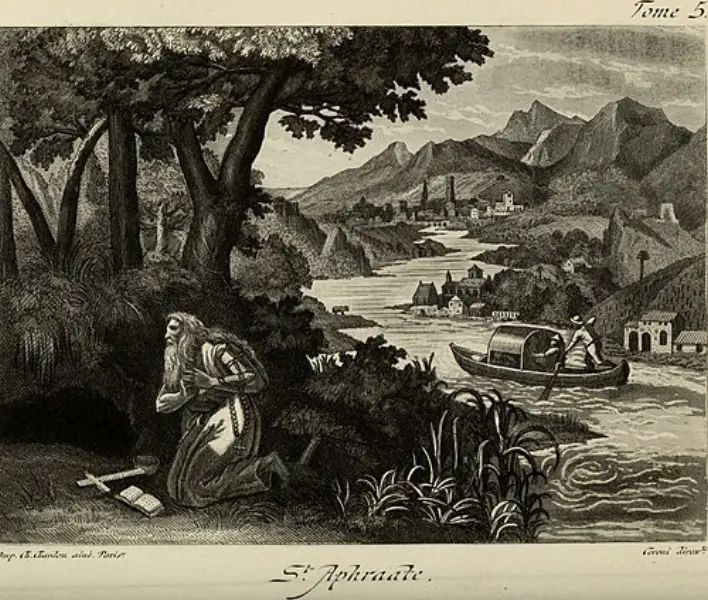
Overview
Aphrahat, honored as the Persian Sage, was the earliest major voice of Syriac Christianity and the first Church father to write outside the Roman Empire. Born around 280 to a family of Iranian descent within the Sasanian Empire — possibly of Zoroastrian background, possibly with Persian Jewish ancestors — he lived as an ascetic and celibate, almost certainly as a 'son of the covenant,' the early Syriac form of communal monastic life. He may have been a bishop: in 344 he was chosen to draft the circular letter that a council of clergy addressed to the churches at Ctesiphon and Seleucia; later tradition, moreover, sets him over Mar Mattai Monastery near Mosul. His extant works — the Demonstrations — twenty-three expositions on faith, prayer, asceticism, prophecy and the Christian life — were written in the 330s and 340s, the later ones as Shapur II's persecution of Christians gathered force, and they breathe pastoral concern for a harried flock caught between two empires. A manuscript colophon of 510 gives him the baptismal name Jacob, which caused centuries of confusion with Jacob of Nisibis that scholarship has long since dissolved. He died around 345; his feast is kept on 29 January and he is counted a patron of Erbil and Mosul.
The Complete Life
A Christian of the Sasanian Empire
Aphrahat was born around 280, not in the Roman world that produced nearly every other Church father, but inside the rival Sasanian Empire of Persia, near the Syrian frontier where the two powers met. His name is the Syriac form of a Persian original, Frahat — modern Farhad — and marks him as a man of Iranian descent; whether his family had been Zoroastrian, or had Persian Jewish roots, the evidence does not allow anyone to say with confidence, and the claim of an actual conversion from Zoroastrianism looks like later speculation. An early tradition preserved in a colophon of 510 gives him the name Jacob — taken by many old readers as identifying him with Jacob of Nisibis, a confusion already current when Gennadius wrote before 496. The confusion is impossible: Jacob attended Nicaea and died in 338, while Aphrahat's own writings show him a Persian subject witnessing the start of Shapur II's persecution in the early 340s, in a city that did not become Persian until 363.
Son of the Covenant
Everything indicates that Aphrahat's Christianity was ascetic from the root. He was celibate, he lived as an ascetic, and he was almost certainly a 'son of the covenant' — the institution, older than organized monasticism in its Egyptian form, by which Syriac Christians bound themselves to continence, prayer, and service inside a covenanted community. George, bishop of the Arabs, when asked in 714 by a friend about the Persian sage, confessed that he did not know the man's name, home, or rank — but gathered from the writings that he was a monk of high esteem among the clergy. That a Persian-speaking churchman of the next century should still be asked about him, and should answer from the Demonstrations alone, is the truest measure of Aphrahat's standing: his books carried his authority when his biography had already faded.
The Demonstrations
The collective title of Aphrahat's works is the Demonstrations, taken from the identical opening words of the twenty-three treatises: on faith, on charity, on fasting, prayer, the ascetic life, penitents, and a long sequence on prophecy and the end. The first ten, written in 337, form an alphabetical acrostic on the twenty-two Syriac letters — a poet's architecture in a teacher's prose. The later Demonstrations are datable by events: one defends Christians against Jewish argument at the moment of a Persian-Jewish rapprochement; another, the circular letter of 344 that Aphrahat was chosen by a council of bishops and clergy to write to the churches of Ctesiphon and Seleucia, an office that argues strongly (William Wright among others so argued) that he was himself a bishop. The last demonstration, written as persecution broke, interprets the suffering of the Persian church from Daniel and the beasts of the empires — eschatology as pastoral care.
Theology of the Persian Sage
Aphrahat's thought is that of a Syriac church still untouched by the council vocabulary of the Greeks. God is 'the Lord of all'; Christ is Son and Word; the Spirit descends on the waters of baptism and dwells in the pure. He reads Scripture typologically and intensely, with a fondness for Daniel and Job — the books of exiles and sufferers — and his ethics center on the ascetic cluster of fasting, prayer, and almsgiving that the sons and daughters of the covenant practiced. He knows nothing of the Arian controversy then convulsing the empire next door; his fights are with Jewish polemic and with the slackness of Christians. That innocence of Greek categories was long counted a defect; it is now recognized as the chief value of the Demonstrations, the clearest surviving window into a Christianity that developed its own idiom under a Persian, not a Roman, sky.
Under the Persecution
The early 340s brought Shapur II's persecution, born of the strategic fear that the empire's Syriac and Armenian Christians might side with a now-Christian Rome — Constantine had declared his empire Christian, and the old balance between the powers broke. Aphrahat wrote through it. Demonstration 21, 'On persecution,' answers the question his flock was actually asking: why the affliction, and how long. He died around 345, before the worst decades, leaving the Persian church its first literature and a pattern for its long history of endurance. Later Syriac tradition set him at the head of Mar Mattai, the famous monastery near Mosul, though the monastery's own chronology makes the claim doubtful.
Veneration
Aphrahat is a saint of an unusually wide communion: the Catholic Church entered him in the Roman Martyrology under 29 January; the Eastern Orthodox and Oriental Orthodox Churches keep the same feast; the Church of the East, which remembers few fathers of the Roman world, honors its own; and the Coptic Church commemorates him on 20 Tobi. Mar Mattai Monastery claims his shrine. He is invoked as a patron of Erbil and Mosul — the cities of the northern Iraqi plain where his language and his churches still, after every catastrophe, survive.
Legacy
Aphrahat is the beginning of Syriac literature that survives under a name, and everything written in Syriac since stands in some relation to him. For the historian of doctrine the Demonstrations document a Christianity that reached full theological maturity without Greek philosophy — Son, Spirit, baptism, and eschatology in Semitic idiom. For the church of Iraq he is the first and still the greatest witness: a man who wrote with the persecutor at the door and whose words are read today by the descendants of the flock he comforted, in the plain where two empires once ground against each other and where Christians have kept the faith through seventeen centuries of everything since.
Timeline
- 280
Born close to the Roman-Syrian and Sasanian Iranian frontier while Shapur II ruled Persia
§ Life, history and identity
- 337
Completed the first ten Demonstrations, alphabetical homilies on Christian living and church order that predate the persecutions
§ About "The Demonstrations"
- 340
Witnessed the outbreak of Shapur II's persecution of Christians, fueled by Roman-Persian political tensions
§ Life, history and identity
- 344
Chosen by a council of bishops and clergy to draft its circular letter to the churches at Ctesiphon and Seleucia
§ Life, history and identity
- 344
Wrote Demonstrations 11 through 22 at the height of the persecution, several on apocalyptic themes and four on Judaism
§ About "The Demonstrations"
- 344
Probably finished the twenty-third Demonstration, on the grape, in the winter spanning 344 and 345
§ Order and subjects of The Demonstrations
- 345
Died around this time, remembered as the Persian Sage of early Syriac Christianity
§ Introduction
The Record
- Major works
- The Demonstrations (twenty-three expositions on Christian doctrine and practice)
- Patron of
- Erbil·Mosul
- Symbols
- Shemagh (head cloth)·Monastic habit
- Canonization
- Pre-congregation; venerated by Catholic, Eastern Orthodox, Oriental Orthodox and Church of the East traditions
Prayer
Profile text adapted from the Wikipedia article, licensed CC BY-SA 4.0.
Pray with this saint every day
Save St. Aphrahat the Persian to your favorites, read the full profile, and get feast-day reminders in the Saints app.
Get the Saints AppFree on the App Store for iPhone and iPad