
1st–2nd century (tradition)·Feast July 20 (Roman Rite); July 23 (pre-1969 calendar; Eastern Orthodox)
St. Apollinaris of Ravenna
First Bishop of Ravenna, Hieromartyr
Overview
Apollinaris of Ravenna is the Syrian founder-bishop and patron of Ravenna, whom the Roman Martyrology paints as a bishop who, proclaiming to the nations Christ's unsearchable riches, shepherded his flock like a good shepherd and honored the Church of Classis close to Ravenna with a glorious martyrdom. Where he was born is not certain, though it was probably Antioch; tradition makes him a disciple of St Peter, who is said to have consecrated him first Bishop of Ravenna under the emperor Claudius (41–54), though the chronological arguments of the bishop-lists point rather to the late second century, with a martyrdom possibly under Septimius Severus. He dedicated himself to the evangelization of Emilia-Romagna, and the Passio gives his twenty-six years as bishop a cycle of arrests, beatings, expulsions, a walk on burning coals, imprisonment in chains, exile to Greece and return — until a final beating at the gates of Ravenna, after which he lived seven days, foretelling that persecutions would increase but the Church would ultimately triumph. The Passio was probably written by Archbishop Maurus of Ravenna (642–671) to assert his see's Petrine origin and autonomy from Rome. The great mosaics of Sant'Apollinare in Classe show the shepherd-bishop among his sheep; his emblem is the sword.
The Complete Life
A Syrian at Antioch
Apollinaris — Apollinare in Italian, Apollinarios in Greek — was a Syrian, and his native place was probably Antioch, the great metropolis of Roman Syria where the disciples were first called Christians. The tradition goes further: it makes him one of Christ's seventy-two disciples, and certainly a disciple of Saint Peter, who consecrated and commissioned him first Bishop of Ravenna during the reign of the emperor Claudius (41–54). The claim cannot be verified, and the chronology of the Ravenna bishop-lists argues against it: the twelfth bishop of the list, Severus, signed at the Council of Sardica in 343, which sets a rate of succession that would place the first bishop not in the Claudian era but in the last decades of the second century, with a martyrdom possibly under Septimius Severus. The Church has kept both readings: the Petrine legend as the city's own memory of apostolic foundation, and the soberer reckoning as the historians' conclusion. What is certain, and confirmed archaeologically, is the antiquity itself: Christian inscriptions of the second century have been found near Classe, the port suburb of Ravenna.
§ Biography
The Passio: Twenty-Six Years of Suffering
The traditional narrative of his episcopate is the Passio Sancti Apollinaris, probably written by Archbishop Maurus of Ravenna (642–671) — a text with acknowledged historical difficulties, since Maurus aimed to show the early origin of his see and its tie to Saint Peter in his campaign for autonomy from Rome, a campaign that succeeded in 666 when Constans II allowed Ravenna to consecrate its bishop without papal approval. What the Passio tells is a cycle of martyrdom: his miracles and preaching won converts and drew down on him the idolaters' fury: they beat him savagely and expelled him from the city; he was discovered half-dead on the seashore, hidden by the Christians, captured again and made to walk on burning coals, expelled a second time, imprisoned in chains to starve, shipped to Greece where his presence silenced the oracles, beaten and sent back to Italy, and finally, under Vespasian, set upon at the gates of Ravenna — probably at Classis — and savagely beaten. For seven days he lived on, predicting that the persecutions would grow but that the Church would triumph in the end.
§ Biography
The Mosaic Bishop
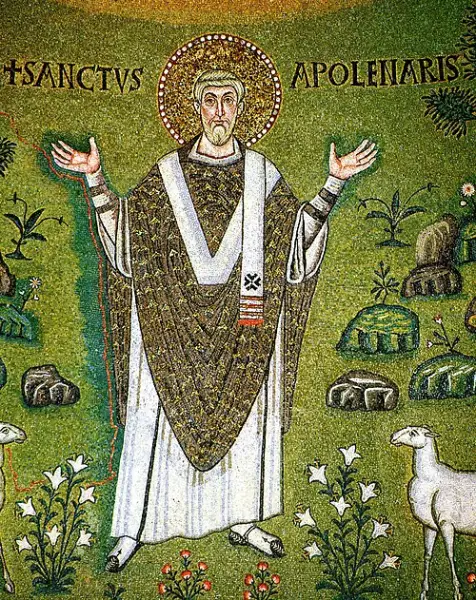
Apollinaris's posthumous career has been as great as his legendary life. Ravenna became the imperial capital of the West and then the Byzantine exarchate, and its churches made him visible forever: the sixth-century mosaics of Sant'Apollinare in Classe show the bishop as a shepherd among his sheep, in green paradise, Christ's cross transfigured above him — one of the most beautiful images in Christian art, endlessly reproduced. A second great church, Sant'Apollinare Nuovo, carries his name in the city itself. His patronage spread with his relics and his fame along the Rhine — Aachen, Burtscheid, Düsseldorf and Remagen honour him — and he is invoked against epilepsy and gout. His feast in the Roman Rite is 20 July; the pre-1969 General Roman Calendar and the Orthodox keep 23 July. The Roman Martyrology's summary — that he steered his flock like a good shepherd and honored the Church of Classis with a glorious martyrdom — is the whole tradition compressed: shepherd, sufferer, victor.
§ Introduction
Timeline
- 41
Tradition holds that St Peter consecrated him first Bishop of Ravenna, perhaps under Claudius (41-54)
§ Biography
- 23 Jul 79
Savagely beaten outside Ravenna's gates, probably at Classis; he dies seven days later, the day kept as 23 July
§ Traditional narrative
- 343
Bishop Severus of Ravenna signs at the Council of Sardica, a fixed point in the debate over Apollinaris's era
§ Biography
- 666
Emperor Constans II grants Ravenna autocephaly, the political aim behind the Passio's Peter-claim
§ Biography
- 856
Relics moved from Sant'Apollinare in Classe into Ravenna's Sant'Apollinare Nuovo, away from Adriatic pirate raids
§ Relics
- 1117
Bořivoj II, Duke of Bohemia, founds a collegiate church dedicated to Apollinaris at Sadská
§ Relics
- 1250
The Apollinaris church by Bologna's Palazzo del Podestà is demolished
§ Veneration
- 1362
Charles IV has the Sadská chapter transferred to Prague's New Town, where another church of St Apollinaris rises
§ Relics
- 1957
A church venerating Apollinaris is founded in Napa, California
§ Relics
- 1969
The Mysterii Paschalis decree removes his 23 July feast from the General Roman Calendar
§ Feast day
- 2002
The 2002 Roman Missal resets his memorial to 20 July, the nearest day free of other celebrations
§ Feast day
The Record
- Patron of
- Epilepsy·Gout·Emilia-Romagna·Aachen·Burtscheid·Düsseldorf·Ravenna·Remagen
- Symbols
- Sword; shepherd with his flock (mosaics of Classe)
- Canonization
- Pre-congregation (ancient apostolic-era cult)
Prayer
Bibliography
Show 1 sources
- ↑ "At Classis, near Ravenna in Flaminia, the martyrdom of Saint Apollinaris, bishop, whose memorial is celebrated on 20 July."
Profile text adapted from the Wikipedia article, licensed CC BY-SA 4.0.
Pray with this saint every day
Save St. Apollinaris of Ravenna to your favorites, read the full profile, and get feast-day reminders in the Saints app.
Get the Saints AppFree on the App Store for iPhone and iPad