
d. 420 or 470 (traditional)·Feast January 5 (Roman Catholic and Slavic Orthodox); January 4 (Greek Orthodox)
St. Apollinaris Syncletica
Legendary Hermit of Egypt
Overview
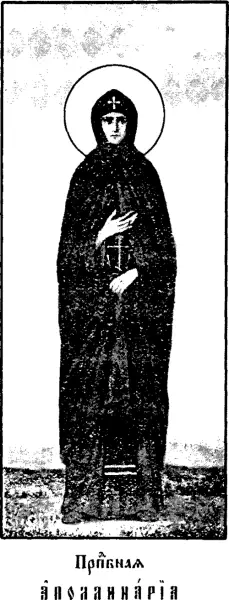
Apollinaris Syncletica, also known as Apollinaria of Egypt, is a saint and hermit of the fifth century venerated in the Eastern Orthodox and Roman Catholic Churches — with the frank caveat, given by every modern authority, that her story is most likely apocryphal, 'a pious fiction', 'so much like a romance'. According to the legend she was a daughter of Constantinople — Symeon the Metaphrast makes her a daughter of the emperor Anthemius, though a consular prefect is more likely — who refused the marriage her parents arranged and persuaded them to let her remain unmarried. On a pilgrimage to Jerusalem she dismissed her slaves, secretly obtained a monastic habit, and, visiting the Egyptian coast on the way home, escaped her companions into the desert. She made her way to Wadi El Natrun, the desert of Scetis, where in a monastery of recluses under Macarius of Alexandria she lived disguised as a man under the name Dorotheus. Years later her demon-tormented sister was entrusted to Macarius for healing; he assigned the cure to Dorotheus, and when the sister relapsed and was thought pregnant, Dorotheus was accused of seducing her — whereupon Apollinaris revealed herself as the daughter of the house. She returned to the desert, and her sex was discovered by the brethren only at her death.
The Complete Life
A Legend and Its Sources
Honesty is the first duty of a profile here: Apollinaris Syncletica's story is most likely apocryphal. The scholars cited in her own article call it 'a pious fiction', 'so much like a romance', and 'a religious romance'. Her legend was probably built out of those of Syncletica of Alexandria — the amma whose sayings open the alphabetical Apophthegmata — and Theodora of Alexandria, both of them Desert Mothers whose stories, like hers, turn on disguise or temptation. The name Syncletica was borrowed from the one; the transvestite-monk plot from the other and from a whole genre of such tales.
§ Hagiography
The Refusal and the Flight
In the tale, Apollinaris' parents hoped to see her wedded young to a man of wealth. She refused and persuaded them to allow her to remain unmarried, wanting, in Baring-Gould's paraphrase, to retire completely from the world like the Egyptian recluses she admired. Allowed a pilgrimage to Jerusalem, she gave freedom to and sent away every slave in her retinue — retaining only an elderly man and a eunuch to look after her tent — while she paid an old woman to obtain a habit for her. On the return journey, at the Egyptian coast, she escaped her companions and fled into the desert, undiscovered even with the help of a local governor whom they called on to search. Her parents assumed she had entered a community of religious women.
§ Religious life
Dorotheus of Scetis
Apollinaris traveled to Wadi El Natrun, the desert valley lying west of the Nile delta, and there entered a big monastery of recluses dwelling in caves and cells under Macarius of Alexandria. Disguised as a man, she took the name Dorotheus. The story's crisis follows the classic pattern: back home, her sister fell victim to demonic possession, and the parents brought her to Macarius, whose healing had made him famous. Macarius, stirred by an inner prompting, would let only Dorotheus heal the girl; after she relapsed and pregnancy was presumed, she named Dorotheus as her seducer. Once confronted, Apollinaris made herself known to her parents as their daughter, stayed several days in their company, and went back to the desert to spend what remained of her life. Her gender was discovered by the hermits only at her death, in 420 or 470.
§ Religious life
Cult and Calendar
Apollinaris was long listed in the Roman Martyrology, and the Greek Orthodox Church keeps her on 4 January, the Roman Catholic and Slavic Orthodox on 5 January. Symeon the Metaphrast in the tenth century gave her the emperor Anthemius as a father — a claim modern scholarship finds more flattering than probable, since a consular prefect of Constantinople is the likelier pedigree, and both the imperial connection and her association with Macarius of Alexandria (who died in 390) were probably added to enhance her spiritual authority.
§ Hagiography
Legacy
In 2001 her name was dropped from the Roman calendar of saints, part of the sweeping cull of legendary figures that followed the Second Vatican Council's reworking of the martyrology. She remains, however, a genuine monument of the imagination of the desert: a story that expressed, in romance form, the early church's conviction that holiness could so completely possess a person that even the body's social meaning — rank, gender, family — might be set aside for God.
§ Death and legacy
Timeline
- 420
Dies in Egypt with her gender unknown to the other hermits; the legend alternatively gives 470 as her death year
§ Death and legacy
- 2001
Her name is dropped from the Roman calendar of saints
§ Death and legacy
The Record
- Symbols
- Monk's habit·Desert cell
- Canonization
- Pre-congregation; long listed in the Roman Martyrology, though her legend is judged apocryphal
Prayer
Bibliography
Show 10 sources
- 1 2 "Saint Apollinaria of Egypt" . www.oca.org . Retrieved 16 August 2024 .
- 1 2 3 Butler, Alban (1998). Butler's Lives of the Saints (8 ed.). Tunbridge Wells, Kent: Burns & Oates. p. 34. ISBN 0-8146-2377-8 . OCLC 33824974 .
- 1 2 3 4 Veder 2006 , p. 162.
- ↑ Delaney, John J. (2005). Dictionary of saints (2nd ed.). New York: Doubleday. p. 55. ISBN 0-385-51520-0 . OCLC 58724402 .
- 1 2 3 Baring-Gould 1877 , p. 70.
- ↑ Watkins, Basil (2015). The Book of Saints: A Comprehensive Biographical Dictionary (8th ed.). London: Bloomsbury Publishing. ISBN 978-0-567-66415-0 .
- 1 2 Veder 2006 , p. 161.
- 1 2 3 Holweck, Frederick George (1924). A Biographical Dictionary of the Saints: Volume 1 . Vol. 1. St. Louis, Missouri: B. Herder Book Company. p. 95.
- 1 2 3 Baring-Gould 1877 , p. 71.
- ↑ Baring-Gould 1877 , pp. 71–72.
Profile text adapted from the Wikipedia article, licensed CC BY-SA 4.0.
Pray with this saint every day
Save St. Apollinaris Syncletica to your favorites, read the full profile, and get feast-day reminders in the Saints app.
Get the Saints AppFree on the App Store for iPhone and iPad