
died 249·Feast February 9
St. Apollonia
Virgin Martyr of Alexandria and Patroness of Dentistry
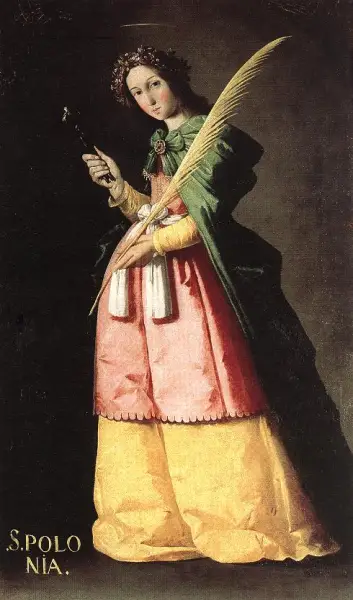
Overview
Apollonia was a virgin martyr who suffered at Alexandria, in Roman Egypt, during a local uprising against the Christians that preceded the persecution of Decius. According to the account preserved by Dionysius, Bishop of Alexandria, she was a woman of mature years and high esteem in the church, described as parthénos presbytis, most likely a deaconess, when the Alexandrian mob seized her amid bloody outrages against the Christian community. Her tormentors beat her repeatedly and shattered all her teeth, then built a pyre outside the city gates and threatened to burn her alive unless she repeated after them blasphemous words. Granted at her own request a moment of freedom, she sprang into the flames and died rather than deny her Lord. Her sufferings were recorded in a letter of Dionysius to Fabius, Bishop of Antioch, preserved in the ecclesiastical history of Eusebius. Because of the torture inflicted upon her teeth, Apollonia became popularly revered as the patroness of dentistry and of all who suffer from toothache, and her relics were scattered through the churches of Europe. She is honoured with feasts on 9 February in the Catholic and Eastern Orthodox churches and on 2 Meshir in the Coptic Orthodox Church.
The Complete Life
A Deaconess of the Alexandrian Church
Apollonia belonged to the Christian community of Alexandria, the great metropolis of Roman Egypt, at a time when the church there was both flourishing and exposed to sudden violence. In the account left by Dionysius, the bishop of the city, she appears under the description parthénos presbytis — words most likely denoting a deaconess — and he records that she was held in high esteem among the faithful. The office she exercised is not further described, but deaconesses of that age cared for the sick and the poor, assisted at the baptism of women, and served as visible signs of the honour the church accorded to consecrated virginity. She was thus neither a hidden ascetic nor an obscure convert, but a figure of standing within one of the most learned and populous Christian communities of the ancient world, a community that had already given the church martyrs, teachers, and confessors. When the storm of persecution broke over Alexandria, it was upon such prominent and revered members of the church that the anger of the mob fell first, and Apollonia's eminence made her an inevitable target.
§ Martyrdom
Martyrdom at the City Gates
The violence that ended Apollonia's life fell in the last years of the emperor Philip the Arab, amid celebrations of the thousandth year since Rome's foundation, an anniversary customarily placed about 248. When one of the poets of Alexandria prophesied calamity, the fury of the mob rose to a great height, and bloody outrages were committed against the Christians while the authorities made no effort to protect them. A Christian man named Metras and a Christian woman named Quinta were seized and killed; the houses of others were pillaged. Apollonia was seized in the same tumult. Her tormentors struck her repeatedly until they had broken all her teeth, and then, erecting a pile of wood outside the city gates, they threatened to burn her alive unless she echoed their blasphemous formulas, words that insulted Christ or summoned the heathen deities. Begging for a brief freedom, she acted at once: springing into the fire of her own accord, she was consumed rather than surrender the faith she had professed. The bishop who recorded her death suggested no reproach; in his eyes, and in those of the Alexandrian church, she died wholly a martyr.
§ Martyrdom
The Question of Voluntary Martyrdom
The manner of Apollonia's death raised a question that occupied the greatest minds of the early church. She belonged to a company of early martyrs who did not await the death with which they were threatened but, whether to preserve their chastity or because they faced the choice between apostasy and death, voluntarily embraced the fate prepared for them — an action that some thinkers judged to run perilously close to suicide. Augustine of Hippo addressed the problem in the first book of The City of God, considering holy women who in time of persecution gave themselves to the waters to preserve their threatened chastity. He confessed that such cases he would not judge rashly, for the church may well have been guided, through sure revelations from God, in rendering this honour to their memory. Perhaps, he reasoned, these women yielded up their lives neither recklessly nor of themselves, but at God's bidding, in obedience and not in error, as must be believed of Samson. In Apollonia's own case the question was settled by the judgment of Dionysius, whose telling of her death carries no trace of censure: to him she counted fully among the martyrs, no less than those who perished at their executioners' hands.
§ Martyrdom
Ancient Veneration and Feast Days
Apollonia was revered as a martyr by the Alexandrian church from the first telling of her passion, and her feast spread in time throughout the West. No formal process of canonization existed in her age; she was raised to the altars by the common recognition of the church, and she stands among the saints of the pre-congregation era. The Roman Catholic and Eastern Orthodox churches keep her feast on 9 February, while the Coptic Orthodox church, heir of the land of her martyrdom, commemorates her on 2 Meshir. Her cult attached itself with special intimacy to the sufferings of her teeth: because her torturers had shattered them one by one, the faithful invoked her against toothache, and medieval pedlars found ready buyers for objects passed off as the saint's teeth, worn as remedies against that pain. Artists represented her holding pincers in which a tooth is gripped, sometimes with the palm or crown of martyrdom, and images of her torture adorned churches and cathedrals from Bavaria to France, ensuring that the memory of her courage remained vivid wherever the plague of toothache was felt.
§ Veneration
Relics, Churches, and Cultural Memory
The relics of Apollonia were dispersed across Europe and cherished in many sanctuaries. The greater part was preserved in the former church of St Apollonia at Rome, her head in the Basilica of Santa Maria in Trastevere, her arms in the Basilica of San Lorenzo fuori le Mura, and parts of her jaw in St Basil's; other relics rested in the Jesuit church at Antwerp, St Augustine's at Brussels, Mechlin's Jesuit house, the church of St Cross in Liège, the cathedral treasury at Porto, and various churches in Cologne. A church dedicated to her once stood in Rome near Trastevere, and though it has vanished, the little Piazza Sant'Apollonia preserves its name. Her memory crossed the oceans as well: Portuguese navigators named the island of Mauritius Santa Apolónia in 1507, and one of the principal railway stations of Lisbon bears her name. Fifty-two images of her survive in English churches, concentrated in Devon and East Anglia, and her figure supports the arms of the British Dental Association. In some regions of Italy she is cast as a kind of tooth fairy, gathering children's fallen teeth by night and leaving a gift in exchange — a folk devotion that carries an ancient martyr gently into the imaginations of the young.
§ Veneration
Timeline
- 248
During festivities commemorating the millennium of Rome's founding, the fury of the Alexandrian mob rose against the Christians in bloody outrages.
§ Martyrdom
- 249
Seized at Alexandria, beaten until her teeth were broken, and burned alive at the pyre outside the city gates rather than blaspheme.
§ Martyrdom
- 1260
The brief account of her passion was extended and moralized in Jacobus de Voragine's Golden Legend.
§ Martyrdom
- 1507
Portuguese navigators named the island of Mauritius Santa Apolónia in her honour.
§ Veneration
- 1993
The Loyola University School of Dentistry closed, while the stained glass window depicting her in the campus chapel remained.
§ Veneration
In Their Own Words
At that time Apollonia, parthénos presbytis (mostly likely meaning a deaconess) was held in high esteem. These men seized her also and by repeated blows broke all her teeth. They then erected outside the city gates a pile of wood and threatened to burn her alive if she refused to repeat after them impious words. Given, at her own request, a little freedom, she sprang quickly into the fire and was burned to death.
The Record
- Patron of
- against toothache·dentists·those suffering tooth problems·Catania·Elst, Belgium·Ariccia, Italy·Cuccaro Monferrato, Italy
- Symbols
- tongs holding a tooth·martyr's palm·crown·cross
- Canonization
- Pre-congregation canonization; venerated in the Catholic, Eastern Orthodox, and Oriental Orthodox churches
Prayer
Bibliography
Show 9 sources
- Olmert, Michael (1996). Milton's Teeth and Ovid's Umbrella: Curiouser & Curiouser Adventures in History, p. 66. Simon & Schuster, New York. ISBN 0-684-80164-7.
- Eusebius of Caesarea, Historia Ecclesiae, I:vi: 41.
- "St. Apollonia". Catholic Encyclopedia. Retrieved 21 December 2017.
- Augustine of Hippo, The City of God, I:26.
- "Virgin Martyr Apollonia - Troparion & Kontakion". www.oca.org. Retrieved 8 July 2021.
- Walsh, William S. Curiosities of Popular Customs And of Rites, Ceremonies, Observances, and Miscellaneous Antiquities, 1897.
- Auber, Jacques. Histoire de l'océan Indien, 1955, p. 233.
- Attwater, Donald; John, Catherine Rachel (1993). The Penguin Dictionary of Saints (3rd ed.). New York: Penguin Books. ISBN 0-14-051312-4.
- Beal, John F. (1996). "Representations of St Apollonia in British Churches". Dental Historian. 30: 3–19.
Profile text adapted from the Wikipedia article, licensed CC BY-SA 4.0.
Pray with this saint every day
Save St. Apollonia to your favorites, read the full profile, and get feast-day reminders in the Saints app.
Get the Saints AppFree on the App Store for iPhone and iPad