
c. 105-185·Feast April 21 (Catholic); July 23 (Eastern Orthodox); April 18 (older attributions)
St. Apollonius the Apologist
Philosopher and Martyr of Rome
Overview
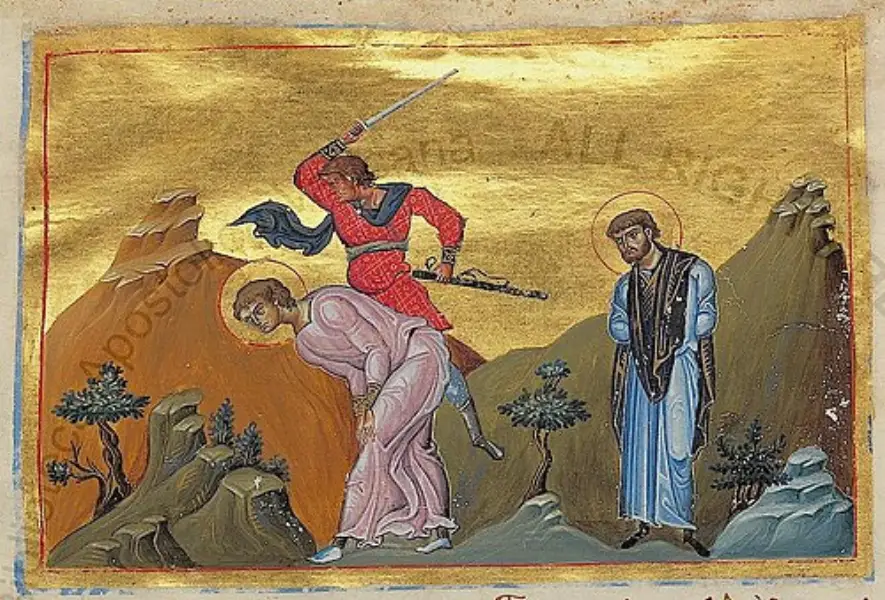
Apollonius the Apologist, or Apollonius of Rome, was a second-century Christian martyr and apologist put to death on 21 April 185 under the emperor Commodus. Four sources speak of him: the record of his trial incorporated into the Ecclesiastical History of Eusebius of Caesarea; chapters 40 and 42 of Jerome's De Viris Illustribus; and two versions of the Passio of Apollonius, one Greek and one Armenian, discovered in the late nineteenth century. By these sources Apollonius appears as a Roman of distinction — perhaps, indeed, a member of the senate — and a man of exceptional gifts, deeply read in philosophy. Denounced as a Christian before the praetorian prefect Perennius, he was called upon to answer for himself and, so Jerome records, read to the senate 'a remarkable volume' in which, far from recanting, he upheld the Christian faith; on this account the law laid down under the emperor Trajan brought him condemnation. Eusebius later had the defense speech put into Greek and woven into his history; the original has since perished. Twice he was examined — first before Perennius, then, three days on, before a panel of senators and jurists — and both hearings were calm and courteous, the interruptions rare, their aim being to make him moderate the statements on which his liability to punishment rested. Death held no fear for him: 'Something better awaits me — eternal life, the reward of one who has lived well on earth.' The sources disagree on his end: the Greek Passio says his legs were crushed, the Armenian that he was beheaded.
The Complete Life
An Illustrious Roman
Apollonius was born at Rome about the year 105; the sources show him a Roman of standing — perhaps even a senator — and a man of exceptional gifts, deeply read in philosophy. He thus belongs to that small class of second-century Christians of high station whose existence embarrassed the pagan charge that the new faith was a religion only of slaves and women. His philosophical formation gave his testimony its particular form: when the moment came, what he offered was not defiance but reasoned defense.
§ Introduction
Trial and Defense
Apollonius was denounced as a Christian to the praetorian prefect Perennius, probably by a slave — the Greek Passio reports that the denouncer too was punished, since the law of Trajan made accusation of Christians by their own household a crime. Called to answer for himself, he read out to the senate, Jerome says, 'a remarkable volume' — in place of a recantation, an apologia for the Christian faith — and on Trajan's rescript the sentence of death followed. Two examinations followed — Perennius conducted the first, and three days afterward a panel of senators and jurists the second — both calm and courteous, Apollonius free to speak with but rare interruptions, whose purpose was to induce him to moderate the statements on which his liability to punishment rested. He refused to soften. He contended that Christianity's understanding of death and life stands above all rivals, and of his own approaching death he said that something better lay in store: eternal life, the portion of whoever has lived this earthly life well. He was executed on 21 April 185; the Greek account says his legs were crushed, the Armenian that he was beheaded.
§ Life
Veneration
Apollonius was not mentioned in the earliest martyrologies and was at first not the object of individual commemoration. Medieval tradition mixed him up with Apollo of Alexandria and with the Apollonius who suffered martyrdom alongside Valentine, whose feast of 18 April was long assigned to him, appearing even in editions of the Roman Martyrology; recent editions have returned the feast to 21 April. The Roman Martyrology's entry reads: 'At Rome, commemoration of Saint Apollonius, a philosopher and martyr. Under the Emperor Commodus he pleaded, before the Prefect Perennius and the Senate, the Christians' cause in an address finely reasoned, and, once the sentence of death had been passed, sealed it with the witness of his blood.' The Eastern Orthodox Church keeps him on July 23.
§ Veneration
Legacy
Apollonius's legacy is the apologia — the reasoned defense of the faith — performed at the cost of life. His speech to the senate, preserved in Eusebius's Greek translation and now otherwise lost, was one of the earliest Christian apologias to be delivered not in a book addressed to the public but before the state itself. The courteous character of his hearings, unusual in the acts of the martyrs, gives his case a special evidential value for historians of Roman law and the persecutions: the empire could try a Christian philosopher with perfect legality and perfect civility, and kill him.
§ Life
Timeline
- 105
Born at Rome
§ Introduction
- 185
Denounced as a Christian to the praetorian prefect Perennius and summoned to defend himself
§ Life
- 185
Reads a defence of the faith before the senate and is condemned to death under Trajan's law
§ Life
- 185
Faces a second hearing before a group of senators and jurists three days after the first
§ Life
- 21 Apr 185
Executed at Rome under Commodus, by crushing of the legs or beheading according to differing accounts
§ Introduction
In Their Own Words
There is waiting for me something better: eternal life, given to the person who has lived well on earth.
The Record
- Major works
- Defense of the Christian faith before the Roman senate (preserved only in Eusebius's excerpts, now lost)
- Symbols
- Philosopher's scroll·Martyr's palm
- Canonization
- Pre-congregation; commemorated in the Roman Martyrology
Prayer
Bibliography
Show 6 sources
- 1 2 3 4 5 6 Enciclopedia dei Santi: Sant'Apollonio di Roma
- ↑ Older sources give 18 April, due to confusion with another Saint Apollonius
- 1 2 3 4 5 "saintpatrickdc.org" . www.saintpatrickdc.org .
- ↑ Hieronym. Epist. 84, Catalog. 42, 53
- ↑ Eusebius , Church History 5.21
- ↑ Martyrologium Romanum (Libreria Editrice Vaticana 88-209-7210-7). Earlier editions of the Roman Martyrology had, under 18 April, the following text: At Rome, blessed Apollonius, a senator under Emperor Commodus and the prefect Perennius.
Profile text adapted from the Wikipedia article, licensed CC BY-SA 4.0.
Pray with this saint every day
Save St. Apollonius the Apologist to your favorites, read the full profile, and get feast-day reminders in the Saints app.
Get the Saints AppFree on the App Store for iPhone and iPad