
1st century·Feast Not a fixed universal feast; commemoration varies by tradition
St. Apollos
Alexandrian Jewish Christian, Co-worker of St. Paul (New Testament)
Overview
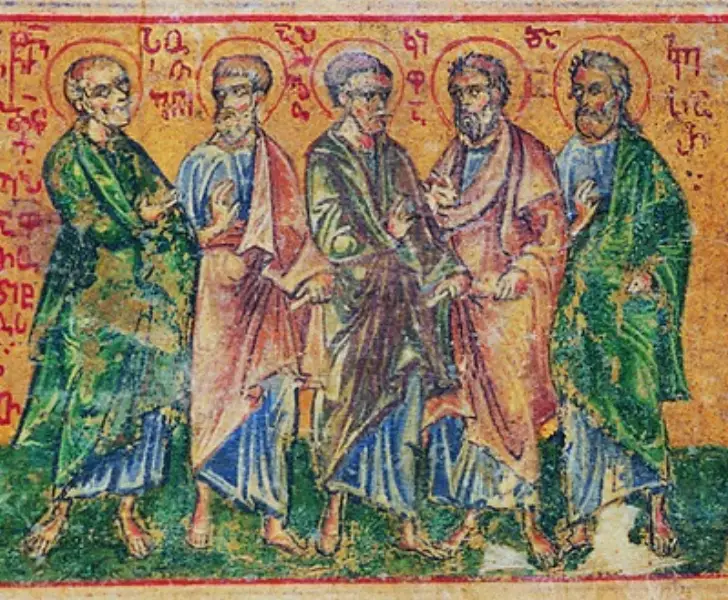
Apollos, a first-century Jewish Christian from Alexandria, was a contemporary and fellow worker of Paul the Apostle who contributed significantly to the early growth of the churches at Ephesus and Corinth. The Acts of the Apostles first presents him as a Christian preacher arriving at Ephesus, likely in AD 52 or 53: fervent in spirit, accurately teaching the things concerning Jesus, yet acquainted only with the baptism of John. Priscilla and Aquila, the tentmaking couple who had reached Ephesus alongside Paul, drew him aside and set before him the way of God more adequately — the difference evidently concerning Christian baptism. He then crossed to Achaia with the Ephesian Christians' letter of recommendation behind him, and proved a great help to the believers in Corinth, powerfully refuting the Jews in public by the Scriptures and showing that the Christ was Jesus. When Paul wrote 1 Corinthians in about 55, Apollos was a figure of such standing that one of the factions at Corinth claimed his name, which Paul rebuked, insisting that he planted, Apollos watered, and God gave the growth. Paul's epistle to Titus shows Apollos still moving and working years later. The Orthodox and other traditions venerate him as a confessor, and an icon of the fifteenth century depicts him among the Seventy. Some later traditions claimed him as a bishop, and the hypothesis that he wrote the Epistle to the Hebrews has been advanced from the patristic age to Luther.
The Complete Life
Early Life
Apollos was a devout Jew of Alexandria, the great Greek city of Egypt, and everything distinctive about him flows from that origin. Alexandria was the seat of one of the largest Jewish diaspora communities in the world, the place where the Hebrew scriptures had been translated into Greek, and the home of Philo, the Jewish philosopher whose allegorical reading of the Law defined a whole school of interpretation. Jerome Murphy-O'Connor's judgement is representative: an Alexandrian Jew, one imagines with difficulty, could have stood outside the influence of Philo — the community's towering intellectual figure — especially given how devoted the latter was to education and preaching. How someone raised in Alexandria came to know the teaching of Jesus and the baptism of John, two figures of rural Galilee and the Jordan, is a genuine puzzle that Stephen Patterson has stated plainly; his two reasonable guesses are a pilgrimage to Jerusalem, where Apollos could have learned of these things, or the arrival in Alexandria of followers of Jesus and John who initiated him into their ways. Luke's description of him at Ephesus, fervent in spirit, speaking and teaching accurately the things concerning Jesus, though knowing only the baptism of John, presents a man formed for eloquence and ready for completion.
Vocation
Apollos' vocation was preaching, and the New Testament shows it being refined. When Priscilla and Aquila heard him at Ephesus, they took him aside, a gesture worth noticing, and completed his instruction in the way of God. What was wanting was, evidently, Christian baptism: Apollos knew only the baptism of John, the preaching of repentance without the Pentecostal gift; the subsequent episode in Acts, where Paul finds disciples at Ephesus baptized into John's baptism and baptizes them in the name of the Lord Jesus, shows the difference in the starkest form. To his credit, Apollos received the instruction of the tentmakers: a learned Alexandrian preacher, formed in the sophisticated synagogue culture of his city, allowed two manual labourers to complete his theology, and then went on with his work. His vocation afterwards was apostolic in the full sense: his work at Corinth strengthened those who through grace had come to believe, and he refuted the Jews in public with power, demonstrating from the Scriptures that Jesus was the Christ, the argumentative preaching of the Hellenistic synagogues now turned to Christian ends. The church's later memory gave him a bishop's throne, at Alexandria, Caesarea, or Iconium in the different traditions, and the Orthodox count him among the Seventy.
Mission
The mission of Apollos was the watering of what Paul had planted. At Corinth he built on the foundation the apostle had laid, and the two men, so different in style, the rabbi's plainness and the Alexandrian's eloquence, were colleagues rather than rivals: Paul's summary, that he planted and Apollos watered while God gave the growth, is the classic text of ministerial cooperation. The Corinthians, however, made a faction of the difference, some claiming Paul, some Apollos, some Cephas, some Christ, and Paul's treatment of these parties in 1 Corinthians 1-3 is the source of nearly everything theology says about Apollos: he is a minister through whom the Corinthians believed, assigned his work by the Lord, a skilled master builder who laid a foundation, which is Jesus Christ, on which others must build carefully. Apollos himself declined the Corinthian enthusiasm: when Paul urged him to return to the city, he was unwilling, as the epistle records, though he would go when he had opportunity. The last glimpse is personal and warm: Titus 3:13 asks that Zenas the lawyer and Apollos be diligently forwarded on their journey, so that they lack nothing. Around this slender record the tradition built a missionary career reaching far beyond Greece, and the fifteenth-century icon that sets him with Epaphroditus, Sosthenes, Cephas, and Caesar shows the church's continuing honour.
Legacy
The legacy of Apollos is double: a ministry the New Testament honours, and a name the church's memory has surrounded with speculation. Within the canon he stands for the church's second generation, the men who were not apostles and were not eyewitnesses but who watered, built, and defended, and for the possibility of friendship in ministry across the widest differences of culture and style. The church's later imagination made him more: the hypothesis that he wrote the Epistle to the Hebrews, that monument of Alexandrian-Christian rhetoric whose author even Origen confessed unknown, was renewed by Luther and remains the most attractive of the proposed solutions. The Orthodox and Coptic traditions have given him a bishop's throne and a confessor's crown, and icons place him among the saints of the apostolic age. The Corinthian affair, finally, has made him permanently useful: every age of the church that has suffered the cult of Christian celebrities has been sent back to Paul's word about the one who planted, the one who watered, and the God who gave, and still gives, the growth.
Timeline
- 52
Comes to Ephesus, probably in 52 or 53, preaching fervently though knowing only the baptism of John
§ Acts of the Apostles
- 52
Priscilla and Aquila take him aside and instruct him more accurately in the way of God
§ Acts of the Apostles
- 55
Paul's First Epistle to the Corinthians names him a leading figure there, watering what Paul had planted
§ 1 Corinthians
The Record
- Major works
- Preaching and teaching ministry at Ephesus and Corinth (no writings survive)·Traditional attribution (hypothesis): the Epistle to the Hebrews
- Patron of
- Preachers (by tradition)·Alexandria (traditional)
- Symbols
- Scroll of the Scriptures·Confessor's crown in iconography
- Canonization
- Pre-congregation; venerated as a confessor in Catholic, Orthodox, Oriental Orthodox, Anglican, and Lutheran traditions
Prayer
Profile text adapted from the Wikipedia article, licensed CC BY-SA 4.0.
Pray with this saint every day
Save St. Apollos to your favorites, read the full profile, and get feast-day reminders in the Saints app.
Get the Saints AppFree on the App Store for iPhone and iPad