
d. 15 September 507·Feast September 15
St. Aprus of Toul
Bishop of Toul (Aper, Èvre)
Overview
Aprus — also Aper, in French Apre, Epvre, Èvre, or Avre — was the seventh bishop of Toul in Lorraine, reigning from about 500 to 507, and brother of Saint Apronia (Evronie). Born in the fifth century, near either Troyes or Trier by varying accounts, he was a man of law who may have pleaded cases as an advocate before choosing the priestly life. When Bishop Ursus died, the people of Toul called for Aprus to take the see; his episcopate lasted seven years. He gave away everything he owned to the poor and lived frugally in his diocese, admired and revered, while fighting strongly against the paganism still raging in the countryside — preaching in particular at Grand in the Vosges, then a center of pagan pilgrimage. He began the construction of a large church outside Toul, to be dedicated to Saint Maurice, but died on 15 September 507 before seeing it finished; the people interred his remains in the unfinished church, which grew into his shrine.
The Complete Life
Early Life
Aprus was born in the fifth century, and even his birthplace carries the marks of a man between two worlds: his official hagiography says he was born at Trancol near Troyes, while popular variants name Trier, seat of the ecclesiastical province of Belgica Prima — either Champagne or the Moselle, in other words, the two poles of late Roman northern Gaul. He was the brother of Saint Apronia (Evronie), herself honored in the martyrologies. Whatever the venue, Troyes or Trier, his field was law; he may have practiced as an advocate before resolving on the priesthood — a career path from the courts to the altar that the Gallic church of the fifth century found natural and useful, and that gave the episcopate many of its ablest administrators. A lawyer's training joined to a saint's poverty was the combination Lorraine remembered, and the episcopate that followed drew on both.
§ Life
Bishop of Toul
On the death of Bishop St Ursus — Latin for bear, as the local tradition enjoyed noting against Aper, Latin for wild boar, his successor — the faithful of Toul called for Aprus to become bishop. He was elected, and his episcopate lasted seven years, from about 500 to 507, the years in which Clovis's Frankish kingdom was swallowing the lands between the Rhine and the Loire. Aper emptied his goods out for the poor and simply lived on among his own people, who admired and revered him — the biographer's phrase catches the plainness of the man, a bishop whose wealth went out at the beginning of his reign and whose reputation rested on presence rather than pomp. Elected on the people's call rather than a king's order, he repaid them with the whole of what he owned. The bear and the boar had made Toul smile; the poverty made it pray.
§ Introduction
Mission in the Countryside
Aprus's mission was directed at the paganism still raging in the countryside of the Toullois, where the rural population had been Christian in name for generations and in practice hardly at all. He preached notably at Grand in the Vosges, a town that was a center of pagan pilgrimage and still has important Gallo-Roman remains — the shrine-town of a healing god, with its amphitheater and its sanctuary, one of the last strongholds of the old religion in northern Gaul. A bishop who chose to preach at Grand was choosing the hardest ground available, the place where the competing cult was strongest and most public. That his cult at Toul remembered this work, rather than court politics or buildings alone, says something about what the local church valued. The Gallo-Roman remains at Grand still stand over the ground he chose for the church's hardest pulpit.
§ Life
The Unfinished Church
Aprus's last undertaking was architectural: he attempted to launch the building of a large church beyond the walls of Toul, to be dedicated to Saint Maurice, the martyr of the Theban Legion whose cult the Burgundian court was then promoting across Gaul. He died before seeing it come to pass, on 15 September 507, and when he died the people of Toul interred his remains in the church under construction, as their statement that the work and the man belonged together. The church of St Maurice became his shrine, the destination of the Toullois pilgrimage, and the nucleus around which the later medieval cult of the seventh bishop grew. A community of clerics kept watch over the unfinished church from the eighth century, and the grave inside it was famous for miracles until the invasions of the tenth century forced its relics into hiding. Burial in a half-built church was the funeral he chose: the man who left law for the altar and goods for the poor was laid to rest inside a work begun for God and left to others to finish.
§ Introduction
Veneration
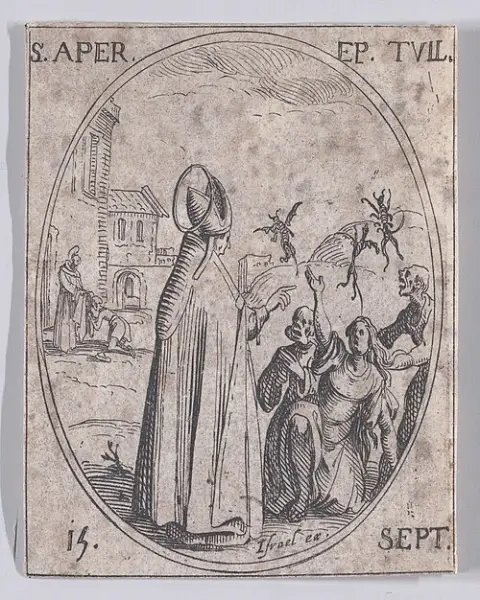
Aprus has ranked as a saint in Toul from the tenth century onward — a formula that tells us the cult predates its earliest documentation and needed no process to begin. His feast is celebrated on 15 September in the calendars of the Roman Catholic and Eastern Orthodox churches, and his name in its many French forms — Apre, Epvre, Èvre, Avre — is scattered through the parish dedications and place names of Lorraine. Jacques Callot's etching of St Aper, made at Nancy in the seventeenth century, fixed his image for the duchy's Counter-Reformation devotion. His relics, hidden behind the walls of Toul during the invasions, were stolen by monks and recovered in 978, and Bishop Gerard I, while he himself lay ill, had the remains of Aprus and Mansuy carried into the city to the church of St John the Baptist. In 1802 the head was transferred to the church bearing his name; when that building was destroyed, the basilica of Saint-Epvre rose in its place.
§ Introduction
Legacy
Aprus's legacy is modest and real: a see governed simply, a campaign in the Vosges against the old pilgrimage, and a church begun and left unfinished to be finished by others. For the church of Lorraine he belongs to the apostolic generation of bishops — Mansuy, Ursus, Aprus, Gerard would follow later — in whose names the continuity of the diocese was expressed. His cult, kept at Toul for a thousand years and then through the modern dioceses, preserves the type of the poor-lawyer bishop: the advocate who gave away his goods, took the hardest rural mission, and died with a building half-built and a people grateful. Every Domèvre village on the Lorraine map repeats his name, and the advocate who gave everything away now stands as patron of forty churches and of the lawyers who leave practice for the altar.
§ Veneration
Timeline
- 500
Elected seventh bishop of Toul on the death of St Ursus; his episcopate lasts seven years
§ Introduction
- 15 Sep 507
Dies at Toul before finishing his church of St Maurice; the people bury him there according to his will
§ Burial
- 978
His relics, kept hidden behind the walls of Toul, are stolen by monks and rediscovered
§ Veneration
- 1802
Bishop of La Fare of Nancy arranges the transfer of Aprus' head to the church bearing his name
§ Veneration
The Record
- Patron of
- Toul and Lorraine·Lawyers who enter the Church (by his career)
- Symbols
- Bishop's vestments·Church under construction (St Maurice, Toul)
- Canonization
- Considered a saint at Toul since the 10th century; pre-congregation cult
Prayer
Bibliography
Show 3 sources
- ↑ Chanoine André Laurent, Ils sont nos aïeux, les saints de chez nous, Mirecourt, 1980.
- ↑ "aper" , Lewis & Short Latin Dictionary, perseus.tufts.edu
- ↑ Karl Leyser, Timothy Reuter, Warriors and Churchmen in the High Middle Ages: Essays Presented to Karl Leyser (Continuum International Publishing Group, 1992), 56.
Profile text adapted from the Wikipedia article, licensed CC BY-SA 4.0.
Pray with this saint every day
Save St. Aprus of Toul to your favorites, read the full profile, and get feast-day reminders in the Saints app.
Get the Saints AppFree on the App Store for iPhone and iPad