
723-784·Feast May 4
St. Arbeo of Freising
Bishop of Freising, First Named Author in German
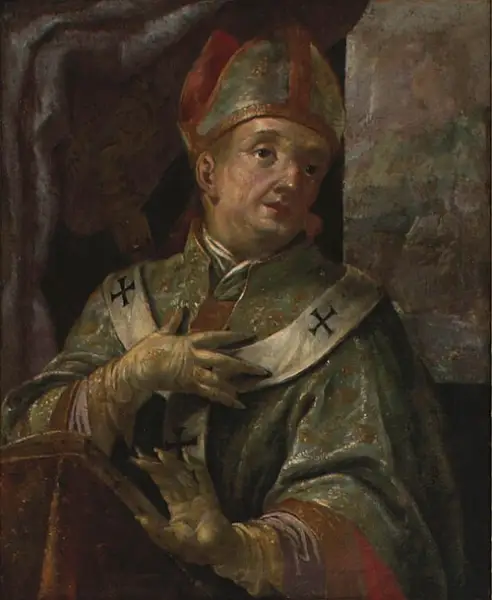
Overview
Arbeo of Freising, also Aribo or Arbo, was an early medieval author and bishop of Freising from 764 to his death on 4 May 784, and is often counted the first named author in the German language. Born at Meran in 723 or earlier and thought to be a scion of the Huosi, the noble dynasty of Bavaria, he may well have been the child whom Saint Corbinian pulled from the rushing floodwaters of the Passer river. Corbinian's brother Erembert raised him and steered him toward the church; he became a Benedictine, served as priest and notary under Bishop Joseph of Freising within the episcopal chancery, and in 763 was named abbot of the monastery newly founded at Scharnitz, becoming Joseph's successor as bishop a year later. As bishop he founded the Bavarian monasteries of Innichen, of Schäftlarn and of Schliersee, moved Scharnitz to Schlehdorf, and carried Saint Corbinian's relics to Freising. He founded the Freising episcopal library and scriptorium, and is sometimes credited with the Codex Abrogans, the first German book.
The Complete Life
Early Life
Arbeo was born in 723 or earlier near Meran, in the alpine south of the Bavarian stem duchy, and is thought to have belonged to the Huosi, one of the five great founding families of Bavarian nobility. His own hagiography of Corbinian lets slip a tantalizing self-portrait: the child whom the saint pulled from the Passer river's rushing flood may be Arbeo himself, saved by the man whose Life he would one day write and whose bones he would carry to Freising. He was raised by Corbinian's brother Erembert — later bishop of Freising himself — and steered from the first toward the church. His schooling fitted him for the chancery rather than the cloister alone: as priest and notary under Bishop Joseph he learned the drafting of charters and the keeping of a see's memory, the craft that makes him, to historians, one of the best-documented men of the eighth century.
Abbot and Bishop
In 763 Arbeo was appointed abbot of Scharnitz, the monastery newly founded at the Brenner approaches; a year later Joseph died, and Arbeo succeeded to the bishopric of Freising, the see Corbinian had founded on the Isar. His twenty years as bishop were a program of institution-building. He established or confirmed the Bavarian monasteries of Innichen in the Puster valley — planted to mission the Slavs of the east — together with Schäftlarn and Schliersee, and he relocated the community of Scharnitz to Schlehdorf. In 767 the relics of Saint Corbinian came to Freising at his instigation — the founding act of the see's cult — and around them he wrote the Vita Corbiniani, our main source for the Frankish bishop. Politically he navigated the long quarrel of the Agilolfing duke Tassilo III with his Frankish suzerains as a loyal supporter of King Charlemagne — a loyalty that may have cost him his diocese in the end, when Tassilo's fall came in 788, though Arbeo did not live to see it.
Writings and the Abrogans
Arbeo's surviving works are two saints' Lives, the Vita Corbiniani and the Vita et passio Haimhrammi, on the bishop-saint Emmeram of Regensburg — vigorous, judgement-rich Latin narratives that are the principal sources for early Bavarian Christianity and among the best hagiography of the century. His larger monument is institutional: he founded the Freising episcopal library and scriptorium, whose manuscripts, catalogued in the surviving Carolingian inventories, made Freising one of the intellectual centres of the age. To this scriptorium is attributed the Codex Abrogans, a Latin-Old High German glossary of about 764-783, often described as the first German book; whether Arbeo commissioned it is debated, but the tradition that counts him the first named author writing in German rests on his circle and his initiative. His Latin name, Heres, a translation of Arbeo, marks the bilingual world he worked in — a Latin bishop of a German-speaking church beginning to write its language down.
Cult and Legacy
Arbeo died on 4 May 784 and was buried at Freising, where his cult was immediate and durable; the Roman Martyrology keeps his feast, and the Eastern Church honours him among the saints of the undivided West. His legacy divides into the ecclesiastical and the linguistic. Ecclesiastically, he consolidated the church of Bavaria at its decisive moment: monasteries planted, relics housed, a library and scriptorium founded that carried Bavarian learning into the Carolingian renaissance. Linguistically, his association with the Abrogans made him a patron ancestor of German letters, invoked in every history of the language's first written monuments. For Germanists he is a footnote that leads a kingdom; for church historians he is the model of the chancery-bishop, the administrator whose paperwork, sanctified by results, made him a saint.
Timeline
- 723
Born near Meran, probably into the Huosi noble dynasty of Bavaria.
§ Introduction
- 763
Made abbot of Scharnitz, a monastery newly founded in the Bavarian Alps.
§ Introduction
- 764
Succeeds Bishop Joseph of Freising, whom he had served as priest and notary.
§ Introduction
- 4 May 784
Dies aged about sixty and is buried at Freising; his feast keeps the same date.
§ Introduction
The Record
- Major works
- Vita Corbiniani (Life of Saint Corbinian)·Vita et passio Haimhrammi (Life of Saint Emmeram)·Codex Abrogans (attributed)
- Patron of
- Freising·German literature
- Symbols
- Bishop's vestments·Book and quill
- Canonization
- Pre-congregation; venerated in the Roman Catholic Church
Prayer
Profile text adapted from the Wikipedia article, licensed CC BY-SA 4.0.
Pray with this saint every day
Save St. Arbeo of Freising to your favorites, read the full profile, and get feast-day reminders in the Saints app.
Get the Saints AppFree on the App Store for iPhone and iPad